Wave Staff Report
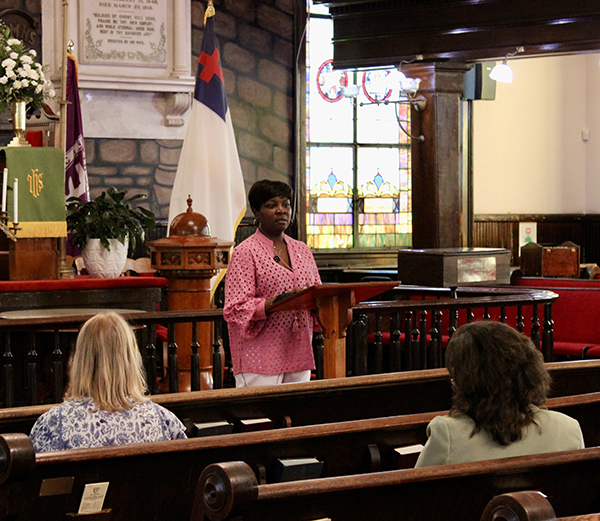
CHARLESTON, S.C., — Deona Smith opened her remarks at the preview for the Emanuel Nine Memorial by reciting the names of the nine people killed 11 years ago at Mother Emanuel AME Church.
Rev. Clementa C. Pinckney. Cynthia Marie Graham Hurd. Rev. Sharonda Coleman-Singleton. Rev. Daniel L. Simmons. Rev. DePayne Middleton-Doctor. Tywanza Sanders. Myra Thompson. Ethel Lance. Susie Jackson.
“We wouldn’t be here if it were not for the nine,” said Smith, executive director of the Mother Emanuel Memorial Foundation. “It was a horrific thing that happened here on June 17th, 2015.”
One week before the 11th anniversary of the mass shooting at Mother Emanuel AME Church in Charleston, South Carolina, Smith shared with media a first look at a memorial, which is being built next to the historic church at 110 Calhoun St.
The memorial is designed to be a permanent public space honoring the nine worshippers who were killed during Bible study on June 17, 2015 by a white supremacist, 21 year old Dylann Roof. The site also honors the five survivors, the resilience of the congregation, and all people impacted by hatred and racial violence.
Construction is well underway, and the memorial will open to the public this fall. Admission will be free.
“It is a safe space that should be available and accessible to everyone,” Smith said. “Everyone in our community and visitors alike.
The Mother Emanuel Memorial Foundation was formed in 2017 and is an independent organization with a board of 15 members that is separate from the church. The foundation is a nonprofit with independent governance and financial oversight and is fully responsible for the memorial. The foundation board is co-chaired by Rev. Eric Manning, senior pastor of Mother Emanuel and John Darby, CEO of the Beach Company.
The media preview included a walk through the construction site and a visit to a museum space across the street that houses many of the works of art, tributes, and gifts sent to Mother Emanuel in the immediate aftermath of the 2015 tragedy. Those items are being curated by Lee Bennett Jr., the church’s historian, and serve as a visible testament to how deeply the attack moved people around the world.
For Smith, a Lowcountry native who grew up AME and has personal ties to the church and its congregation, leading the foundation is deeply meaningful.
“This is my charge: to lead this organization and to try to present a memorial that the families, the survivors, and the community at large can be proud of,” she said. “Something that earns the respect and honor of who they were as people in our community.”
The memorial, designed by architect Michael Arad, who also designed the 9/11 Memorial in New York, will feature a Memorial Courtyard with a names fountain, fellowship benches, a contemplation basin for quiet individual reflection, and reimagined church grounds connecting the memorial to Mother Emanuel AME Church.
The foundation has raised and pledged approximately $19.9 million toward a $25 million campaign goal. Donors have ranged from individual donors, the true drivers of the project, to major corporations including Boeing, Wells Fargo, Bank of America, TD Bank, Coca-Cola Consolidated, the Beach Company, and Nucor, as well as municipalities and philanthropic organizations.

“In the same way that Charleston came together after the tragedy, Charleston has come together to fund this memorial,” Smith said.
One piece of the memorial is fully dependent on continued fundraising: the Survivors’ Garden, which will be built on the east side of the church to honor the five people who lived through the attack.
“We talk a lot about the Emanuel Nine,” Smith said. “Very few people talk about the survivors and they’re the ones who experienced it and who are still here. So, it’s very important that we not forget them and that we make sure that Survivors’ Garden is built.”
She said the foundation needs to raise at least another $2 million to complete it.
Charleston is one of the most visited cities in the country, Smith noted, and the memorial is being built with that reach in mind. But it’s about more than tourism.
“We want to provide a space for people to come and gather, to talk to each other, to have conversations with each other that they may never have had otherwise and to put together an opportunity for generations to come,” she said. “It’s a space you can come and discuss what’s wrong. It’s a space you can come and celebrate what’s right. And it’s a space you can come when you’re personally troubled, just to sit at the altar inside the Memorial Courtyard and just have a brief moment of prayer and reflection.”
Through its Crossroads Education and Outreach program, the foundation plans to develop an annual cohort series, lectures, film screenings, community dinners, and programming focused on the root causes of racism and hate and what communities can do together to combat them.
“We cannot have a tragedy like this in our community and not have programs to try to prevent it from ever happening again,” Smith said. “We want to have programs where there will be an annual cohort where people can come in and take classes and lectures and talk about what happened, how do we prevent it from happening again, and really how do we change some of the things that we sometimes unknowingly feel and think, the things that prevent us from truly being a united community.”