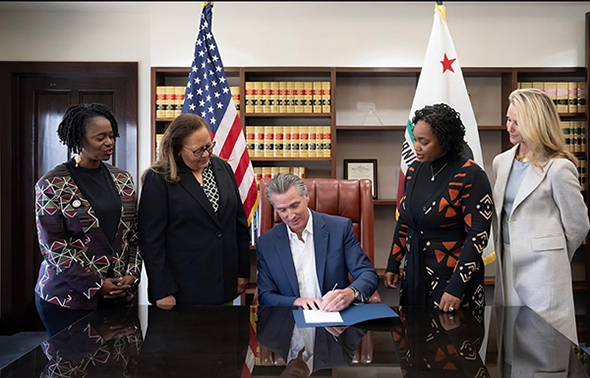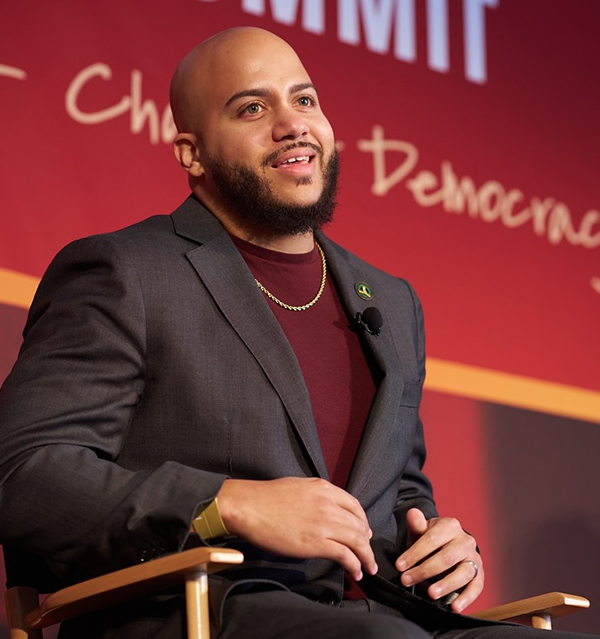
Isaac Bryan, who represents the 55th Assembly District in Sacramento, is a rising star in the state Legislature. Only 33, he is vice chair of the California Legislative Black Caucus and also serves on several key Assembly committees.
Courtesy photo
By Joe W. Bowers Jr.
Contributing Writer
LOS ANGELES — Assemblyman Isaac Bryan, D-Culver City, represents California’s 55th Assembly District — which also includes Baldwin Hills, Leimert Park, the Crenshaw Corridor, Del Rey, and parts of Mid-City — an area long recognized as the political and cultural center of Black Los Angeles.
This is one of a series of articles by California Black Media consisting of interviews with California newsmakers about key issues in 2025 and what lies ahead in 2026.
At 33, Bryan is already one of Los Angeles’ more seasoned state lawmakers. Elected in 2021, he quickly became one of the Legislature’s leading voices on democracy protection, economic mobility and justice reform. Vice chair of the California Legislative Black Caucus, he also serves on key Assembly committees — including Natural Resources (which he chairs), Judiciary, Governmental Organization and Privacy and Consumer Protection — where many of the state’s major equity and civil rights debates take shape.
In 2025, Bryan was at the forefront of several defining state battles — advancing the Legislative Black Caucus’ Road to Repair agenda, safeguarding political representation and pushing for overdue respect for incarcerated firefighters.
Bryan sat down with California Black Media to reflect on the year. Here are his responses to seven key questions, edited for length and clarity.
CBM: Looking back on 2025, what do you see as your biggest win — the thing you’re proudest of getting done or moving forward?
IB: There are two. One, incarcerated firefighters have been fighting wildfires in California for 100 years, and they have made slave wages that entire time. When the Palisades Fire and the Eaton Fire were raging this year, there were incarcerated people on the front lines making $1 an hour. We raised those wages to the federal minimum wage (Assembly Bill 247). It is the first time an incarcerated person in California will earn a minimum wage for their labor. If not now, when?
And the second is Proposition 50. It was uniquely targeting Black representation in Texas and throughout the South to push the president’s agenda, and it’s an agenda that we know is anti-Black. We helped organize the state to send a resounding message with Prop. 50, and I am incredibly proud of that.
CBM: How do you think your leadership, the laws you worked on, and the initiatives you championed helped make life better for Californians this year?
IB: Every single thing that I was a part of this year has a disproportionately positive impact on people who look like us. As vice chair of the Legislative Black Caucus, we were very focused on improving life for people who rely on social safety nets. We protected a lot of that from federal cuts.
AB 246 prevents seniors from losing their housing if their Social Security income drops. AB 248 removes wage caps for incarcerated people who are working in county facilities. AB 1299 lets cities reduce or waive parking penalties for people facing homelessness or financial insecurity, and we know who is most likely to face those challenges and who is most likely to be living in their car.
We can’t always explicitly name race in legislation, but we made sure the work was targeted toward folks who are struggling the most. Unfortunately, as has been the case for the last several hundred years, it is our people.
CBM: What was the most frustrating challenge for you this year?
IB: It was frustrating to work so closely with the governor on something like Proposition 50 and then watch him veto five priorities of the Legislative Black Caucus, including my AB 7, which would have created priority admissions for the descendants of American chattel slavery at California’s public universities. It was incredibly frustrating and disheartening. But he is still our governor for another year, and I plan on having a productive relationship with him into the next legislative session as well.

CBM: What gave you the most hope or inspiration in 2025?
IB: The exit polls show that voters in our community are anchoring democracy. About 91% of Black men supported Prop. 50 — the strongest support of any group in the state. There was so much criticism of Black men earlier in the year and seeing that data made me proud.
CBM: What’s one lesson from 2025 that will shape how you approach decisions in the year ahead?
IB: Don’t rest on your laurels and don’t trust that anybody else is going to come in and do the work for you. You can accomplish tremendous things, but there is always more work to do. Stay active and stay vigilant in 2026 and don’t slow down.
CBM: If you had to sum up the biggest challenge facing Californians this year in one word, what would it be?
IB: Authoritarianism.
CBM: What’s the number one goal you want to accomplish in 2026 to create more opportunity and justice for Californians?
IB: I want to make sure that the state budget reflects our values and that we don’t let the federal government dictate how we love and protect our own people. We have to make sure this deficit is not balanced off the backs of people who are already struggling. That is what I am focused on.
It feels like a moment where we’ve got to be all in and really be ready for it.
Joe W. Bowers Jr. is an editor for California Black Media.