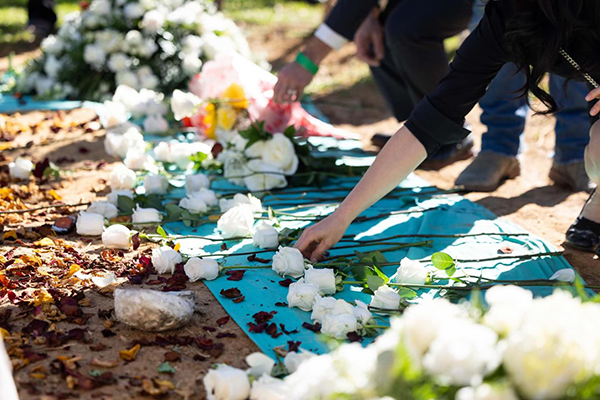
People attending the Ceremony to Commemorate the Unclaimed Dead drop white roses on the gravesite that carries the remains of more than 2,300 people who died in Los Angeles County in 2022 and whose bodies were never claimed by relatives. The ceremony was held Dec. 11 at the Los Angeles County Crematory and Cemetery in Boyle Heights.
Courtesy photo
Wave Wire Services
BOYLE HEIGHTS — More than 2,300 people who died in Los Angeles County but whose bodies remain unclaimed were laid to rest Dec. 11 in a common grave during an interfaith ceremony that has taken place annually for well over a century.
The Ceremony to Commemorate the Unclaimed Dead was held at the Los Angeles County Crematory and Cemetery adjacent to Evergreen Cemetery.
Local faith leaders presided over the ceremony, which is held annually by the Los Angeles County Board of Supervisors, along with the Department of Health Services’ Office of Decedent Affairs and the Los Angeles General Medical Center Chaplains.
The people being buried — 2,308 in all, some of whom were homeless or had no next of kin who could be contacted — died in 2022.
Bodies are held for three years between the year of death and burial, to allow family members to claim cremated remains.
The Office of Decedent Affairs, which manages cremation and burial for indigent/unclaimed individuals who die within L.A. County, works with families to help with the retrieval of the remains.
“This annual ceremony is part of a commitment that the county has upheld since 1896 to ensure everyone in Los Angeles County, no matter their means, is laid to rest with respect and dignity,” County Supervisor Janice Hahn said during the county Board of Supervisor’s meeting Dec. 9.
Hahn said she is grateful that people take time to attend the ceremony each year.
“We don’t know enough about the lives of the people we are laying to rest this week to do their memories justice,” she said. “But we know many of them were unhoused. Some were children. Some were immigrants to this country. Many were sick. Some suffered mental illness that made their lives painful and difficult.
“Almost all of them were very poor,” Hahn added. “And for one reason or another, they had no loved ones to claim their bodies when they passed.
“I think this is one of the more special things we do as a county, and it means a lot to me to be part of it every year,: Hahn continued. “These individuals left this world alone and we take this responsibility seriously to honor their lives and grieve their deaths.”
The ceremony, which was open to the public and was livestreamed on Facebook aims to offer people “an opportunity to pay their respects and stand in solidarity with our most vulnerable community members,” according to a county statement.
Shortly before the ceremony, ashes were placed in a single communal grave with a marker indicating the year of cremation.
Interfaith prayers, including the Lord’s Prayer in multiple languages, followed as did a ceremony where those in attendance placed white roses on the common gravesite.