Designation signals interest in preserving Black sites
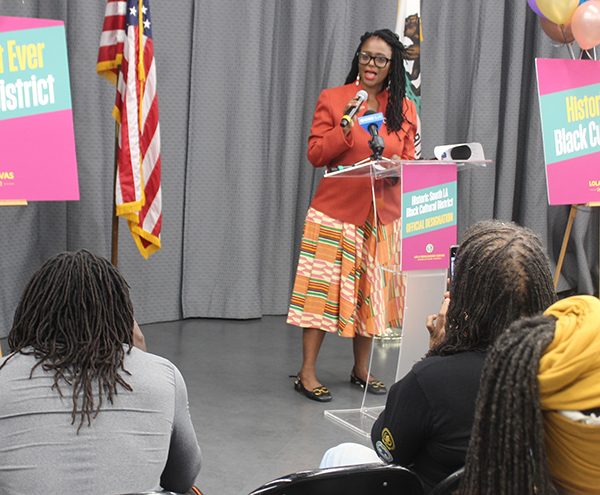
State Sen. Lola Smallwood-Cuevas speaks during a press conference Dec. 12 announcing the designation of historic South Los Angeles as California’s first Black Cultural District at the California African American Museum. The designation will make it easier to preserve cultural landmarks from Central Avenue to Crenshaw Boulevard.
Photo by Stephen Oduntan
By Stephen Oduntan
Contributing Writer
EXPOSITION PARK — Historic South Los Angeles was designated California’s first Black cultural district on Dec. 12, a milestone community leaders say affirms generations of Black cultural, artistic and political contributions — and signals a renewed effort to preserve institutions that have long anchored Black life in the area.
The designation, approved by the California Arts Council and announced during a press conference at the California African American Museum, marks the first time the state has formally recognized a cultural district rooted in a historically Black community.
“For generations, South L.A. has been a center of Black culture and creativity that has shaped Los Angeles and California,” said State Sen. Lola Smallwood-Cuevas, who represents the 28th Senate District and led the effort. “This designation makes clear what this community has always known — that Black culture in South L.A. matters, deserves to be preserved, invested in and celebrated.”
Surrounded by artists, civic leaders, business owners and longtime residents, Smallwood-Cuevas framed the announcement as both a celebration of legacy and a response to mounting pressures facing Black communities across South Los Angeles, including rising property values, displacement and the loss of cultural institutions.
The Historic South L.A. Black Cultural District spans a wide area stretching from Central Avenue to Crenshaw Boulevard and includes more than 4,000 cultural assets, supporters said — from historic jazz corridors and dance institutions to Black-owned businesses that have doubled for decades as gathering spaces, organizing hubs and cultural landmarks.
Karen Mack, founder and executive director of LA Commons, said the designation reflects years of community advocacy and partnership with city planners to ensure cultural preservation is embedded in land-use decisions.
“Our small businesses are the lifeblood of our culture,” Mack said, noting that neighborhood institutions have long carried history not just through commerce, but through community.
City Planning Director Vince Bertoni said the district builds on years of work by the city’s Office of Historic Resources to identify and protect African-American historic sites across South Los Angeles. He said the city’s planning department will serve as a key local partner in implementing the district, drawing on historic resource surveys and preservation efforts already underway.
Those efforts, Bertoni said, are intended to safeguard cultural landmarks while creating a framework that allows longtime residents and institutions to remain rooted in place as investment and development continues.
For business owners in the room, the designation was less about policy and more about survival.
Queen Aminah, a Leimert Park business owner and president of the Leimert Park Village Merchants Association, said her shop has long functioned as more than a storefront.
“My shop is the home of the community,” Aminah said. “It’s the home of the Million Man March. These are spaces where history lives, not just where business happens.”
Smallwood-Cuevas said the designation provides new tools for preserving those spaces while creating opportunities to introduce South L.A.’s cultural legacy to a broader audience — particularly as Los Angeles prepares to host major international events, including the soccer World Cup next year and the 2028 Olympics.
“We don’t want people getting on the freeway and driving from the beach straight through downtown,” she said. “We want them to stop, to partake, to spend money, and to experience the Black South L.A. that we know and love.”
To support that effort, Smallwood-Cuevas has secured $3 million in state funding tied to the cultural district designation. She said the funding will be used to build cultural infrastructure, install markers and monuments, and develop coordinated strategies to connect and promote the district’s many cultural assets.
The goal, she said, is to create a framework that allows South L.A. to tell its own story — while ensuring that longtime residents, artists and institutions benefit from increased visibility and investment.
Community leaders acknowledged that recognition alone will not solve the challenges facing South Los Angeles, particularly amid ongoing gentrification and displacement. But they described the designation as a tool for building what Smallwood-Cuevas called “staying power.”
“We are already experiencing hyper-gentrification and hyper-displacement,” the senator said during a one-on-one interview following the press conference. “This is about preserving space, supporting small cultural businesses, supporting our cultural centers, and creating jobs so that the next generation of artists can stay.”
Supporters stressed that the designation is not an endpoint, but a beginning.
“This is the start of a larger effort,” Smallwood-Cuevas said. “It will require real partnership, real investment and real leadership from everyone in this room.”
As the press conference concluded, speakers repeatedly returned to the idea that South L.A.’s cultural significance is not confined to the past, but continues to shape the city and state today.
“Connections are important,” one community member said. “Don’t forget them.”
For many in attendance, the designation was seen as long overdue — and as a public acknowledgment that the cultural heartbeat of Black Los Angeles remains alive, even as the community fights to protect it.
Stephen Oduntan is a freelance writer for Wave Newspapers.