By Erin Aubry Kaplan
Contributing Writer
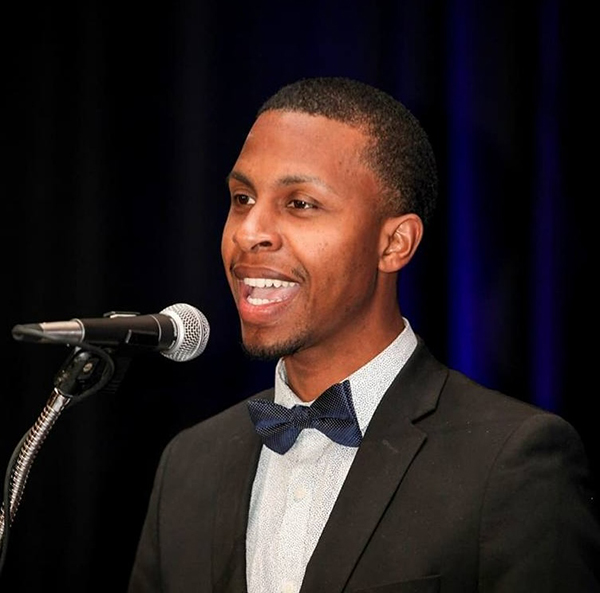
SOUTH LOS ANGELES — When Chris Martin was in high school in the early 2000s, he was taken off guard when a student insulted not him, but where he lived: South Central Los Angeles.
Martin went to Dorsey High in the Crenshaw district, L.A.’s marquee Black community that’s west of, and overall more affluent than the Central Avenue area Martin called home.
“They said, ‘Man, your neighborhood is grimy,’” Martin recalled. “I thought, ‘They’re talking about my community.’ Even though the two communities shared similar demographics, “Black people looked at [South Central] as a place to leave, a place to be from,” Martin said. “You make it and you move out.”
That moment inspired a vow Martin made early in his life to stay put in the modest neighborhood where he grew up and to advocate for it however he could. Today, he’s making good on that vow by running for the Ninth District seat on the City Council in the June 2 primary election
Martin’s candidacy comes at a pivotal moment, as the demographic changes that have buffeted Black residents in Los Angeles for decades now seem to be at a tipping point, with the Ninth District at the center. A Black stronghold that has been represented by a Black council member since 1963, the district is now about 78% Latino, the highest such percentage of any council district in the city, and 13% Black.
It is widely expected to be represented by a Latino after the departure of the termed-out current Councilman Curren Price. Political observers have long assumed that Price — who is facing trial later this year on embezzlement, perjury and conflict of interest charges in a corruption case brought by county prosecutors — will be the last Black person to hold the seat, at least for the foreseeable future.
Though the primary is four months off, the Ninth District race is already reflecting that assumption. In a field of six candidates, Martin is so far the sole African American who has filed to run; the rest are Latino. That’s not entirely surprising, but it obscures a more layered reality.
Low numbers notwithstanding, Black people remain an outsize portion of the electorate because a higher percentage are registered to vote. There’s also the fact that entire generations of younger Latinos who grew up in South Central with Black neighbors, friends and mentors tend to have more inclusive and progressive politics than older generations who lived in predominantly Latino areas, like East L.A. In other words, South Central has shaped them.
“You need to weave together both populations,” said Manuel Pastor, a sociology professor at USC who has studied the history of Black-brown dynamics in South Los Angeles. “Four years ago, Latinos were nationalist, challenging Black leadership in the Ninth and saying, ‘This is our time.’ It’s changed. They need Black support.”
Still, it’s significant that no Black elected officials have endorsed Martin yet — a break in the tradition of those officials throwing support to Black candidates to at least maintain representation in areas with notable Black populations. This time, many have thrown their support to Latino candidates.
Price has endorsed his deputy chief of staff, Jose Ugarte. Eighth District Councilman Marqueece Harris-Dawson has endorsed Elmer Rodan, a former organizer in South Los Angeles at Community Coalition, the grassroots outfit Harris-Dawson once led. County Supervisor Holly Mitchell is backing entrepreneur and activist Jorge Nuño, who was an early candidate in the supervisor race Mitchell won in 2020.
The Ninth covers much of South Central, including Martin’s neighborhood. He has reason to be proud of it: The Central Avenue corridor is not only the geographic heart of South Central, it was the starting point of Black L.A. itself, an area that blossomed in the 1930s and ’40s with thriving jazz clubs, businesses and Black culture.
But the deterioration noted by the students at Dorsey was real. As the racial segregation fell away, the neighborhood suffered, as Black folks with means, ambition and status moved to other places, including Crenshaw.
But for Martin, that was never the end of the story. His candidacy has become a challenge to the narrative that the Black aspirations for political power that long defined South Central are now gone. His refusal to move — rare for a Black professional like him — was a conscious choice.
“My mom said to me at a very young age, ‘Don’t forget where you come from,’” he said. “I always wanted to serve the community while I was in the community. That’s always been important to me.”
In addition to taking a stand for the neighborhood, Martin said his candidacy is a response to what he sees as the failure of Black elected officials to nurture local young talent and assure not just the political future but the well-being of Black people, whatever their numbers.
Many Black people, especially older generations, feel that demographic changes are making them invisible, and irrelevant. But Martin is a millennial who grew up next door to immigrants.
While racial unity wasn’t a given, to him, Black and brown was simply what South Central was. And immigrants have always been an integral part of Martin’s legal career representing families in the foster care system and dependency court; the majority of families he’s advocated for have been Latino. It helps that he speaks Spanish.
“I love my Latino brothers and sisters,” he said. “They’ve helped make me what I am.”
Martin learned cross-cultural organizing as an aIumnus of the Ralph J. Bunche Youth Leadership Academy, founded at Jefferson High School.
“It was all Black and brown and they tried to teach us all to organize, improve,” he said.
Among other things, his cohort helped establish a jazz park and start in 2003 a weekly farmer’s market at 42nd Street and Central Avenue that is still going on.
At the same time, Martin has been shaped by the racial justice activism of Black Lives Matter. He protested with the L.A. chapter in 2020 after the murder of George Floyd, and coordinated with hundreds of other lawyers to push for the release of 500 protesters arrested by police, something he’s especially proud of.
Martin doesn’t see Latinos as part of the problem of Black erasure. The real issue, he said, is Black leadership that limits itself.
“I do believe that when you advocate for Black folks you advocate for everyone,” he said. “I’ve been to rallies in support of Latinos against the state-sponsored violence of ICE. The brown families I’ve represented in dependency court have been targeted, and I’ve worked to keep these families together.”
Another essential part of Black leadership has been its focus on jobs. Martin said that if elected, he would build a jobs center in South Central focused on artificial intelligence — despite the misgivings many people, especially people of color, have about AI.
“We have to teach our young children about it, the future,” he said. “Black people need to be a part of tech.”
He wants to reallocate the city budget to help ensure that contracts for infrastructure go to Black and brown people.
Whether Black people will reembrace the Ninth, by staying put and staying invested in Black interests, as Martin has, remains, for the moment, an open question. Martin said that ideally, other Black people in search of community — not to mention relatively affordable housing — will move in too and mount a kind of second act to Central Avenue’s heyday.
“I see people coming back, building for the future,” Martin said. “I want to make that happen, while I still have the opportunity.”
Erin Aubry Kaplan is an award-winning journalist who examines the persistent barriers to racial justice and opportunities for progress in an era of receding Black presence in Los Angeles and California. This article was produced by Capital & Main, a nonprofit publication focused on inequality. It is published here with permission.