By Dwight Brown
Contributing Writer
Black filmmakers, actors and films were an integral part of the 2026 Sundance Film Festival. Now that the event is leaving Park City, Utah after 40-plus years, they were around to say farewell. In 2027 the fest is headed to Boulder, Colorado.
In the past, some portrayals of Black families living in low-income communities have been filled with stereotypes — especially regarding men. These days astute filmmakers tackling that subject have depicted rounded characters and eschewed cliches.
A.V. Rockwell’s 2023 film “One Thousand and One,” which featured Teyana Taylor as a mother caught in life’s urban struggles while parenting her young son, avoided demeaning clichés. The men around her had issues, but all were three-dimensional characters — void of demonizing depictions. “If I Go Will They Miss Me” is a throwback. A bad one.
Writer/director Walter Thompson-Hernandez (“Kites”) sets his family drama of woe in working-class Watts. Lozita’s (Danielle Brooks) is blessed with her young son Anthony, Aka Lil Ant (Bodhi Dell). A model middle schooler whose creative head is always in the clouds.
Dreaming of Black boys floating in air and conjuring other mystical images, Fantasyland is his refuge, mythology his thing and Pegasus his hero. Mom is less blessed with her husband Big Ant (J. Alphonse Nicholson, “They Cloned Tyrone”). Stints in prison, issues with drugs, playdates with other women and an overt animosity towards Lil Ant make him a thorn.
All on view is artistically and surrealistically rendered. Like a visualist creating a fable and not a wise griot. The story never rises as high as Lil Ant’s dreams.
It’s mired. Big Ant is an abusive, negative trope. An inner-city Black man as a devil. A creep. A one-dimensional character. A drag.
In one pivotal scene, Big Ant, in a fit of madness, sadistically rips up his son’s treasured, fanciful artwork. When Lil Ant confronts him, the father smacks him. Ugh!
Viewers looking to Lozita for sanity will likely be disappointed when she misses this key chance to break the cycle of abuse. Whatever the character does later to protect her family is way too late.
Patient audiences have already checked out. It’s a big disappointment. Just like the script and the filmmaker’s dated interpretation of Black fathers.
The winsomeness of the cinematography (Michael Fernandez), music (Malcolm Parson) and sets (production designer Maria Perez Ramirez) lingers. That’s where any positive commendations should end.
In “Lady,” the lead character is a road warrior driving a cab on the chaotic streets of Lagos, Nigeria. The job requires courage, and Jessica Gabriel’s Ujah, a 20-something, has that kind of gumption. She owns her van, supports herself and is a thriving female driver in a male-dominated occupation.
The setting, premise and engaging lead character are products of first-time feature filmmaker Olive Nwosu’s great imagination. Her vision of city life captures an urban hustle and bustle spirit.
The footage starts with a dirge-like slow jazz/blues score (composer Ollie Mayo), so reminiscent of early Spike Lee film soundtracks. Then the music shifts into tangy Afrobeats and a vibrancy takes hold.
Saturated colors and perfectly shot cinematography (Alana Mejia Gonzalez) give the proceedings a dazzling quality as Nwosu spins her feminist tale. One that involves Lady, at the behest of her childhood friend Pinky (Amanda Oruh), becoming a chauffeur for sex workers.
A sisterhood grows between the driver and her passengers. One that triggers traumatic moments from Lady’s childhood that have left her afraid of sexual intimacy.
The cast of women are all treasures. Gregarious, funny, gossipy. All living in a rat race that pushes them to find work the best way they can. Filmgoers will want Lady to find love, drive off into the sunset and have a happily-ever-after ending.
The overdramatic script has other ideas. Which is a pity. The setup, production elements and acting are far stronger than the final stages of the story.
Easy to love the film’s setup, direction, production elements, characters and vibe more than the story. Nonetheless, a nice peak at the seamy side of city life with a touch of social unrest in the background.
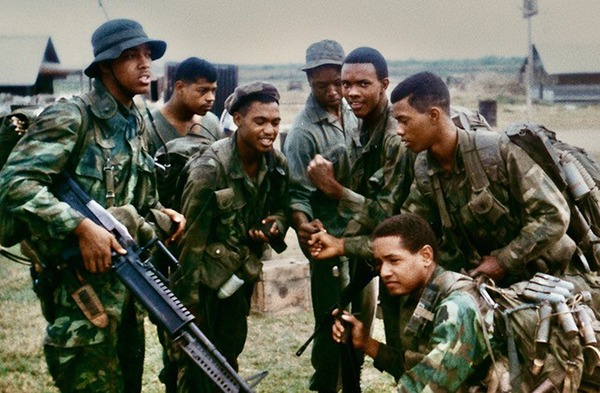
“Soul Patrol” is a soldier’s story. Veterans in this poignant documentary recollect their past and examine the present while writer/director J.M. Harper archives it all.
Home life, combat, the aftermath of the unpopular Vietnam War. Super 8 videos shot back in the ‘60s, other archival footage, present day interviews and compelling reenactments are the vital pieces in this carefully assembled puzzle by editors: Byron Leon, Niles Howard, Gabriela Tessitore.
All elements are elevated by a musical soundtrack that embodies the times, with old soul music by James Brown to Jimmy Ruffin.
Back in the 1960s, when they were young, these men dealt with racism in the states, Martin Luther King Jr.’s murder, Robert Kennedy’s assassination and civil rights issues. In Vietnam, bigoted commanding officers and fighting the Viet Cong added more pressure.
And fighting and killing brown-skinned people, then returning to an indifferent and disrespectful America was the final insult. Luckily, behind enemy lines they built a camaraderie as the first all-Black Special Operations Long-Range Reconnaissance Patrol unit in Vietnam. It’s a brotherhood that binds them today — even into their 80s.
Talking through their PTSD, sharing anecdotes and admitting to struggles becomes therapeutic and healing — for those in the film and those who watch.
The unfairness of it all is duly noted. Logan Triplett’s astute cinematography doesn’t miss a smile, tear or hug. The hallowed history of these unsung heroes has been preserved. First recorded by the patrols’ own Ed Emanuel in his 2003 memoir “Soul Patrol.” Now sensitively chronicled by filmmaker J.M. Harper. Audiences can only think one thing, “Thank you all for your service.”
Dwight Brown is the film critic for the National Newspaper Publishers’ Association.