By Cynthia Gibson
Contributing Writer
LOS ANGELES — In her latest book, “Living the California Dream – African American Leisure Sites during the Jim Crow Era,” author Alison Rose Jefferson provides new insights into how the great migration of Blacks beginning in 1910 from the American South to the urban North, Midwest and West challenged the prevailing narratives that exclude African Americans and shows their active role in shaping regional identity.
Her research demonstrates that in California and other western states — unlike the South — racial discrimination existed in implicit practice rather than explicit legal prescriptions.
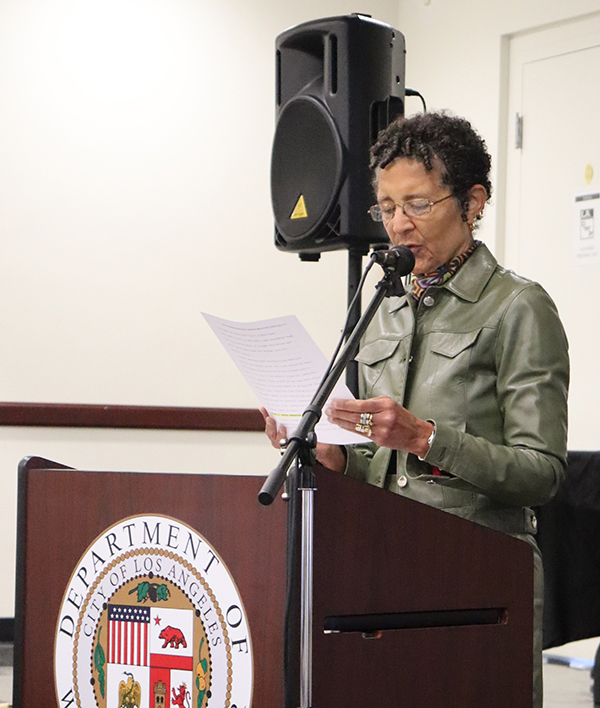
At a Black Women for Wellness Black History Month presentation Feb. 13, Jefferson chronicled the history of several recreational sites developed by African Americans. She spoke about the impact of Blacks creating spaces for leisure had on the surrounding community and the challenges Blacks faced from white residents and local government.
Jefferson’s presentation focused on several specific Southern California leisure sites created in the 20th century by and for African Americans — Bruce’s Beach in Manhattan Beach, Lakeshore Beach Club in Lake Elsinore and Santa Monica’s Bay Street Beach.
In 1912, Willa Bruce and her husband Charles purchased oceanfront property to establish a resort for Black residents who were barred from other beaches. It became a popular gathering place for African Americans on weekends and in the summer.
The successful venture spurred other African Americans to buy land and build vacation cottages nearby.
From the first days of operation white neighbors and members of the Ku Klux Klan harassed the Bruces and their customers, which included setting fire to a mattress under the resort’s main deck and burning down a nearby home belonging to another Black family.
When harassment failed to drive the Bruces out, the city used eminent domain in 1924 to seize the land under the pretense of building a park. The Bruces and other resort community property owners challenged those proceedings but were unsuccessful.
Nearly a century later, the state passed legislation which authorized Los Angeles County to legally return the property to the descendants of the Bruce family.
“These moves are good things, but this restitution does not provide tangible collective benefits to the purged African Americans of all classes from Manhattan Beach and the loss of a vibrant socioeconomic cultural space where to this day Black people make up less than half a percent of the city’s 35,000 population,” Jefferson said.
Another one of the earliest places African Americans went for recreation and relaxation was Lake Elsinore in Riverside County, one of the furthest inland of the African American leisure sites. The Mission in Palm Springs and Lake Elsinore were among numerous resorts in Riverside County that were popular from the 1880s to the 1960s, according to Jefferson. People from around the Southland, especially from the Los Angeles area, visited the resorts to soak in as well as drink the cold and hot mineral waters for health, healing and relaxation.
By the late 1920s, Riverside was proclaimed the empire of recreation and health in the Lake Elsinore Valley. Several local Black residents established businesses, purchased vacation homes and a few invested in resorts and recreation space.
The Lake Shore Beach Company began creation of the largest resort operation for Black patrons at Lake Elsinore. The leaders of this investment group were prominent Black Angelenos, physician Wilbur C. Gordon, attorney Charles Darden, businesswoman Sally Taylor Richardson and businessman Arthur L. Reese.
Jefferson noted that the Black community’s presence has been left out of the local history narratives and landmark designation programming to obstruct the understanding of the full shared collective history of the range of community builders and their impact and contributions to the development of Lake Elsinore and the Southern California region.
Another Black-owned resort in Riverside County, the Park Ridge Country Club, opened in 1927.
The local elite and other white racist citizens strongly contested the African American reconstruction of this venture. In the Corona community, the Black businessmen’s effort to make the venture a success have been left out of the local history narratives and public memory, thereby limiting the understanding of the Corona community’s historical actors and evolution, Jefferson said. The omission of this history of Corona, like Lake Elsinore, erases the complicated layers of social dynamics of race, space, power and capitalism in California.

In Santa Monica, African American built and have sustained a community since the founding of the city in 1875. Early residents established themselves a few blocks away from the Pacific shoreline in the environs of Bay Street Beach. This is near the civic center today and Phillips Chapel Christian Methodist Episcopal Church, the first national African American organization established by formerly enslaved citizens in 1870. During the same time period just south of Santa Monica, a Venice enclave of African Americans also began to form.
Both communities have managed to survive waves of discrimination and the encroachment of wealthy residents for more than a century.
In 1908 at 4th and Bay street near Phillips CME, the oceanfront area emerged as a gathering place where African Americans from all over Los Angeles could enjoy the beachfront. From 1900 to the 1960s, many Black beachgoers once referred to this area as the Bay Street Beach.
White people, referring to the darker skinned beachgoers, referred to it as the Inkwell, Jefferson said. Some Black people repurposed this name as a badge of pride while others refused to use the name.
Accessible by streetcar, the blossoming African American enclave centered around Phillips CME Church, saw Black-owned businesses and leisure sites emerge. The area became ap lace of refuge and community formation.
Prominent attorney Charles S. Darden, a resort developer in Lake Elsinore; and Norman O. Euston, founder of Golden State Mutual Life Insurance Company; led a Santa Monica Black enterprise in the 1920s. It was one of the important attempts at beach area business development sabotaged by white supremacist. This was at a time overlapping the rise of Black beach culture and residency that supported a deeper African American community in Southern California in the first half of the 20th century.
While white supremacist actions hindered African Americans from buying property throughout the urban region and sabotaged their beach service businesses into the 1950s, their communities, presence and agencies sustained their use of public space us. In 2005, the city of Santa Monica designated a local landmark for Phillips CME Church at the oceanfront near Crescent Bay Park and Bay street. This set the stage for the official recognition of a cultural African American monument, the Bay Street Historic District in 2008.
Jefferson said her goal is bring attention to the contributions Black businessmen and women who tried to take advantage of everything that California had to offer and developing business to service the needs of their community.
“I’m also interested in people understanding that Black people have been here and enjoying the resources that California had to offer, even if sometimes they were pushed around a bit in terms of prejudice or discrimination,” Jefferson said.
Cynthia Gibson is a freelance reporter for Wave Newspapers. She can be reached at ckgcommunications@gmail.com.