‘Free at last’ – Rev. Jesse Louis Jackson Sr. 1941-2026
Civil rights icon taught Black America to ‘keep hope alive’

By Stephen Oduntan
Contributing Writer
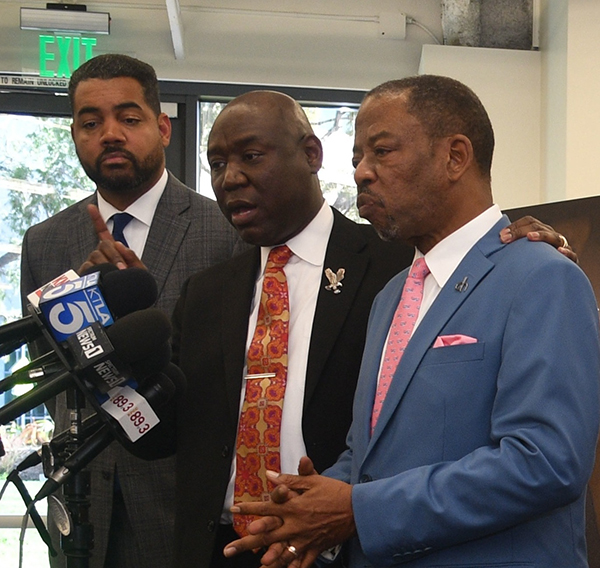
SOUTH LOS ANGELES — A small group of faith leaders and community organizers gathered Feb. 17, at True LA Church to honor the life and legacy of the Rev. Jesse Jackson, remembering the civil rights leader as both a national figure and a personal mentor whose influence reached deeply into the city.
Rev. Douglas E. Nelson, pastor of True LA Church, said the gathering came together quickly after news of Jackson’s passing, calling him “a treasure … to America and to the world.”
“He taught us that you do what you can, while you can, with what you have,” Nelson said. “Jesse Jackson has departed, but he has left so much more than he took with him. It’s been deposited in each one of us.”
Najee Ali, director of Project Islamic Hope and a member of the National Action Network, described Jackson as a mentor and friend whose work reshaped American politics.
“There would be no President Barack Obama had it not been for Reverend Jesse Jackson,” Ali said. “Without question, Reverend Jesse Jackson is one of the greatest Americans ever.”
Ali recalled traveling with Jackson during visits to Los Angeles and said the civil rights leader remained accessible to ordinary people.
“Reverend Jesse Jackson loved the people,” he said. “That’s why it seems like everybody in L.A. has a picture with him.”
Pastor Oliver E. Buie of Bel-Vue Community Presbyterian Church, who said he was born in the segregated South, reflected on Jackson’s influence on his own life.
“Many of the privileges I enjoy today are due to the work he has done,” Buie said, adding that Jackson’s message to “keep hope alive” remained a guiding reminder during difficult moments.
The Rev. William Smart, president and CEO of the Southern Christian Leadership Conference of Southern California, pointed to Jackson’s direct involvement in local labor and community struggles, including mediating disputes and supporting organizing campaigns in the region.
“These are just a few instances where Jesse Jackson came and did the work that was necessary in this city,” Smart said, noting that Jackson’s efforts helped shape opportunities for future generations.
Other speakers emphasized Jackson’s influence as both a preacher and advocate for justice.
“He was a champion for justice, but he was also a preacher,” said the Rev. Leroy Matthews Jr. of One Lord Ministries. “He will always be remembered, and he will never be forgotten.”
National and local leaders also issued tributes.
U.S. Rep. Maxine Waters said Jackson was not only a historic civil rights leader but also a personal mentor whose influence shaped her political career.
“The very Reverend Jesse Jackson was not only my close friend and confidant, he was my longtime political ally and mentor,” Waters said in an emailed statement. “He was a brilliant, gifted and courageous civil rights leader who inspired millions.”
Waters said Jackson’s organizing helped transform Democratic Party politics and built the Rainbow Coalition, bringing together diverse communities long before diversity and inclusion became widely recognized priorities.
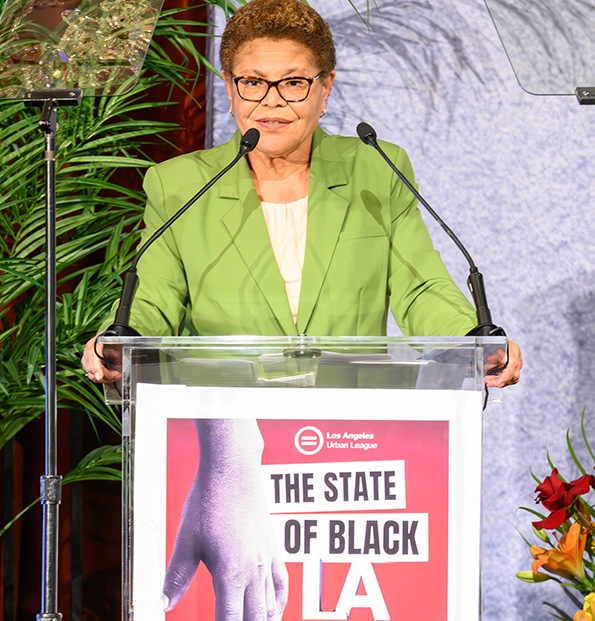
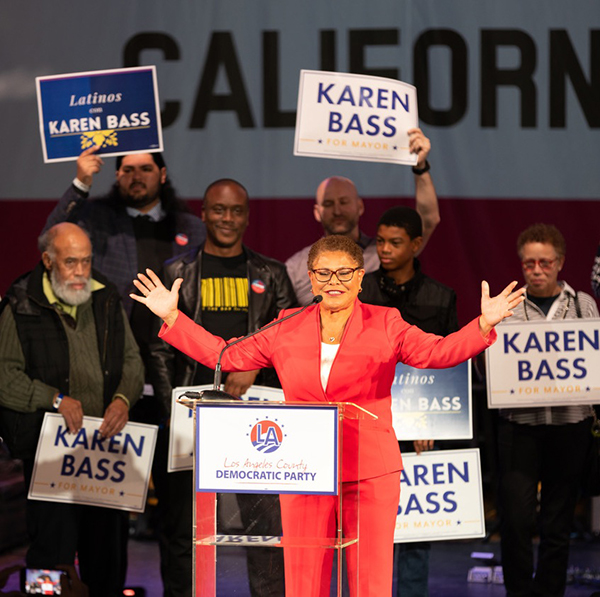
Mayor Karen Bass said she was “deeply saddened” by Jackson’s death and praised his lifelong advocacy.
“Rev. Jackson was a civil rights hero and a tireless advocate for those too often overlooked,” Bass said in a statement. “He was an icon who helped elect countless Black leaders, and his historic presidential campaigns paved the way for the eventual election of President Barack Obama.”
Community leaders also called for a formal recognition of Jackson’s impact in Los Angeles.
Earl Ofari Hutchinson, president of the Los Angeles Urban Policy Roundtable, urged the Los Angeles City Council to declare a Jesse Jackson Civil Rights Day of Remembrance in the city.
“Jesse Jackson played a major role in the battles for political empowerment, economic and social justice for minorities in Los Angeles through the years,” Hutchinson said. “It’s only fitting that city officials declare a day of remembrance to honor his contributions in Los Angeles.”
Jackson’s health had sharply declined in recent weeks. He announced in 2017 that he was diagnosed with Parkinson’s disease, and was recently diagnosed with progressive supranuclear palsy, a neurodegenerative condition similar to Parkinson’s. Reports emerged in November 2025 that Jackson had been placed on life support.
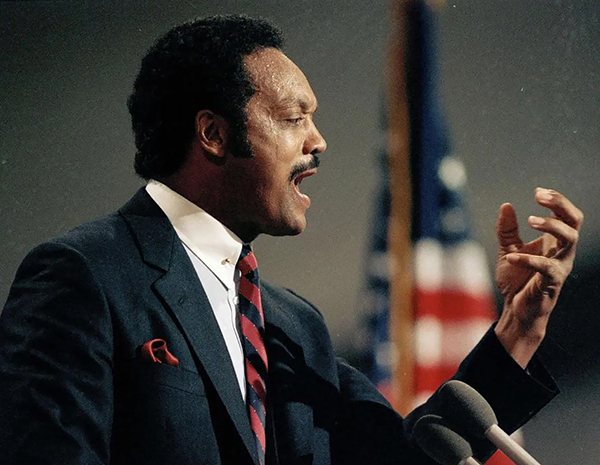
Born in Greenville, South Carolina, Jackson was a protégé of the Rev. Martin Luther King Jr., and was famously at King’s side moments after the civil rights pioneer was assassinated on the balcony of a Memphis motel in 1968.
After King’s death, Jackson fell out with Ralph Abernathy, King’s successor as chairman of the Southern Christian Leadership Conference, and went on to found the groups that would merge to form the Rainbow/PUSH organization, which promote civil rights and political activism throughout the United States.
The group established a headquarters in Chicago and that became Jackson’s base of operations as he increasingly gained influence in the Democratic Party, successfully taking on powerful Mayor Richard Daley in a dispute over delegate seating at the 1972 Democratic National Convention in Miami. As leader of Rainbow/PUSH, he continued to advocate for voting rights, lead boycotts of companies for alleged discrimination and generally push for more Black, female and minority representation in all walks of public life.
Jackson launched a groundbreaking campaign for the Democratic presidential nomination in 1984, winding up in third place in the delegate count behind former Vice President Walter Mondale and Colorado Sen. Gary Hart.
Jackson was given a prime-time spot to address that summer’s Demonstration convention and delivered an electrifying speech that set him up for another run in 1988.
Jackson’s 1988 campaign garnered even more votes and mainstream media attention, as he seriously challenged the front-runner, Massachusetts Gov. Michael Dukakis, for the nomination. Jackson won primaries in several deep South states and in Michigan, but eventually lost the nomination decisively to Dukakis.
Jackson’s activities were not confined to domestic politics. In 1983, he negotiated with Syrian President Hafez al-Assad to secure the release of a captured American pilot, Navy Lt. Robert Goodman. He followed that up in 1984 by negotiating the release of 22 Americans being held in Cuba after an invitation by Cuban president Fidel Castro.
Jackson continued serving as an advocate for progressive policies and self-determination among urban youth in the 1990s. He traveled to Los Angeles after the deadly 1992 riots sparked by the acquittal of four policemen in the videotaped beating of Rodney King, pleading for both justice in the courts and peace in the streets.
He also hosted the public affairs show “Both Sides with Jesse Jackson” on CNN from 1992 to 2000.
As the 2008 presidential campaign got underway in 2007, Jackson endorsed Illinois Sen. Barack Obama, then watched with a mixture of pride and jealousy as Obama became America’s first Black president. Jackson had clashed with Obama at times during the campaign for trying to appeal too much to the political center in his view, but the image of a tearful Jackson at Obama’s election-night victory speech went viral and confirmed that the weight of a historic moment in U.S. history that Jackson himself helped to make possible wasn’t lost on him.
Speakers at the vigil at TrueLA Church also recalled a personal side, describing him as deeply devoted to his family and proud of his children.
At the close of the service, attendees joined hands in prayer and repeated one of Jackson’s most enduring affirmations: “I am somebody.”
The phrase, popularized by Jackson during rallies, sermons and youth programs, became a declaration of dignity and self-worth — especially for young Black Americans growing up amid poverty and discrimination. For many, it symbolized Jackson’s belief that social change begins with recognizing one’s own value and voice.
For those present at the vigil, that message — and Jackson’s broader legacy — remains unfinished work.
“We must continue to fight for justice,” Ali said. “That’s what Reverend Jesse Jackson would want.”
Stephen Oduntan is a freelance writer for Wave Newspapers.