Making History
New murals unveiled near Harbor Freeway salute Black heritage

Wave Staff Report
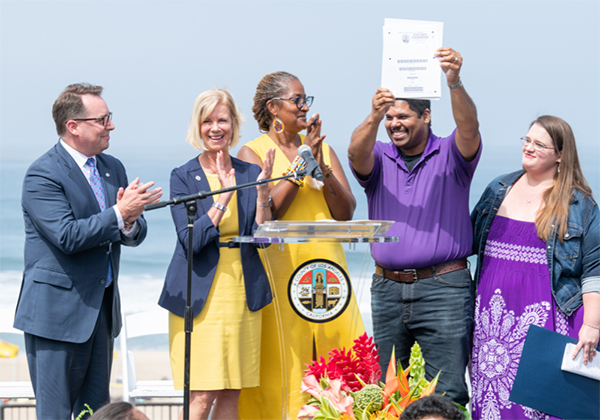
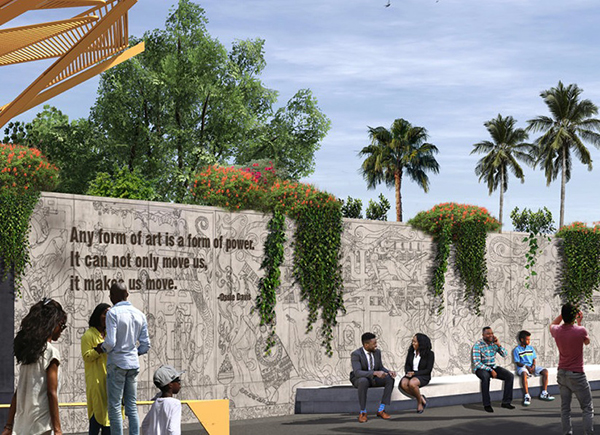
SOUTH LOS ANGELES ― The state Department of Transportation and the city Department of Cultural Affairs unveiled three new murals near the Harbor (110) Freeway March 11 depicting historical institutions like Wrigley Field and the Dunbar Hotel, as well as portraits of Martin Luther King Jr., Billie Holiday and others who visited those locations.
The $2.89 million beautification project was funded by Gov. Gavin Newsom’s Clean California program — a $1.2 billion, multiyear cleanup effort led by Caltrans to remove trash, create thousands of jobs and engage communities to transform public spaces. The project also includes sustainable landscaping and fencing improvements, completed in 2024, along seven miles of the freeway.
“In line with Clean California’s goals to beautify and restore pride in our communities, these murals along I-110 provide a stunning and accessible way to preserve and honor South Los Angeles’ history and culture,” said Caltrans District 7 Director Gloria Roberts.
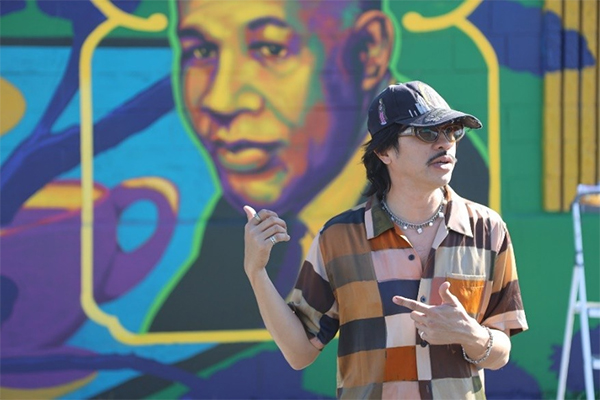
“Jazz on the Field” by artist MisterAlek graces a wall at 43rd Street and Grand Avenue, and “Safe Travels” by artist Bodeck Luna is featured at 43rd and Flower streets. A third mural, “South Central Strong” by artist Moses Ball is scheduled for installation sometime this spring at Colden Avenue and Flower Street.
“The three artists selected for these commissions — Moses Ball, Mister Alek, and Bodeck Luna — represent excellent examples of the talented artistry that we have here in Los Angeles,” said Daniel Tarica, general manager of the city’s Department of Cultural Affairs. “Creativity is central to our city’s identity, and murals like these give our artists the opportunity to share their creative vision and beautify our cityscape.
“Simultaneously the work inspires the public and connects our communities to the region’s rich and diverse cultural history,” he added.
“Jazz on the Field” by MisterAlek celebrates the cultural heritage of Wrigley Field, a ballpark formerly located at 425 E. 42nd Place, and the Dunbar Hotel at 4225 S. Central Ave. — both a short distance from the mural site.
Before it was demolished in 1969, Wrigley Field was home to the Los Angeles Angels of the Pacific Coast League from 1925 through 1957.
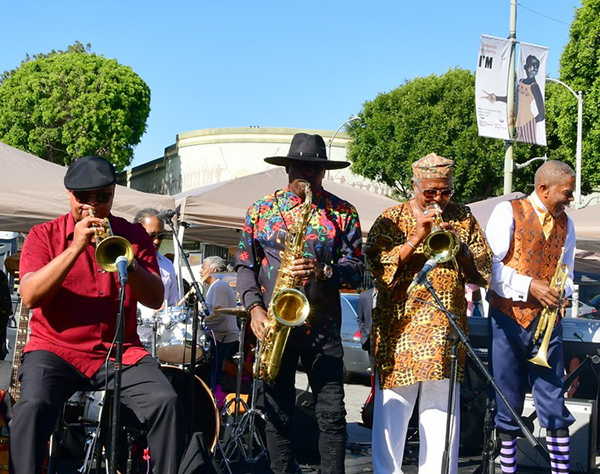
It also served as the home field of the Major League’s Los Angeles Angels in their first year of existence in 1961. Additionally, the stadium also was a venue for boxing events, as well as the Cavalcade of Jazz in the 1940 and 50s and the historic Los Angeles Freedom Rally May 26, 1963, when Rev. Martin Luther King Jr. addressed a crowd of nearly 40,000 people during the civil rights movement. The Dunbar Hotel was a hub for Los Angeles’ jazz scene with artists such as Etta James and Louis Armstrong performing there.
Speaking on his goals for the mural, MisterAlek said, “The main purpose is to bring back history that’s lost, to remind us where we come from and where all this started. We’re right in front of West Vernon Elementary and hopefully this will inspire [the students] —the whole point [is] to be able to educate and inspire the new generation.”
A short walk across the 43rd Street bridge over the freeway brings pedestrians to “Safe Travels” by artist Bodeck Luna. Painted in Luna’s favored hues of green and purple, “Safe Travels” brings focus to Black families traveling in Los Angeles, under the guidance of Victor H. Green’s “Green Book,” a national travel guide first published in 1936 that assisted many Black Americans navigate oppression during the Jim Crow Era. A portrait of Green is seen on the right side of the mural.
That mural also references the Dunbar Hotel, an entry in the “Green Book” as an anchor for traveling musicians and the Black community, with portraits of Billie Holiday and Charlie Parker who frequented the hotel.
The depiction of a blackberry branch above Holiday and Parker is a nod to Wallace Thurman’s novel “The Blacker the Berry,” which explores the harsh conditions and prejudices experienced by Black Americans.
Luna said he was drawn to the “Green Book” themed call for art, noting the importance of continuing to teach the next generation about the stories and struggles in American history.
“I felt inspired to preserve history, and I wanted to be instrumental in using my talent to depict this narrative of resilience,” Luna said.
Currently in progress is “South Central Strong” at Colden Avenue and Flower Street. The mural recognizes South L.A.’s struggles with issues such as child trafficking as well as the community’s underlying strength and resilience to combat those issues. Artist Moses Ball seeks to bring everyday community heroes to light with portraits of figures such as Ron Finley, an urban gardening activist known for the Ron Finley Project.
Other important themes representative of the human condition are also featured, including a mourning mother, fatherhood, the guardianship over younger siblings, and the guidance of elders among other archetypes.
“In an environment where we’re sometimes afraid to speak out against dangers, I hope this mural stands as a testament that we will boldly protect our children and young women in our families,” Ball said.
In addition to murals, the beautification project featured landscaping improvements completed in 2024 by Diversified Landscape Co. at the intersections of Century Boulevard, Manchester Avenue, 83rd Street, Florence Avenue, Gage Avenue, Vermont Avenue, and other locations of the I-110 corridor.
Additional improvements near the freeway include: 62,655 drought-tolerant plants, approximately 16,000 square feet of rock blanket paving and 5,700 square feet of gravel mulch added to on and off ramps and medians for a low maintenance ground covering; more than 8,000 cubic yards of wood mulch to reduce soil erosion, new irrigation systems and 1,400 linear feet of new fencing.
The project is one of 317 Clean California projects beautifying communities throughout the state. Since launching Clean California in July 2021, Caltrans and its local partners have picked up more than 3.5 million cubic yards of litter from highways and public spaces — the equivalent of filling about 165,000 garbage trucks with debris and trash.