By Antonio Ray Harvey
Contributing Writer
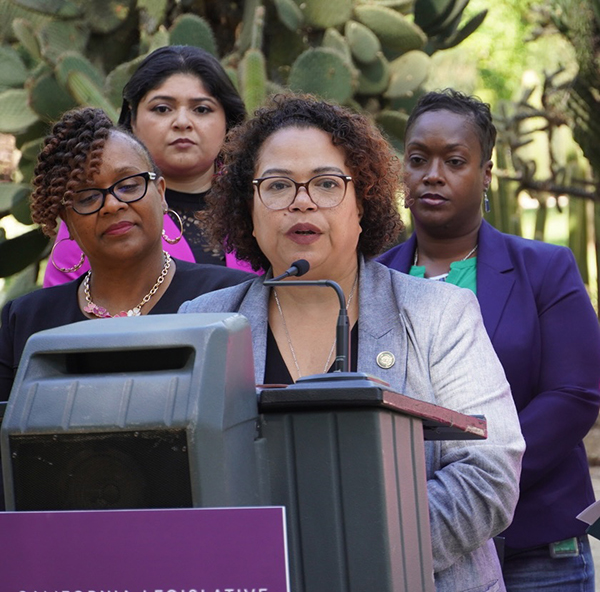
SACRAMENTO — Members of the California Legislative Black Caucus, in collaboration with the California Legislative Women’s Caucus, stood in unity March 25 to present a 2026 legislative package aimed at advancing family-centered economic and social equity.
The package focuses on uplifting women, caregivers and survivors of violence, while addressing economic disparities, strengthening social safety nets and expanding access to health care.
Assemblywoman Mia Bonta, D-Alameda, emphasized the critical role of women lawmakers in shaping policies that support families. She introduced Assembly Bill 2434, which aims to increase transparency and protect the rights of families visiting incarcerated individuals in California.
“Women in this legislature and across this state are the ones who hold things together,” Bonta said. “We show up, and we do our work even when the system falls short.”
The legislative package is organized around six core pillars: affordability; child care and education; public safety and gender-based violence; health care access; support for vulnerable communities; and workplace and economic equity.
Bonta joined Assemblywomen Rhodesia Ransom, D-Stockton; LaShae Sharp-Collins, D-La Mesa; and Lori Wilson, D-Suisun City; and state Sen. Lola Smallwood-Cuevas, D-Los Angeles; – all members of the Legislative Black Caucus — at a news conference announcing the proposals.
Wilson introduced AB 1570, “Healthcare Coverage: Diagnostic Imaging,” which seeks to eliminate out-of-pocket costs for medically necessary diagnostic and supplemental breast imaging.
Wilson, who was diagnosed with breast cancer in April 2023 during her first full year in office and later announced she was cancer-free, said her personal experiences have shaped her legislative priorities.
“In 2023, while fighting breast cancer, I was fortunate enough to receive quality care. I saw others with similar diagnoses face different outcomes,” Wilson said. “So, I made it my mission as part of a bill package every year that I would address these disparities.”
Sharp-Collins authored AB 1755 to eliminate the “100-hour rule” in the state’s CalWORKs program, which currently reduces or cuts off benefits if a parent works 100 or more hours per month.
By removing the rule, the bill aims to prevent a “benefits cliff” and allow working families to increase hours without losing critical support.
“With rising costs, people are still struggling to survive,” Sharp-Collins said. “If we truly value families, we must end this outdated policy and build a CalWORKs system that supports women, protects children, and recognizes the realities of today’s economy.”

Additional lawmakers joined in supporting the package, including Assemblywomen Dawn Addis, D-Morro Bay; Blanca Rubio, D-Baldwin Park; Michelle Rodriguez, D-Chino; and Gail Pellerin, D-Santa Cruz; as well as state Sens. Susan Rubio, D-Baldwin Park; Aisha Wahab, D-Hayward; and Caroline Menjivar, D-Burbank.
Among the proposals is Senate Bill 1192, the “Reclaim Act,” introduced by Rubio. The bill seeks to protect domestic violence survivors from “litigation abuse” by allowing courts to issue prefiling orders to prevent abusers from filing frivolous lawsuits intended to harass or financially burden victims.
“Too many survivors are retraumatized when the court system is used as a weapon against them,” Rubio said. “The Reclaim Act is about restoring dignity, safety, and freedom — and making sure the justice system protects survivors, not their abusers. Survivors should never have to choose between their safety and their right to justice.”
Legislative Women’s Caucus Chair and Assembly Majority Leader Cecilia Aguiar-Curry, D-Winters, said the package reflects broad legislative support, noting it was finalized through a 14-member caucus vote representing the 59-member bipartisan body.
The package is “pragmatic and committed to delivering real results,” Aguiar-Curry said.
“This year’s legislative package reflects both the diversity of our state and the complexity of the barriers that still exist for women and their families in California,” Aguiar-Curry said. “Our mission here at LWC is to make sure policy keeps pace with the realities and stresses of modern life.”
Antonio Ray Harvey writes for California Black Media.