Wave Staff Report
COMMERCE — Officials from the cities of Commerce and Bell Gardens have each declared fiscal emergencies and placed local sales tax measures on the June 2 ballot in response to significant projected revenue losses tied to California Attorney General Rob Bonta’s recently approved card room regulations.
Both cities have placed quarter-cent sales tax increases before voters to stabilize finances and prevent cuts to critical services that fund police, fire, parks and recreation, library services and senior and youth programs.
The new state regulations, which target long-standing card room operations in both cities, are expected to significantly reduce gaming activity by effectively eliminating blackjack-style games and restricting player-dealer games, key economic drivers for both cities.
Commerce relies on card room table tax revenue for approximately 40% of its general fund, while Bell Gardens depends on similar revenue streams that generate over $17 million annually, representing a substantial portion of its operating budget.
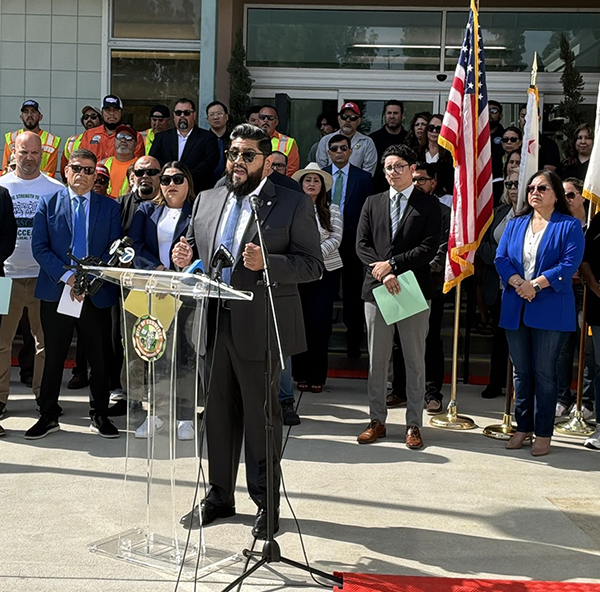
At a press conference at Commerce City Hall March 26, officials from both cities and from the California Gaming Association criticized the attorney general’s new regulations which they say benefit casino operations of Native Americans tribes at the expense of cities who rely on card room revenue to boost local revenues.
“Our City Council did not take this step lightly, but we are being forced to act due to the actions of Attorney General Bonta,” said Commerce City Manager Ernie Hernandez. “The attorney general’s own analysis shows these regulations could cut card room revenue dramatically.
“For Commerce, that means fewer resources for public safety, parks, and the essential services our residents depend on,” Hernandez added. “This measure is about protecting our community from decisions made outside our control.”
According to Attorney General Bonta’s own economic analysis the Standardized Regulatory Impact Assessment, the regulations could result in up to a 50% loss in jobs and revenue across the card room industry. Despite these findings, the regulations were approved, leaving cities like Commerce and Bell Gardens facing immediate fiscal uncertainty.
Commerce has placed the Commerce Essential Services Protection Measure which is projected to generate approximately $4.5 million annually and the city of Bell Gardens has placed Measure BG which is projected to generate approximately $1.2 million annually.
Without these measures, city officials warn of potential impacts including reduced public safety services, cuts to community programs, and delays in infrastructure investments.
“Bell Gardens is facing the same financial emergency as the city of Commerce all due to Attorney General Bonta,” said Miguel De La Rosa, mayor of Bell Gardens. “The Parkwest Bicycle Casino generates more than $17 million annually for our city, funding that supports public safety, community programs, and day-to-day operations. Even a conservative reduction would require immediate and difficult cuts, and with potential impacts beginning as soon as April 1, we cannot afford to wait.”
City leaders emphasized that their ability to respond is constrained by existing funding structures. In Bell Gardens, despite a total sales tax rate of 10.5%, the city retains only 1.75 cents of every dollar, underscoring the limited tools available to offset sudden revenue losses.
Both cities stressed that the issue goes beyond budgets and directly impacts residents’ quality of life.
The card room regulations were approved by the attorney general without a clear justification, to benefit a few wealthy gaming tribes. Now, cities like Commerce and Bell Gardens are left to absorb those consequences, forcing immediate action to protect essential services and maintain stability for their residents.
In a related action, he California Gaming Association announced March 31 that it has filed motions in San Francisco Superior Court, which seek a preliminary injunction blocking the new card room-specific regulations issued by the California Department of Justice’s Bureau of Gambling Control from taking effect while litigation proceeds. T
he motions are the next step in two lawsuits, filed March 6, challenging the legality of the regulations, which restrict table games that California card rooms have operated legally for decades.
“Without court intervention, these regulations will strip cities of critical tax revenue, shutter long-standing card rooms, and eliminate thousands of good-paying jobs,” said Kyle Kirkland, president of the California Gaming Association. “The attorney general is forcing changes that reverse decades of lawful, state-approved gaming without authority, justification or substance and in direct conflict with his own economic analysis showing catastrophic harm.
“A preliminary injunction is essential to stop this unlawful overreach and protect the working families and communities that rely on card room revenue before the damage becomes permanent.”
The legal filings are supported by declarations from nine California cities, including Commerce, Bell Gardens, Gardena, Inglewood and Hawaiian Gardens in Southern California, underscoring the widespread fiscal impact of the regulations.