By Janice Hayes Kyser
Contributing Writer
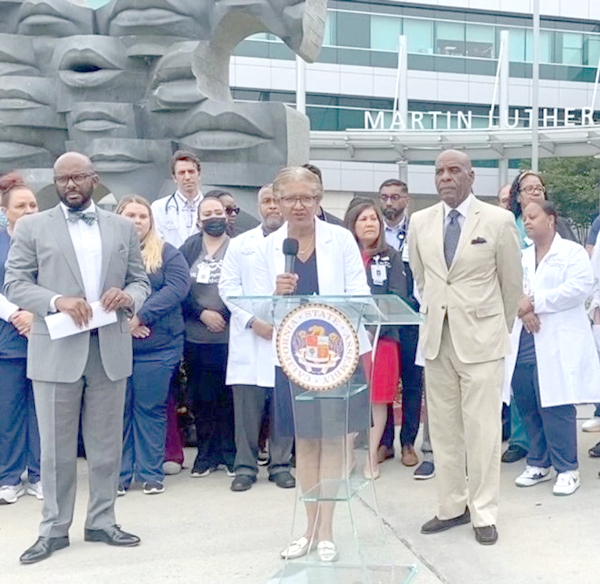
WILLOWBROOK — On a stretch of South Los Angeles once defined by what it lacked, Martin Luther King Jr. Community Hospital stands as something far more than a place of care — it stands as a promise reclaimed.
For decades, families in this community lived with a quiet, dangerous truth: when emergencies struck, help was often too far, too late, or too unequal. The absence of nearby, quality health care wasn’t just an inconvenience — it was a matter of life and death. And when the original hospital bearing King’s name closed its doors in 2007, that absence became a wound — one that cut into trust, dignity and survival itself.
When the hospital reopened in 2015, it was more than a ribbon cutting. It was a declaration that South L.A. — long overlooked — would no longer be left behind when it came to access to health care.
Yet, today, that promise is once again tenuous as federal Medicaid cuts, part of HR 1 known by the Trump administration as the “Big Beautiful Bill,” threaten the hospital that was built to serve one of the city’s most vulnerable populations.
Of the more than 1.3 million residents who live in the hospital’s service area, 38% have no high school diploma and a quarter of the households earn below $25,000 a year. Nearly all of the hospital’s patients are Black or brown and suffer from diabetes, heart disease and pneumonia at roughly twice the rate of other residents of the state.
Some 97% of the patients the hospital sees are either publicly insured or uninsured. Hospital officials are projecting that HR 1 will create an $80 to $100 million gap if left unaddressed. Hospital administrators say supplemental funding doesn’t cover those losses, much of them stemming from its emergency department that now sees five times the projected number of patients, approximately 125,000 people per year.
Dr. Atul Nakhasi, vice president of government affairs and community relations at MLK, says the irony is the hospital is fighting to exist in part because of the very factors it was designed to confront: poverty, inequity and a health care system that doesn’t fully pay for caring for the poor.
“We were born out of need and we are meeting that need by serving a population that’s been historically underserved,” Nakhasi said. “For-profit hospitals don’t want to care for the population we serve because they cannot make any money. We are a safety net for our community, but that net is being stretched thin.”
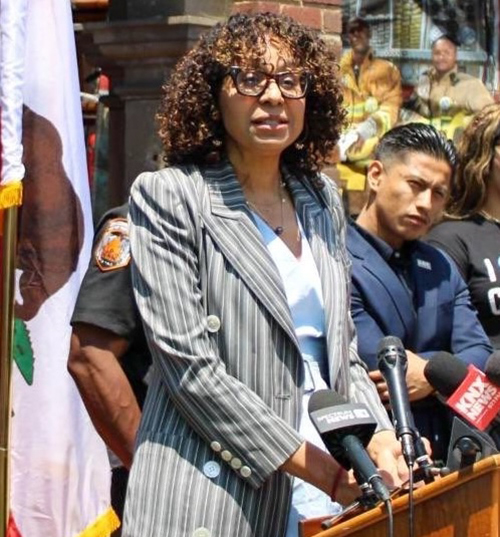
U.S. Rep. Sydney Kamlager-Dove, who represents the 37th District where the hospital is located, says when the Trump administration cut $1 trillion in Medicaid last year the impacts were especially devastating for her district, which has the fourth largest Medicaid enrollment in the country.
“When America has a cold, Black America has pneumonia,” Kamlager-Dove said. “So, any cuts to health care have a bigger impact to our communities.
“Under Trump and Republicans, there always seems to be money for bombs, but never enough to help Americans make ends meet. I’ll keep fighting to restore health care funding, push back against future cuts, and ensure our tax dollars are used to support healthy communities.”
Los Angeles County Supervisor Holly Mitchell, who represents the Second District, home to the MLK campus, is also in the fight at the local level working on both long- and short-term solutions to protect the hospital.
One of those proposed solutions is Measure ER that will be on the ballot this June. If the voters pass it, it will be a temporary half-cent sales tax, that will exclude groceries and medicine and items purchased with WIC or SNAP. An estimated $1 billion annually for five years is expected to be generated to help L.A. County’s health care system — which includes MLK — that has been severely impacted by federal funding cuts, and public health services, community clinics, and emergency rooms. Mitchell is also working with state representatives to explore creating a loan fund for distressed hospitals.
“I’ve got a lot of plates spinning on this; I realize the urgency,” Mitchell said. “MLKCH provides top flight care in a culturally relevant way. If they’re forced to reduce their services or close their doors it would hurt many people and put pressure on surrounding hospitals. We’ve been through this scenario before.”
Glenn Melnick, a USC professor and a world-renowned expert in health economics and finance, says what hurts MLK is that unlike most hospitals it doesn’t have larger shares of commercially insured patients who offset the losses from patients on Medi-Cal.
“Policy makers need to examine the nuances of our complex health care delivery system and consider alternative payment models that take into account differences across hospitals,” Melnick said. “At the same time, we also need to slow health care spending growth in California to address growing affordability challenges.”
For many in L.A.’s Black community, this is not just a policy debate, it’s an all too familiar story of being left behind.
It’s a story Marsha Mitchell, a mother, a professional and a 40-year resident of South L.A., is tired of.
“We don’t deserve this,” she said. “Part of the reason for the Watts riots was inequitable access to health care. And, some 61 years later, here we are again. It’s daunting. “
Lemiah Johnson, founder of L.A.-based For Real People, a community-based nonprofit that advocates for holistic health access for marginalized communities, says cutting hospital funding is a direct attack on the social safety net that many Black and brown families depend on.
“Hospitals are anchors in the community and people need to know and deserve to know where they can go for emergencies, mental health services, preventative care and support,” says Johnson, an L.A. native who holds a master’s in public health from Emory University in Atlanta.
Los Angeles-based author and activist, Earl Ofari Hutchinson, says the health of MLK Community Hospital is vital to the health of South L.A.
“For years MLK has been the health care provider of last and maybe even only resort for countless numbers of poor Blacks and Hispanics in South L A.,” Hutchinson said. “Taking away that care could be the death knell for thousands.”
Janice Hayes Kyser is a freelance reporter for Wave Newspapers.