By Nicole Chang
Contributing Writer
LOS ANGELES — Some 550,000 property owners in the city will receive unique ballots by mail asking them to approve an increase in property assessment fees to pay for maintenance and repair of LA’s street lights.
If approved, funding for the city’s streetlight system would nearly triple. Ballots must be returned by June 2, and the measure requires majority approval to pass.
During a press conference on April 8 at the Bureau of Street Lighting’s Field Operations Yard on Santa Monica Boulevard and Virgil Avenue speakers said the outcome could have broader implications for public safety and infrastructure management.
The press conference, hosted by American Community Media, featured Bureau Executive Director and General Manager Miguel Sangalang, Assistant Director Fabian E. Cheng, Construction and Maintenance Superintendent Manuel Reyes Hago, and Field Operations Superintendent Sylvia Torres.
According to the bureau, the system currently operates on about $45 million annually in assessment revenue, while actual needs are estimated at $125 million. Officials said the gap reflects aging infrastructure and growing maintenance demands.
For single-family homes, annual assessments currently range from about $53 to $83, or roughly $5 per month. If approved, the average cost would rise to about $117 annually, or about $12 per month.
The city’s streetlight system includes about 220,000 lights, more than 9,000 miles of underground conduit and approximately 27,000 miles of copper wiring, covering nearly two-thirds of the city’s 470 square miles.
However, only about 185 employees are responsible for maintaining the system, contributing to delays.
Sangalang said about 32,000 service requests are currently backlogged, with some repairs taking nearly a year to complete.
Copper wire theft and aging infrastructure remain major challenges. Roughly 100,000 streetlights have reached the end of their lifespan, and many poles are overdue for replacement. Damage to underground systems can sometimes cause outages across entire sections.
“Problems that used to be fixed in a day can now take days just to diagnose,” said maintenance superintendent Manuel Reyes Hago.
Founded in 1925, the Bureau of Street Lighting marked its 100th anniversary last year. Sangalang said the system, originally built to support early urban development, is now strained after decades without fee increases.
“While the city has grown and demands have increased, funding has not kept pace,” he said.
The bureau is introducing new technologies to improve efficiency and reduce costs.
Since 2008, the city has converted streetlights to LED, saving about $10 million annually in electricity costs. The bureau is also expanding solar-powered lights, electric vehicle charging stations and smart sensor technology.
“Streetlights are no longer just lighting — they are becoming platforms for EV charging and smart city infrastructure,” Assistant Director Fabian Cheng said, noting that more than 1,000 EV charging units are already integrated into the system.
He added that about 30,000 streetlights could potentially be converted to solar power.
The bureau is also using in-house manufacturing and 3D printing to produce components such as underground connection boxes to reduce maintenance costs.
Officials warned that failure to approve the fee increase would likely worsen repair delays and raise safety concerns.
“Many structures are nearing the end of their lifespan, and large-scale replacement will be necessary in the coming decades,” Sangalang said.
He emphasized that the proposed increase represents the first adjustment in 30 years and is essential to maintaining the city’s infrastructure.
“Streetlights may go unnoticed, but they are critical to public safety,” he said.
Maintenance delays are compounded by field conditions, said Sylvia Torres, who oversees field operations.
“Crews often have to troubleshoot underground systems before repairs can even begin,” Torres said. “That process can take days depending on the location and the extent of the damage.”
The proposed assessment would affect approximately 584,000 parcels across the city, covering most properties with adjacent streetlights. Each ballot will reflect the proposed fee for that specific property.
The assessment has not been increased since 1996, and under state law, it cannot be raised without approval from property owners.
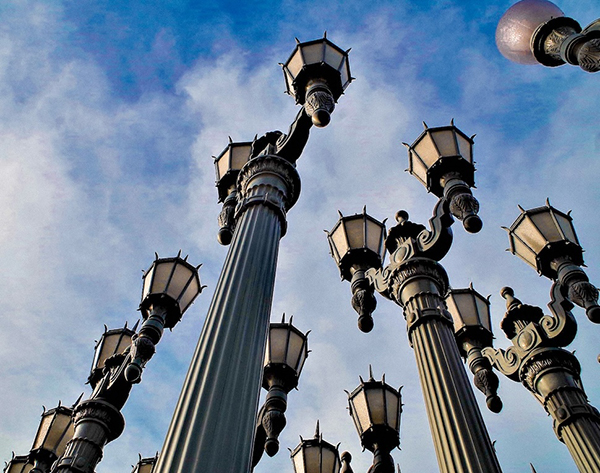
Following the press conference, officials took reporters to the Vermonica art installation of 15 historic streetlights. Cheng noted that Los Angeles has more than 400 different streetlight designs, reflecting the city’s diverse neighborhoods.
“This is the first time we’ve been able to tell our story,” Torres noted with pride as the tour concluded.
Nicole Chang writes for American Community Media.