By Stephen Odubtan
Contributing Writer
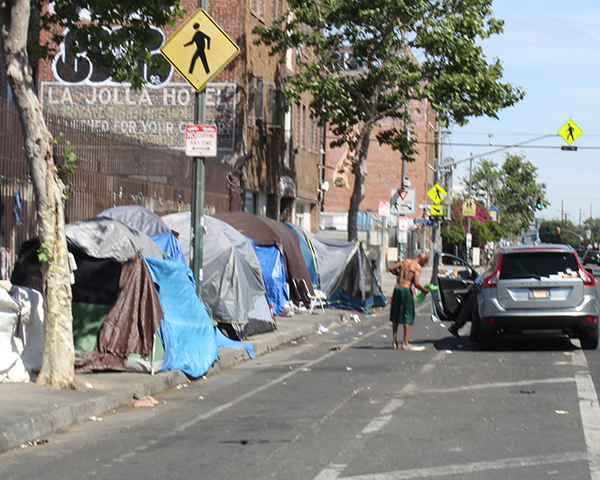
SOUTH LOS ANGELES — As Mayor Karen Bass unveiled a new city budget April 20, service providers and residents say the real test will not be how many people are moved off the streets — but whether they are able to remain housed.
The nearly $15 billion proposed budget continues investment in homelessness response efforts, including programs aimed at moving people indoors and expanding services.
At a press conference announcing the proposal, Bass said the plan is focused on maintaining progress while improving efficiency.
“This budget is about protecting the progress we’ve made,” Bass said, adding that the city is “investing in what works” while making “smarter decisions with every dollar.”
City officials point to recent gains, including declines in street homelessness and two consecutive years of overall reductions in the homeless population.
But on the ground, many say the system remains difficult to navigate — particularly for those trying to secure stable housing in the first place.
Sophia Knight, who has been living in her car for three months, said she has repeatedly tried to access housing programs but continues to encounter barriers.
“They keep wanting to see more income, but I just don’t have it,” she said.
Knight said she has reached out to multiple programs across Los Angeles County, only to find limited availability.
“Everything is full,” she said. “There doesn’t seem to be any programs left open.”
Even when opportunities arise, she said, program requirements can conflict with daily life.
“They told me I had to be there at 6, but I work until 8:30,” she said. “It’s just obstacle after obstacle.”
For others, the challenge comes after securing housing.
Paul Hogan, who has experienced housing instability across Los Angeles County, said he has seen people cycle in and out of the system.
“They track you until you get housing,” Hogan said. “After that, you don’t exist.”
He described a pattern in which individuals are placed into housing but struggle to maintain it, eventually returning to homelessness.
“They get kicked out, and then you go through the whole system again,” he said.
Service providers say those experiences reflect broader pressures across the region’s homelessness response system.
Matthew Tecle, executive director of Safe Parking LA, said programs that serve as a bridge for people living in vehicles are at risk as the city reshapes its budget priorities.
“The homeless services system is undergoing a massive contraction,” Tecle said. “We are seeing fewer options for people in our programs.”
That concern is reflected in the city’s proposed budget.
While funding for homelessness “street strategies” — including outreach, hygiene services and engagement programs — remains in place overall, budget documents indicate that Safe Parking programs are being scaled back, with only three months of funding allocated to support their demobilization.

The programs, which serve people living in their vehicles, are often one of the few structured pathways toward housing for those unable to afford rent.
Even among those who successfully transition out of homelessness, stability often depends on sustained support.
David Mays, who now lives in permanent housing after spending years in a safe parking program, said his path to stability took time — and consistent help.
“They saved my butt … twice,” Mays said.
He said it took more than a year to move through the system and secure housing, with caseworkers helping him navigate through medical needs and the application process.
But he warned that programs like the one that helped him are critical for others trying to reach the same outcome.
“If you cut that program off, I really think it’s going to be devastating,” he said. “There are people who are just barely holding on.”
Community leaders say the stakes are especially high for neighborhoods already grappling with housing instability.
Earl Ofari Hutchinson said the city’s approach must focus not only on reducing visible homelessness, but ensuring long-term stability.
“The issue is not just getting people off the streets,” Hutchinson said. “It’s making sure they don’t end up right back there.”
As the city begins to implement its new budget, residents and advocates say the question is whether the system can provide that kind of sustained support — or whether gaps will continue to push people back into homelessness.
Stephen Oduntan is a freelance writer for Wave Newspapers.