Contributing Writer
LOS ANGELES — Viridiana has been in agony these past few months, wondering if at any moment she might lose her job, her health insurance, maybe even be deported.
A DACA recipient, Viridiana (who asked that we only use her middle name) has waited a year-and-a-half for her status to be renewed.
“I feel desperate, frustrated,” she said in Spanish. “My boss has been very patient. I’ve already had to ask him to wait a little longer for my work permit to be renewed, but it hasn’t happened yet, while the wait keeps getting longer. I don’t know what else to do.”
DACA, or Deferred Action for Childhood Arrivals, is an Obama-era program that grants eligible undocumented residents who came to the United States as minors, relief from deportation and work authorization. DACA recipients can renew their status every two years.
But a legal ruling issued in late April by the Board of Immigration Appeals, part of the Department of Justice, effectively ended deportation protections for the program, leaving more than 500,000 DACA beneficiaries, or Dreamers, vulnerable to deportation.
Reporting shows the Trump administration arrested 261 DACA recipients last year, deporting 86 of them. U.S. Customs and Immigration, meanwhile, is reporting wait times of up to 122 days for renewal requests to be processed, compared to an average of 15 days the previous year.
Immigrant advocates say they have seen waits of up to six months or more, impacting employment, education, as well as individual and family incomes, among other consequences.
“I submitted a request to renew in October 2024, one month before my status was set to expire,” Viridiana said. “A process that once took a few weeks has now gone on for a year and a half.”
Born in Obregon, a city in Mexico’s northwestern state of Sonora, Viridiana came to the United States with her parents when she was 6 years old. She says her life changed in 2012 when President Obama issued his executive order creating the DACA program.
Now 40 and a single mother of four kids, Viridiana works as a cashier at a grocery store in Los Angeles, in addition to being the sole caretaker for her aging mother.
“I’ve already lost my driver’s license,” she said. And while California issued a new one — under AB 60 undocumented residents in the state can apply for driver’s licenses — it is marked so as to prevent her from using it as a legitimate form of federal ID.
Viridrana, who has no criminal record and has never been arrested, says her DACA status had previously been renewed six times, each time the process taking around a month to complete.
According to the U.S. Customs and Immigration Service website, her case is still pending. A notice informs visitors that requests for renewal are handled in the order they are received.
A recent column in the Washington Post by U.S. Sen. Dick Durbin, D – Illinois, points to so-called “processing holds” at U.S. Customs and Immigration Service targeting applications from 39 countries. No information is given as to when processing will resume, Durbin notes.
“These delays may seem like a minor bureaucratic change,” Durbin wrote, “but when a person’s DACA authorization expires, they lose their ability to work and their protection from deportation.”
The holds, Durbin said, are part of a broader, albeit less publicized, attack on DACA by the administration.
“These aren’t just isolated cases; it’s happening on a scale we’ve never seen before,” said Greisa Martínez Rosas, executive director of United We Dream. “These delays are part of a cascading crisis that is weakening the DACA program piece by piece.”
Members of the Congressional Hispanic Caucus recently joined immigrant rights advocates in Washington, D.C., to urge Congress to establish a pathway to citizenship for DACA recipients and all immigrants.
Angélica Salas directs the Coalition for Humane Immigrant Rights (CHIRLA). She says the administration’s targeting of DACA has hit California and Los Angeles especially hard, given the state is home to the largest number of DACA recipients in the country.
“They’re teachers, scientists, lawyers, doctors, nurses,” she said, “and with the delays they’re losing their jobs. And it’s not just the worker who loses but all the people who depend on them: kids lose a teacher; patients lose their care givers. Everyone suffers.”
CHIRLA is among the organizations working to win permanent residency status with a path to citizenship for DACA beneficiaries. For her part, Salas believes the delays are intentional.
“They want to destroy and detain us by any means possible,” she said.
Juan José Gutiérrez, national coordinator for the Full Rights for Immigrants Coalition based in Los Angeles, agrees. The government is “suffocating” DACA beneficiaries, he said.
Many DACA recipients, meanwhile, are expressing their frustration anonymously through social media.
One comment by a user on a DACA Facebook group page notes that his status expires in two weeks.
“I’m trying to stay positive, thinking that everything will be OK, but at the same time I’m going crazy,” he wrote.

Posting on the DACA Dreamers, Renewals & Updates website, a mother notes, “Even though my son was approved, he hasn’t received his card, and the situation is very stressful because he lost his job and suffered a crisis that landed him in the hospital for a month.”
Driven by desperation, some DACA recipients are turning to sites like GoFundMe, seeking support while they wait for the renewals.
“I am a mother of three, working a full-time job and doing everything I can to provide for my kids,” writes Lisbeth on her GoFundMe campaign page. “My DACA permit is set to expire in August, and I need to renew it as soon as possible. My only other support, my children’s father, was recently detained and is currently in ICE custody, leaving me as the sole provider for our family.”
Lisbeth, 28, spoke to American Community Media over the phone from her home in North Carolina, where she works as a school janitor and where she lives with her kids, ages 9, 4 and 2. She received DACA for the first time in 2014.
“I came to this country when I was 6 years old; one day in 2005, my family woke me up in the early morning, and my grandmother put a lunchbox with tortillas and beans in my backpack. I didn’t know they were bringing me to the United States,” she said.
As for going public with her status, she said necessity led her to overcome her fear of exposing her status.
“I’m very worried because I don’t have the money to pay for the DACA renewal,” she said. “And since the process is taking longer than expected, if I don’t hurry and my work permit doesn’t arrive on time, I won’t be able to continue working.”
Araceli Martinez writes for American Community Media. This story is part of “Aquí Estamos/Here We Stand,” a collaborative reporting project of American Community Media and community news outlets statewide.
CAPTION
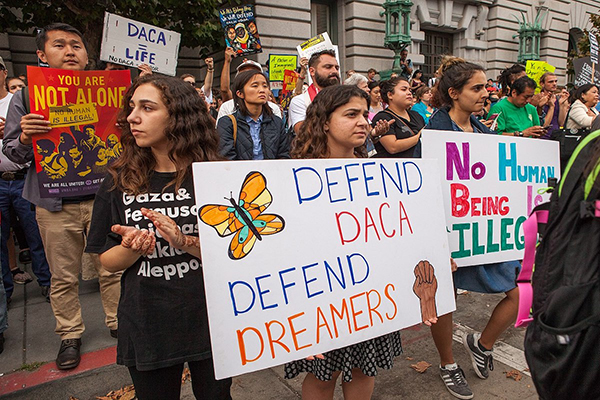
The Trump administration is making it harder for immigrants to renew their status as Deferred Action for Childhood Arrivals, or DACA. Renewal delays make it hard, if not impossible, for immigrants to hold onto jobs while their status is in limbo.
Courtesy photo