THE HUTCHINSON REPORT: Why so many homeless white guys are on South L A. streets

By Earl Ofari Hutchinson
Contributing Columnist
The response was, to say the least, unexpected. I’m talking about one of my recent Facebook posts in which I asked the question “Why are so many unhoused mentally challenged white men on South L.A. streets?
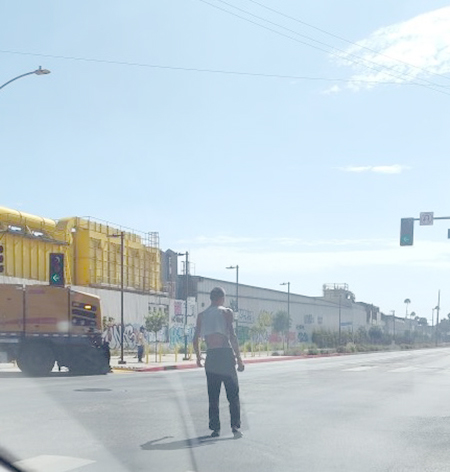
I posted this along with a picture of a shirtless, seemingly mentally challenged young white man panhandling and mumbling out aloud in the middle of a busy South L.A. intersection. It produced an avalanche of comments and musings from dozens of readers.
The opinions ranged from disbelief, to surprise, to offering a host of reasons why they are turning up in noticeable numbers in predominantly lower income African American and Hispanic neighborhoods.
The reasons for the surge can be cited by rote. These men lack jobs, education, are afflicted by mental, drug and alcohol addiction, and are deeply impoverished. They are widely regarded as white society’s washed-out discards, an embarrassment better out of sight and out of mind, so where better for them to wind up than in South L.A.
They are here because of two steadily mounting crisis factors that have slammed many lower income, working class young white men. The first is poverty.
It’s true that Hispanics, and especially African Americans, have disproportionately chronic higher rates of joblessness and poverty than whites. However, in terms of raw numbers, census figures on poverty consistently show that the majority of men in poverty are white. In most cases, they are either marginally skilled or unskilled and have not attended college.
This ties directly into the second crisis issue that has hit young white males hard. That is drug use.
A study by the National Survey on Drug Use and Health in 2017, found that nearly 40% of young white adults aged 18 to 25 used illicit drugs. Several studies in the years since then have found no evidence of any decline in that stratospheric figure on white drug use. Overall, whites consistently have the highest rates of drug use and abuse of all ethnic groups.
Experts on this issue have come to the same conclusion as to why the high drug use among this group. Drugs are cheap, accessible and they are the way many express their sense of rebellion and alienation from society. It is also their means to deal with stress and anxiety that often comes from the lack of skills, education and jobs.
They are derisively and popularly branded as proverbial white trash. Like Blacks and Hispanics, they are saddled with a boatload of stereotypes and negative depictions.
One observer of the “white trash” cultural and media portrayal ticked off this list of pejoratives about them: They’re called angry (white males), lazy, dirty, overweight, sunburned, stupid, racist, alcoholic, abusive, jobless, tacky, diseased, violent, backwards, Bible-thumping and uneducated.
These stereotypes are repeated and depicted so routinely in the media and popular culture that it is practically an article of belief that a poor white guy must fit one, if not all, of these stereotypes. That hardly engenders sympathy and a willingness to assist a person who is widely viewed as inherently offensive.
After all, the equally popular and no less stereotypical belief, is that a “normal” white person is hard working, educated, cultured, and most importantly, perfectly fits into mainstream (read white) society.
In the book, “Not Quite White: White Trash and the Boundaries of Whiteness,” author Matt Wray notes that “White trash names a people whose very existence seems to threaten the symbolic and social order. As such, the term can evoke strong emotions of contempt, anger, and disgust.”
There’s one other factor that has served to push more young white males to South L.A. streets. The sense of insecurity and even hostility that they often experience living on Skid Row. They often are regarded as just as out of place there and thus unwelcome as they are in white middle class suburban communities.
They are kind of reverse racial outcasts. They do not have the means to flee to more distant neighborhoods where they would not be welcome anyway. So, the closest, easiest, and probably safest bet for them is to hang out on a South L.A. street.
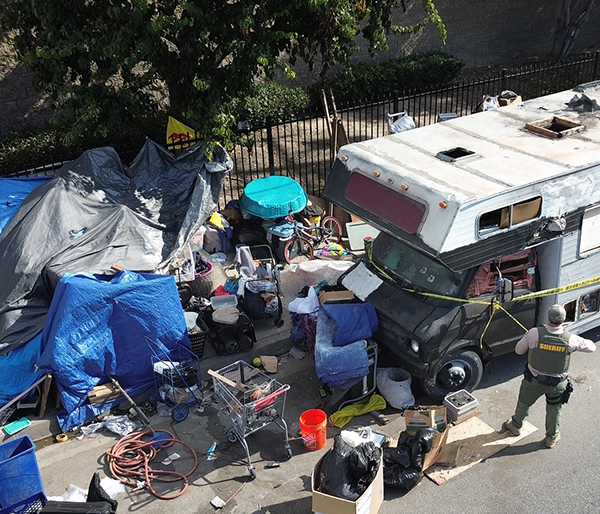
The blame finger for their plight locally is pointed squarely at Los Angeles officials for not doing enough to combat the surge in homelessness among all groups affected.
It is no easy task. The “where do they go” has been asked every time cities make periodic sweeps of homeless encampments.
The sweeps amount to little more than rearranging the deck chairs on the Titanic. That is simply shifting them from one part of the city to another, maybe placing a few in temporary shelters, while leaving the rest right back where they started, plopped out on yet another sidewalk. And that sidewalk for an increasing number of white males is in South L.A.
Earl Ofari Hutchinson is an author and political analyst. His forthcoming book is “Trump’s Obama Obsession” (Middle Passage Press).