By Edward Kissam
Contributing Writer
On Inauguration Day, Jan. 20, 2025, President Donald Trump made clear there would be a renewed assault on immigrants’ rights. What wasn’t clear at the time, but is now, is that this would escalate beyond hate ridden rhetoric into systematic disregard for the rule of law.
That is the key takeaway from the ACLU’s July 16 report, “Agents of Chaos and Cruelty,” which details rampant misconduct by federal immigration agents across the country.
“The abuses detailed in this report are about more than immigration,” co-authors Denise Bell and Naureen Shah wrote. “They reveal a blueprint for expanding authoritarian rule in the United States, with profound consequences for everyone in America.”
Bell, an ACLU consultant, and Shah, ACLU director of Policy and Government Affairs for Immigration, examined more than 1,200 instances of immigration law enforcement across eight states. According to the authors, there was aggressive and often illegal use of force or threatened use of force in about one out of four instances.
According to the report there were:
- • 241 incidents involved physical force.
- • 128 incidents involved threatened force, including the brandishing of weapons or verbal threats or force.
- • 105 incidents involved weapons such as batons, tasers, and flash bang grenades.
- • 86 incidents involved chemical irritants.
- •82 incidents involved agents using their cars, such as boxing in or hitting other people’s cars.
People caught up in enforcement actions included 155 U.S. citizens, 30 legal permanent residents, as well as 144 immigrants in liminal status. The latter includes Deferred Action for Childhood Arrivals recipients, temporary protected status recipients, and immigrants with a U visa (victims or witnesses of crime).
Bell and Shah documented 624 instances of enforcement in everyday locations — such as neighborhood sidewalks and streets, bus stops, gas stations, grocery stores, and malls — as well as 252 enforcement actions at places of work, including car washes, restaurants and food stands, landscaping and construction sites.
These encounters, they wrote, turned “sites of daily life into danger zones.”
Immigrants who are lawfully living and working in the U.S., but whose legal status is not permanent are particularly vulnerable, they note. Many, if not most, are “in the system,” having provided detailed personal information to U.S. Citizenship and Immigration Services in applications for legal status or by filling out address change forms.
Included in this group are the more than 300,000 Haitians whose temporary protected status officially ended as of July 27. Reporting suggests ICE has made plans to ramp up detentions and deportations of Haitians with enforcement efforts starting as early as this week.
The ACLU report also undercuts rhetoric about targeting “the worst of the worst,” finding that 214 children were detained, targeted for enforcement or experienced law enforcement misconduct, and that among these, 32 were U.S. citizen children. In 54 incidents, agents directly interrogated or detained minors.
Agents “chose to conduct enforcement in places children were present — at school pick-ups and drop-offs, during traffic stops, in courthouses — even when they did not need to,” the authors wrote. They “instilled terror.”
Others targeted were identified as “enemies” based solely on the fact that they exercised their 1st Amendment rights to free speech: 80 community or legal observers, 71 protesters, 24 journalists, 23 elected officials or their staff, and seven clergy.
The eight states in the study (Arizona, California, Colorado, Florida, Illinois, Louisiana, Maryland, and North Dakota) comprise one fourth of the entire U.S. population, suggesting the aggregate national impact on American communities is at least four times greater than what the authors detail.
The report weaves together a broad range of sources to explain that violations aren’t usually “mistakes” or “rogue officers” but built into the current enforcement system, reinforced by tactics most often thought of in connection with authoritarian dictatorships.
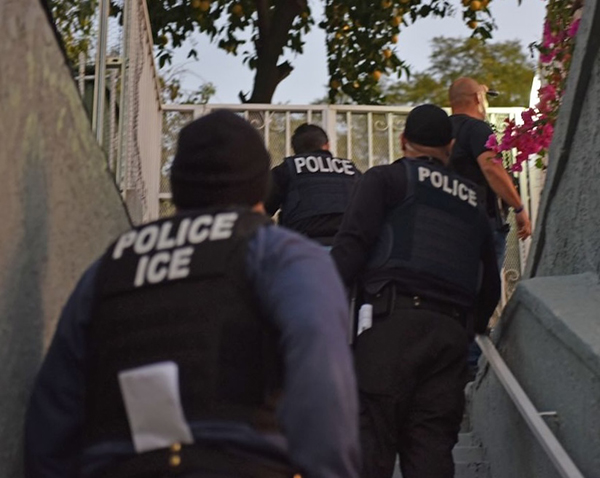
In about one quarter of the incidents analyzed, Immigration and Customs Enforcement or Customs and Border Protection agents were masked, and in about the same proportion agents were driving unmarked cars.
Moreover, ICE has deliberately deployed white nationalist and vehement anti-immigrant messaging in its recruitment efforts. Lackluster screening has also led to the hiring of recruits with documented behavior or mental health issues, including David Brouillette, who killed 26-year-old Joan Sebastian Guerrero in Maine on July 13.
According to Brouillette’s own family and friends, he has a long history of mental health struggles as well as aggressive and abusive behavior.
“They’re going to kill someone,” Bell wrote in her notes — presciently, as it turns out — well before events in Minneapolis led to the deaths of U.S. citizens Alex Pretti and Renée Nicole Good.
The report includes specific and practical recommendations:
- • Dismantle the national immigration policing force (ICE and CPB) which is too large to make it accountable. In its place Congress should create an Immigration Management Agency focused on improving community life and preserving the U.S. economy which relies heavily on immigration.
- • Develop and reliably implement clear rules for processing immigration cases and create a pathway to citizenship for millions of longstanding settled immigrants.
- • Limit participation of state and local government in immigration enforcement and take measures to prohibit commandeering of state resources by the federal government (as was done in Los Angeles and Washington, D.C., for example.)
- • Pass state legislation to authorize civil suits against federal, state and local officials who violate individual’s civil rights.
“In countries experiencing authoritarianism, the loss of basic freedoms grows so widespread that it grows less poignant,” the authors warn, noting that even as the scale of immigration enforcement attacks escalates, tracking them becomes more difficult. “It is a fact of life, obscured or ignored, rather than protested.”
Edward Kissam writes for American Community Media.