THE HUTCHINSON REPORT: Hiding homeless are hard to count, track and care for

By Earl Ofari Hutchinson
Contributing Columnist
You won’t see them from the Harbor (110) Freeway. You also will not see them from the street that runs next to the freeway. But they are there.
“They” are the unhoused. How they manage to evade public view, public scrutiny and enforcement of the anti-homeless encampment sweeps and removal presents another troubling dilemma in the ongoing battle against homelessness.
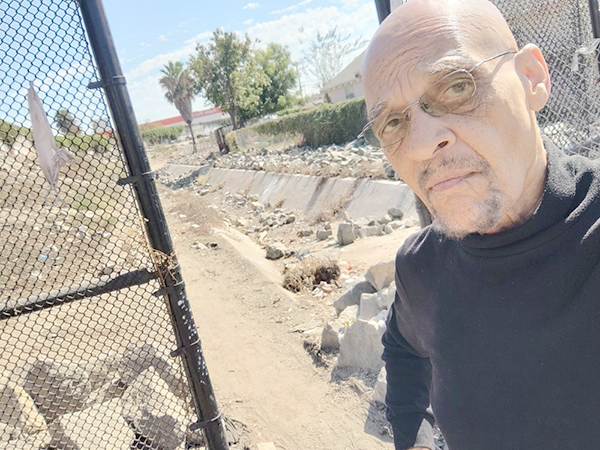
On a recent day, I walked down a dirt trail cut through the rocks and pavement by the freeway near Manchester Boulevard .in South Los Angeles. I had earlier seen several people cutting through the fencing, so I was curious.
By the side of the trail there was a huge scattering of garbage, junk, assorted household items, furnishings, tires and broken bikes. A short distance away there were several makeshift tents and battered shelter overhangs. The occupants were busily moving a few worn items around.
It was a hidden encampment. And it was not unique.
There are more than a few of them scattered throughout South Los Angeles. They pose added headaches for city officials.
The most worrisome is that the hidden encampments are just that: hidden. They do not show up in any of the standard counts of the homeless. Thus, it is impossible to get anything that even remotely resembles an accurate count on how many homeless people there are in the city and where they are located.
This is not a small point. If there are many unknown and uncounted unhoused that makes it nearly impossible to provide needed services, aid and shelter for them. It also poses an added safety danger for residents who live within a stone’s throw of the hidden encampments.
Law enforcement is often left totally in the dark about these encampments and is unable to provide patrols, monitoring, surveillance, and when necessary, the removal of the encampments.
The problem and the danger cut both ways. The unhoused who tuck themselves out of sight and out of mind of city officials, do it with the often forlorn and false hope that their inconspicuous hide out gives them a protective shield from violence, arrest and removal. That rarely is the case.
They will not remain hidden for long. Residents will report on their presence, and law enforcement will eventually intervene. That often means arrest as a nuisance or for disturbing the peace.
The hidden unhoused often face the possibility of having a criminal record, court dates and fines, or incarceration. That could render them ineligible for various types of needed assistance programs.
That also can make them ineligible for jobs. There are cases where they have been denied housing vouchers. Often, they can’t be located to provide them with housing vouchers. That virtually guarantees their continued slide back to the streets.
Then there is race. Numerous surveys find that African Americans, Hispanics, and other minorities are those most likely to be displaced or removed. But the burden falls especially heavy on African Americans.

A 2022 survey by the U.S. Department of Housing and Urban Development found that nearly 40% of those displaced and removed were African Americans. A 2017 American Journal of Preventive Medicine study found that Black and Hispanic women were far more likely to experience housing insecurity, housing instability and food insecurity.
That affects in greater numbers those that choose to hide out in the hope of avoiding many of the problems that confront the reported unhoused.
It’s no coincidence the number of hidden unhoused climbed in the last two years. That can be laid squarely on the mandate from California Gov. Gavin Newsom. In August 2025, with much fanfare, Newsom announced the formation of a task force to clear out the homeless encampments in California’s 10 biggest cities.
Los Angeles topped the list. The special targeted areas were encampments on state property, such as along highway medians or freeway on and off ramps, and under overpasses. Los Angeles Mayor Karen Bass applauded the state’s initiative.
“Homeless encampments, debris and graffiti located on highways and freeways are under state jurisdiction,” she said in a statement. “I am glad that the governor is continuing action to collaborate with local efforts. Los Angeles has bucked nationwide trends of increasing homelessness and Governor Newsom’s announcement of a task force today will help keep that momentum.”
The ancient problem though with Newsom’s task force was that once the known encampments were dismantled where would the unhoused go? The housing, services and support funding and resources were finite and often tied up in a hopeless tangle of confusion and mismanagement. That works against getting as many of the unhoused as possible into a safe shelter, as well as getting the help they needed to stay there.
This intractable flaw ensures that many unhoused will take matters into their own hands. They will seek and find a place tucked away that they hope will give them some sense of security and well-being.
That’s exactly what it appeared the occupants that camped out near the nearly hidden dirt trail I walked down hoped for. Sadly, there are a lot more of them living unhoused and hidden that desperately hope the same.
Earl Ofari Hutchinson is an author and political analyst. His forthcoming book is “The Garbaging of America” (Amazon ebook and Middle Passage Press).