By Darlene Donloe
Contributing Writer
WATTS — The barbershop where the movement met, the church that hosted the after-school program, the living room where a record was cut. The city of Los Angeles wants to know where they are.
On Sept. 12, from 2 to 5 p.m., preservation officials will trade City Hall for Phoenix Hall at the Watts Labor Community Action Committee, 10950 S. Central Ave., to ask residents to map Black history themselves as part of the first of three community talkbacks for the African American Historic Places Los Angeles update, a joint effort of the Getty Conservation Institute and L.A. City Planning’s Office of Historic Resources.
The afternoon will include music, fellowship and refreshments. The real agenda is memory.
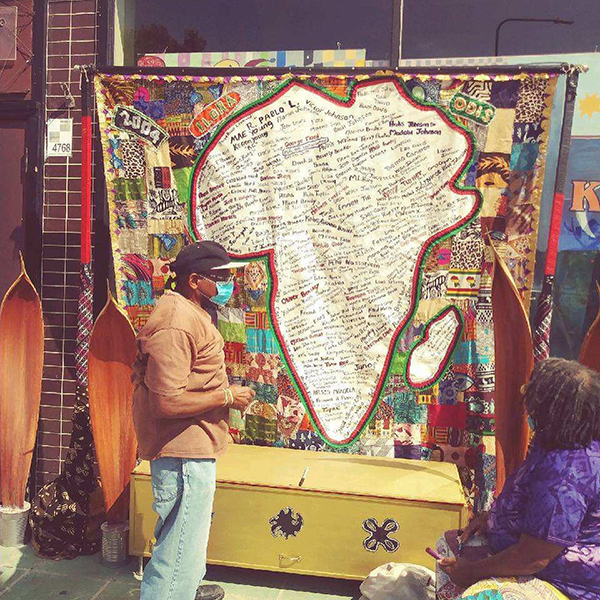
Residents will help identify lived experiences, cultural landmarks and neighborhood histories that have shaped Black Los Angeles through storytelling and collective memory.
“We chose WLCAC because we wanted a location that was important to the community,” said Sarah Corder, vice president and principal architectural historian at South Environmental, the firm co-leading the update. “WLCAC has such a wonderful history in Watts.”
Historic context statements are concise documents that help identify and evaluate historical resources by focusing on how geography, history and culture influenced a community’s development.
Los Angeles’ Citywide Historic Context Statement is the result of SurveyLA, which surveyed nearly 880,000 parcels.
It includes 10 culturally focused contexts: African American, Asian American, Chinese American, Filipino American, Japanese American, Korean American, Thai American, Jewish history, Latino history, LGBT, and women’s rights.
The African American context was last completed in 2018.
“The story isn’t finished — and some parts haven’t been fully told,” said Rita Cofield, associate project specialist at the Getty Conservation Institute, who is leading the project for Getty.
Born and raised just outside Watts, Cofield joined Getty in May 2022 to lead its African American Historic Places Los Angeles. She describes the context as a framework.
“It gives you an idea of how to identify historic sites in Los Angeles through a framework, through the African-American lens experience,” Cofield said.
That lens, she said, is not a monolith.
“Attendees will have an opportunity to share stories that they may have only shared in the context of their families, or churches,” she said.
“Not everybody is a native of Los Angeles, so they bring in the migration experience,” Cofield said. “My parents were from Mississippi and Texas. The African-American experience is not a monolith.”
Asked why it has taken until 2026 for the city to expand Black preservation beyond Central Avenue, Los Angeles City Councilman Tim McOsker, who represents Watts, said, “Los Angeles has an incredibly rich Black history, and so much of that history lives in Watts.”
In a statement released by his office, McOsker said, “We can’t speak to why the Planning Department recognition did not come sooner or what efforts may have been made before Councilmember McOsker took office. Since taking office, he has been determined to make sure Watts gets the attention and investment it deserves. Preserving the places that tell the story of Watts is an important part of making sure that history is recognized and carried forward for future generations.”
Corder, from Playa del Rey, has been with South Environmental for three years and in the field for 20 years.
She supervises the team writing the document and leads engagement with NOMMO Cultural Strategies. NOMMO is a Black-owned, award-winning, certified minority-owned firm with experience advising leading cultural institutions and global brands.
She said all ethnic contexts are complex to research.
“It’s very difficult to research any type of ethnic history because a lot of history was written honestly by white people.” Corder said. “And the history is oftentimes lost through people who have passed away in the communities.
“One document to capture absolutely everything important in Los Angeles’s Black community would have been impossible.”
The 2018 statement stopped at 1980. That cutoff is standard in preservation — the 45- or 50-year mark when things are generally considered historic. The current update will push further.
“When we took on this project, it was really important for us to expand it at least into 1992 because we wanted to make sure that the uprising in ’92 was captured because it was such an important cultural touchstone,” Corder said.
That expansion opens new themes: modern music including West Coast rap, first responders including firefighters and LAPD history, legal organizations, sports, and environmental injustice.
“This African-American context document is new information,” Cofield said. “For instance, sports is not in that document. When people talk about Watts, they talk about it from the flashpoint of the rebellion. There is so much more.”
If the talkback results in one new historic-cultural monument in Watts, McOsker said when it comes to deciding what it should be, he will yield to the judgment of the community.
“We have a few historic-cultural monuments in Watts including the Watts Towers, Watts Happening Cultural Center (aka Mafundi Building), and the Watts Train Station,” he said. “For any others, our office would want the community to help answer that question. The people of Watts know which places carry the history that deserve to be preserved, and this process should be guided by their voices.
“At the same time, our office is working to expand the Cultural Crescent in Watts that will connect and celebrate the community’s important cultural institutions and creative spaces,” he added.
The existing document includes the California Eagle, Black radio stations, recording studios out of people’s homes, newspapers, and themes of medicine and entertainment, but the team wants to expand on them.
“Watts is such an important community because it has such a strong history of people coming to settle there during the Great Migration, but also fighting for what they needed about public services, safety,” Corder said. “A lot of what we see in Watts became a catalyst for things that spread across Los Angeles.”
Asked what Watts reveals that West Adams or Pacoima might not, she said: “One thing that we are diving into in Watts is how this idea of survival was critical and how the resistance — ‘how things are not OK, and we’re going to do something about it’ — was the spirit in Watts.”
“There are just so many revolutionary things that come out of Watts, like West Coast rap being founded,” she added. “And then the Charles Drew Medical College being near Watts, and the Martin Luther King Hospital being established in Watts and creating jobs.”
Corder said the goal is not to sanitize.
“We take formal documentation, census records, newspapers, books, and we compare it with what we learn when we’re in the community because oftentimes those sources don’t have the whole story,” she said. “We are seeking to create something that is dictated by the communities that live there and not just outsiders coming in and extracting information.”
At Phoenix Hall, the team will collect what they call memory cards — where residents identify important places, people and events.
“Once we get that information, then we feed all of that into our historic context statement,” Corder said. “Then we look at some of these places. Are they still there? That’s really important for the [historic-cultural monument] designation process.”
Sharing does not automatically make a place a landmark, Cofield said. The update may identify sites, but will not pursue designation without owner support.
After Watts, two more talkbacks are planned: Sept. 26 at Lore Bookstore in Leimert Park and Oct. 10 at the Museum of African American Art in the Baldwin Hills Crenshaw Plaza.
Darlene Donloe is a freelance reporter for Wave Newspapers who covers South Los Angeles. She can be reached at ddonloe@gmail.com.