By Sunita Sohrabji
Contributing Writer
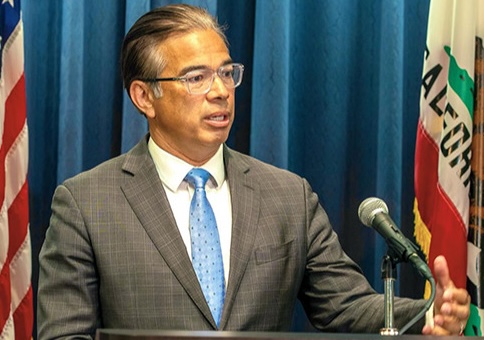
SAN FRANCISCO — California Attorney General Rob Bonta led a 22-state coalition which filed a lawsuit Sept. 14 aiming to block the Trump administration’s new public charge rule.
The administration was set to begin implementing the new rule Sept. 18, dramatically expanding the ability of immigration officials to use participation in means-tested public benefits programs as grounds to deny lawful permanent residency. Even before the new rule drops, thousands of Californians — especially those in mixed status families — have disenrolled from benefits for which they are eligible.
“No family should have to choose between accessing health care and nutrition assistance today — or protecting their pathway to a green card tomorrow,” Bonta said in a press statement announcing the lawsuit “The Trump administration is seeking to rewrite more than 100 years of law with its expansive new definition of who is considered a ‘public charge.’”
”In doing so, it is providing individual immigration officers with the discretion and power to punish families for lawfully accessing certain public benefits programs during short-term periods of need. This administration’s cruelty continues to know no bounds,” Bonta added.
Santa Clara and San Francisco counties also have joined the lawsuit. New York Attorney General Letitia James, and Illinois Attorney General Kwame Raoul joined Bonta in leading the multi-state coalition. The lawsuit was filed in the U.S. District Court for the Southern District of New York. The litigants characterize the new public charge rule as “arbitrary and capricious.”
At an American Community Media news briefing Sept. 9, state officials, community organizations and immigration rights activists discussed the stake for Californians as the public charge rule is implemented.
“The public charge test is going to be much more subjective,” said Ariel Brown, an attorney with the Immigrant Legal Resource Center. “It creates confusion and a chilling effect.”
The rule does not apply to everyone seeking to change immigration status to permanent residency, Brown said. Refugees, asylees and certain humanitarian immigrants are among those exempt from the public charge ground of inadmissibility. Lawful permanent residents applying for citizenship also generally are not subject to the test. And people applying to renew their green cards are also not subject to public charge.
But for families with a green-card application pending or planned, the stakes can be substantial, Brown said. She encouraged prospective applicants seeking a green card to file before Sept. 17, since the rule will not be applied retroactively.
Undocumented people who do not currently have a pathway to legal permanent residency are unlikely to be impacted, said Sarah Dar, vice president of policy and advocacy at the Children’s Partnership. All speakers stressed that undocumented immigrants are ineligible for federal public benefits.
More than one million California children are estimated to have one undocumented parent, and over one in four children in immigrant families are U.S. citizens with only one non-U.S. citizen parents, Dar said.
The new regulation allows immigration officials to consider if anyone in a household has accessed public benefits, such as the Supplemental Nutrition Assistance Program, the Children’s Health Insurance Program, Medicaid, Section 8 housing support, and other safety nets.
“So for a lot of parents and families, the huge concern, is, ‘I have a U.S. citizen child or a child that’s eligible for a means-tested service, and I’m concerned that their use of the benefit is going to impact my immigration case,” Dar said.
According to a report released in April by Stanford University, more than two in three California parents surveyed (67%) were concerned that immigration enforcement activities could affect their family’s participation in child care. The data were similar among immigrant parents (71%) and non-immigrant parents (64%).
About one in 10 California parents surveyed (9%) said their child missed at least one day of child care in the past month due to concerns about immigration enforcement in their community, according to the report.
Brown noted that a child’s use of benefits cannot alone determine public charge ineligibility for a green card. But it can be used as one of several factors in a more comprehensive picture.
A previous version of the public charge rule prohibited Department of Homeland Security officers from looking at benefits used by children or other family members who were not applying for change of immigration status. That protection is now gone, said Adriana Cadena, executive director of the Protecting Immigrant Families Coalition.
“This second Trump administration has again weaponized public charge rule to destabilize immigrant families and to corner them and their U.S.-born children into deprivation,” Cadena said. “It opens the door for the green card process to be based on partisan politics and even personal bias by DHS officers.”
“The real threat that we see is an attempt to deter immigrant families from accessing benefits,” Cadena said. “This new public charge policy is intended to force families to choose between applying for a green card, even now or in the future, or accessing basic needs that they need, like health, like food, rent, and health care. And we know that the consequences are severe;”
The state is stepping in, said Daniel Torres, chief equity officer and special counsel at California Health and Human Services. He noted that the state plans to provide information through trusted messengers, including community-based organizations, faith leaders, schools and workers with the Women, Infants and Children program. The state also is aiming to connect families with state-funded legal services.
“The biggest challenge is that the chilling effect reaches entire families, including U.S. citizens in mixed-status households,” he said.
Torres cited the case of a mother who is undergoing chemotherapy, but is afraid to enroll in Medi-Cal because of fears of impacting her family’s eligibility for legal permanent residency.
“The vagueness and discretion in this rule means that when someone has an adverse decision, it may not be transparent which factor led to that denial,” Torres said. “It could take years for us to really understand how this rule is being implemented.”
The faith-based community is also stepping in to fill gaps for people who have already dropped off benefits because of fear of invoking public charge, said Cheryl Branch, executive director of Los Angeles Metropolitan Churches.
“We’re helping with rides to dialysis, prescription copays, blood pressure cuffs, food pantries, cooking programs, home cooking,” Branch said. “Food is front line.”
The Black diaspora is often left out of conversations on public charge, but they are no less impacted, said Branch, noting that roughly 22% of the population served by the churches in her network are from diaspora communities. Those include immigrants from Nigeria, Belize, Ethiopia, Jamaica, Haiti, South America and Kenya.
“For us, public charge is a community story, not just an immigration story,” Branch said.
Several of the speakers encouraged people to consult with attorneys before dropping off benefits. A list of nonprofit organizations qualified to assist individuals is available on the California Department of Social Services website.
Sunita Sohrabji writes for American Community Media.