By Sunita Sohrabji
Contributing Writer
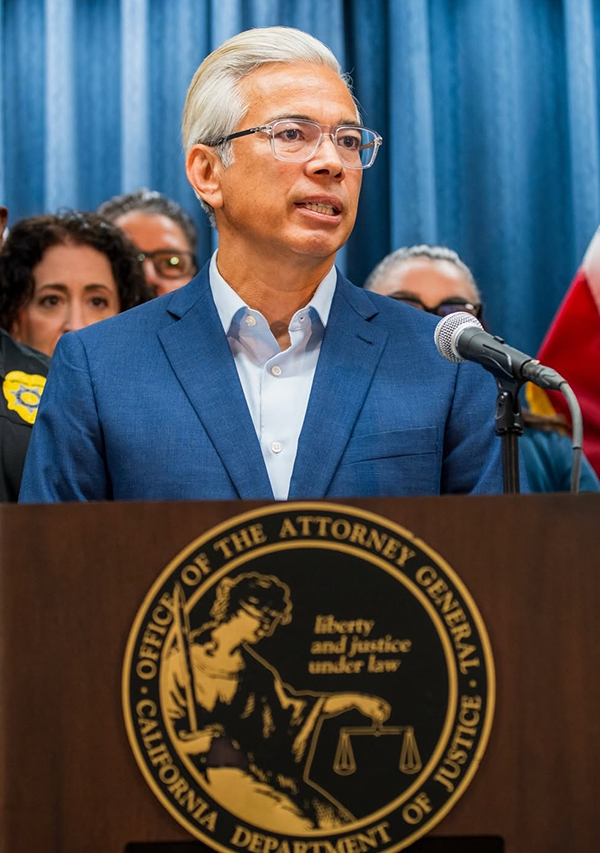
SACRAMENTO — California Attorney General Rob Bonta expressed confidence Sept. 24 in winning a lawsuit he and a 22-state coalition have filed to prevent the implementation of the Trump administration’s public charge rule.
The Trump administration began implementing its new public charge rule Sept. 18. The rule dramatically expands the ability of immigration officials to use participation in means-tested public benefits programs as grounds to deny lawful permanent residency. Even before the new rule drops, thousands of Californians — especially those in mixed status families — have dropped out of benefits for which they are eligible, fearing impact to their immigration status.
“I’ve said this before and I’ll say it again here: we’re confident in any court,” said Bonta, speaking at an American Community Media news briefing. “We believe we have the facts and the law on our side.”
He noted a recent victory Sept. 14, in which the Supreme Court issued an injunction denying the Trump administration’s request to stay a preliminary injunction blocking key parts of a new U.S. Postal Service rule on mail ballots.
“So we feel confident in any court,” Bonta said. “It’s very possible that this case, more likely than not, gets addressed without going to the U.S. Supreme Court. But if it does, we feel confident because this is an action taken by the federal administration.
“If you just look at the law and apply it to the facts, we should prevail, and that’s what the U.S. Supreme Court should be doing,” Bonta added. “And if they do that, which they should, we believe we’ll win.”
The new rule impacts immigrant parents of U.S. citizen children, noted the Attorney General. “If a child is a U.S. citizen but their parents are not, under this rule, the benefits that child lawfully receives can be held against their parents.”
“The administration wants to punish immigrant families for using benefits that their children are completely legally entitled to,” Bonta said. “Congress never intended or authorized immigration officers to have unchecked discretion to deny someone legal status for using government programs, but that’s exactly what this rule gives them.
“That’s why we’re asking the court to strike down this unlawful rule and guidance that comes with it because no one is above the law, not even the president.”
“This rule could affect millions of families, U.S. citizens and non-citizens alike,” Bonta added. “When you tell families that getting help with groceries, health care, rent could be used against them in an immigration decision, people stop getting the help they need. They stop getting groceries, health care and rent.”
The attorney general was joined by California Health and Human Services Secretary Kim Johnson.
“All across California, there is so much fear, so much concern, so much thinking about what this means for people individually, and for their family, in terms of health, access to food supports and other resources within our broader health and human services safety net,” Johnson said. “And we know that this is very much intentionally chaotic.
The Trump administration implemented a slightly different version of public charge in 2020, the last year of President Donald Trump’s first term. The Biden administration then narrowed the scope of public charge.
Johnson spoke about the implementation of the rule in 2020.
“In our previous experience with public charge, we did see a very significant chilling effect,” she said. “People who were eligible and able to access critical basic need services were disenrolling or not applying for them out of fear.”
”And that’s our big challenge that we have in front of us, is to really make sure that with this public charge rule, people understand that it does not apply to all immigrants,” Johnson added.
The rule does not apply to everyone seeking to change immigration status to permanent residency. Refugees, asylees and certain humanitarian immigrants are among those exempt from the public charge ground of inadmissibility. Lawful permanent residents applying for citizenship also generally are not subject to the test. And people applying to renew their green cards are also not subject to public charge.
Critically, undocumented people who do not currently have a pathway to legal permanent residency are not impacted by public charge.
California state has rolled out a robust set of initiatives designed to help people impacted by public charge, and — concurrently — the GOP’s spending package, HR 1, approved last year, which rips almost $1 trillion from the Medicaid/Medi-Cal budget and $187 billion from the Supplemental Nutrition Assistance Program over the next eight years.
The California Department of Social Services has posted a guide to help people with public charge related immigration questions. Johnson encouraged people to use the list provided by the department, to avoid the risk of getting scammed by private individuals purporting to be attorneys.
“Before an individual makes the terribly hard decision to disenroll [from] resources like health care access and food, we highly encourage them to access and consult with a trusted expert to figure out if public charge applies to them and their specific circumstances,” Johnson said. She noted that the state has already seen a dropoff in enrollment for critical safety net programs, because “people fear being seen by the system.”
The state has also invested in navigators, community health workers, and promotoras. It has launched the 988 hotline to help folks in the state who are struggling with mental health challenges.
Personal information shared with the state for benefits enrollment is safe, Johnson said.
Turning her lens to the impacts of HR1, Johnson said that emergency room visits across the country are expected to rise, as ERs become the last bastion of care for people losing health insurance coverage. The state has lost billions of dollars because of federal budget cuts, she said, noting that 58% of the state’s Health and Human Services Department’s budget is federal dollars.
“We can’t possibly mitigate it all just by simply backfilling with state dollars,” Johnson said. “So yes, people will begin experiencing the impacts of this policy above and beyond the public charge experience,” she stated.
Affordable Care Act enrollment has dropped by 3 million across the country as of June 2026, noted a report by KFF. Vice President JD Vance recently noted that 760,000 people who — he claimed — were fraudulently enrolled in ACA coverage have been dropped from their plans. Another 419,000 have been flagged for review.
Sunita Sohrabji writes for American Community Media.