Residents fighting data centers face tough foe in city of Industry
Community groups opposed to the projects face an economic powerhouse seemingly unaccountable to nearby residents

Contributing Writer
LOS ANGELES — Falynn Love met her husband 25 years ago at the Puente Hills Mall, a place best known as a filming location for the 1985 movie “Back to the Future.”
Today, Love is fighting to preserve the largely vacant, 1970s-era retail center in the city of Industry, about 15 miles east of Los Angeles, as a third space for the community, and to stop plans to turn the site into a massive industrial complex with two large warehouses, a new bus transit station and a 10-megawatt data center.
Those plans have sparked fierce opposition among residents of the San Gabriel Valley, where a diverse coalition of community groups across an array of predominantly Latino and Asian suburbs has mobilized to try to stop a series of proposed data centers over concerns they will worsen the area’s air quality and noise pollution and hike residents’ utility bills.
“We’re going to be bearing the cost of these kinds of projects,” said Love, who joined the fight after learning about plans for the Puente Hills Mall when attending a neighborhood meeting in Rowland Heights, an unincorporated community just across the street.
As with many residents in the coalition, the issue impelled Love to get involved in activism for the first time.
“It doesn’t matter what race you are, what background, what religion,” Love said. “Everybody is standing for the same thing, and it’s community, it’s people, it’s environment.”
The San Gabriel Valley has become a hotbed of opposition to the building of data centers for artificial intelligence, part of a nationwide backlash uniting communities across demographic groups and political parties — a Gallup Poll earlier this year found seven in 10 Americans oppose construction of data centers in their area. Community groups have notched victories across several cities in this region of nearly 2 million people, including in Monterey Park, which in June became the first city on the nation to pass a voter-approved ban on data centers.
But community efforts to block data centers have come up against a formidable obstacle in the city of Industry, a sprawl of industrial warehouses and commercial manufacturing centers that snakes across 12 miles of the San Gabriel Valley. Though it borders a dozen communities from El Monte to Diamond Bar, with just over 200 residents, it’s a municipal oddity that has faced legal challenges faced since its incorporation in 1957.
Public records obtained by community groups and reviewed by Capital & Main show city of Industry officials have been discussing data center proposals with developers in recent years — the largest of which is the plan for the Puente Hills Mall site. Activists say there are few means by which residents of surrounding communities can protect themselves from the impacts because the city has few actual constituents and its leaders are unaccountable to nearby residents who could be harmed.
“Residents and surrounding communities are really disadvantaged by the fact that this unaccountable city exists,” said Samuel Brown-Vázquez, an organizer with No Data Centers San Gabriel Valley.
A city of Industry spokesperson reached by Capital & Main said the city has not approved plans for a data center but declined further comment for this story.
Data centers, large industrial facilities that house computer servers to store, process and transmit digital information used by artificial intelligence, cloud computing and other digital services, require large electrical systems, enormous amounts of water for cooling equipment and other resource-intensive infrastructure.
As technology becomes more reliant on these services to feed AI-powered search engines and chatbots, data centers are rapidly expanding nationwide, but so is community resistance, as residents raise concerns about the environmental and health impacts of the resource-hungry facilities and their effects on electricity and water rates.
“I couldn’t believe that a data center was going to be built within a five-minute walk of my house,” said Steven Kung, co-founder of No Data Center Monterey Park and a candidate for the Monterey Park City Council.
“It didn’t sit well with me because data centers usually get built in rural communities or deserts, and there was this cognitive dissonance in a data center coming to such a housing-dense area,” Kung said. “It felt like environmental racism.”
Monterey Park, a predominantly Asian and Latino community of about 57,000 people just a few miles west of the city of Industry, has been leading the local data center resistance.
After fierce community backlash, the Australian-owned investment firm StratCap pulled its plans for a 247,000-square-foot data center in the city.
Grassroots canvassing, social media campaigns and protests led to a temporary moratorium and eventually a city ordinance, which paved the way for a ballot measure. In June, 86% of residents approved Measure NDC, becoming the first city in the nation to pass a ban on data centers.
“It feels very empowering in a time when people feel powerless,” Kung said.
No Data Centers San Gabriel Valley, a coalition of residents, activists and at least six community organizations from across the San Gabriel Valley, has used similar tactics in El Monte, Montebello and Baldwin Park, where city councils adopted temporary moratoriums on data centers, and Alhambra, where a citywide ban is on the November ballot.
But there’s a 12-mile-long obstacle to community groups’ aspirations to keep data centers out of the San Gabriel Valley.
Data center opponents in the region are now turning their attention to the city of Industry, where they know that going up against a city with so much power yet so few residents or oversight will require new strategies.
“Those of us in unincorporated L.A. County are going to get stuck with the impacts — the public health impacts, the adverse environmental impacts — and there is no remedy and no recourse or enforcement mechanism at this juncture,” said Brown-Vázquez, the organizer with No Data Centers San Gabriel Valley.
The city of Industry is an industrial powerhouse with 92% of its land zoned for industrial use and 8% for commercial use.
But with a population of 210, it is one of the least populous cities in California according to a 2024 estimate by the U.S. Census Bureau. Residents of El Encanto Healthcare and Habilitation Center, a skilled nursing facility that was once a provate mental institution, even comprise some of the current voting population.
Activists say the City Council operates with little accountability from the small residential population. A City Council election hasn’t been held since a 2020 recall, which was the first election in nearly 20 years.
Brown-Vázquez is a resident of Avocado Heights, a designated SB 535 Disadvantaged Community and unincorporated area encircled by the city of Industry. His sister has cancer, which he believes could stem from their proximity to underregulated industrial activity.
Multiple environmental concerns have arisen over the city of Industry, including groundwater contamination from a former Benchmark Technology facility and lead contamination and from the Ecobat battery recycling plant.
“City of Industry is really an anomaly in terms of municipalities within the state of California in that it’s almost completely exempt from a lot of the safeguards that should theoretically exist,” Brown-Vázquez said.
In February, the Industry City Council voted to change zoning laws to allow Battery Energy Storage Systems allow and data centers virtually everywhere in the city.
“The city is shaped like a tapeworm, basically snaking throughout the San Gabriel Valley along the [Pomona] Freeway,” Kung said.
“By rezoning and allowing for data centers and battery energy storage systems, these dangerous entities … could touch almost every city in the [San Gabriel Valley[,” Kung added.
BESS systems can provide a reliable power supply to the grid, but potential risks include lithium battery fires include and health effects from harmful gases released in such fires. Data centers operate around the clock and often rely on battery storage systems for a consistent energy supply.
“It’s clear this is 100% a necessary part of the infrastructure to build out and increase the load capacity to accommodate data centers,” Brown-Vázquez said.
While the city of Industry said it has not approved plans for a data center, public records show city officials discussed potential building sites with developers, including at the Puente Hills Mall site, the site of the former Alfred S. Madrid Middle School and the Industry Business Center building 10, before changing zoning laws.
Public records reviewed by Capital & Main include a December email discussing substation power for the Industry Business Center building 10. In it, Industry City Manager Joshua Nelson wrote, “I think we should just bank/count/gamble with it being a data center and we will find a user that will use the power.”
A representative for Raeden Inc., the company that proposed the data center, told Capital & Main that “Raeden is not currently pursuing a project in the city of Industry. We were previously exploring a site in the area, but are not actively moving forward at this time.”
Brown-Vázquez said the city of Industry has not been transparent with the public about its data center discussions and has tried to suppress information by not providing interpreters or filming public meetings and by making it difficult to submit public comment.
In March, dozens of residents from neighboring communities across the San Gabriel Valley lined up to give public comments at a City Council meeting. They were told to fill out a comment card by 9 a.m., but public comments were pushed to the end of the meeting after the city held an hourslong closed session.
“They’re doing that specifically to try to dissuade people from speaking,” said Brown-Vasquez, while outside the council chambers. “This is how they operate. It’s part and parcel of their operations.”
“We might not live in the city of Industry, but we are stakeholders, and we deserve the opportunity to be able to weigh in and to submit comments,” added Brown-Vázquez, who has filed multiple Brown Act violations against the city.
The city of Industry is one of “the Big 4 industrial cities in L.A. County, alongside Commerce, Vernon and Santa Fe Springs, which together comprise 24% of the county’s industrial space and market themselves as attractive places for investment due to low taxes and fees, permissive zoning and other business-friendly policies.
“Nowhere else in Southern California — or the entire West Coast — will you find this concentration of industrial power, logistics excellence and business opportunity,” the consortium promoting business investments states.
The city of Industry has roughly 3,000 businesses employing over 68,000 people and generating over $31 billion annually in total sales in a city with only a few hundred residents.
With few city residents reaping those economic benefits, Brown-Vázquez said he wants to know where all the money is going.
The city of Industry had much higher per-capita revenue, over $300,000 per resident, in fiscal year 2024 compared to under $2,000 per resident in neighboring cities like El Monte and La Puente, according to data from the California State Controller’s Office.
The Marici BESS project, a 400-megawatt battery storage facility that will connect to Southern California Edison’s electric transmission system, was approved by the city in February. This project is anticipated to generate $6 million in community benefit fees and around $3 million in project sales and use tax revenue, according to a community benefit agreement reached between the city and the developer.
“We’re supposed to be the beneficiaries of investment,” Brown-Vázquez said, adding that the revenue generated from industry should be invested back into the neighboring communities.

The city of Industry has been the center of several corruption scandals where city business investments were used to siphon money, including by former Mayor Dave Perez and former City Manager Paul Philips. Despite multiple efforts by the state at regulating activity there, the city remains an industrial powerhouse.
New legislation co-sponsored by the Big 4 could further perpetuate the city of Industry’s power in the San Gabriel Valley, Brown-Vázquez said.
Introduced in February by state Sen. Bob Archuleta of Norwalk, and signed by Gov. Gavin Newsom in September, Senate Bill 1274 establishes “industrial cities” as an official definition in state code for programs, policies and funding.
Archuleta said in an interview that industrial cities are burdened with heavy traffic from commerce and the large influx of a daily commuter workforce. Street infrastructure projects in those cities are underfunded by the state, he said, and clearly defining industrial cities in state code can give them a pathway to advocate for more transportation funding.
“This is our way of saying thank you for making California the economic hub that it is,” Archuleta said. “If we’re going to turn the tide, and bring in labor, and bring in new development and new opportunities to maintain our fourth-largest economy status, this is how we have to do it.”
Brown-Vázquez believes this blanket designation could lead to future exemptions for industrial cities, which he said already operate with few regulations or concern for the environmental well-being of neighboring communities.
No Data Centers San Gabriel Valley is working to apply pressure on the city of Industry through regional joint power associations by asking school districts to pass resolutions and by calling on county and state officials.
“They need some pressure put on them to understand that their decisions impact a lot of communities,” Love of Rowland Heights said about the city of Industry.
“Why doesn’t L.A. County or the state of California come down on some of these [industrial] cities? Why are they just allowed to be reckless with the surrounding community bearing the brunt of that?” Love asked.
Several new state laws are imposing new requirements on water use, electricity costs, land use and local oversight for data centers. Despite previously vetoing such legislation, Newsom recently signed comprehensive laws aimed at regulating the data center industry.
L.A. County Supervisor and Board Chair Hilda Solis, who represents the San Gabriel Valley, heard the calls of her constituents and introduced a motion in April to address the health and environmental impacts of data centers.
At the Board of Supervisors meeting, county officials cited numerous health concerns related to data centers, noted strains on the electric grid infrastructure and consumer utility rates, raised concerns about the strain on water consumption, and said fire and zoning codes have not been updated with clear regulations for the new type of data centers being proposed.
Despite these alarms, Solis received pushback from colleagues, such as Supervisor Lindsey Horvath, who called data centers a “21st century reality.”
Supervisors approved a watered-down version of Solis’ motion, directing county departments to conduct a comprehensive study of the potential public health, environmental and community impacts of data centers, without implementing the proposed moratorium on new builds in unincorporated areas.
After further analysis, the county Department of Regional Planning provided recommendations for managing data centers and, in September, issued a temporary moratorium on hyperscale data centers in unincorporated communities.
The ban could become permanent under a recent motion from Solis. County supervisors were scheduled to vote on the measure at a meeting Oct. 6 but Solis pulled the item from the agenda.
In a statement, Solis said that she postponed her motion to allow more time to address “issues raised by our labor partners and ensure we have a strong policy that reflects the needs of our residents and workers.”
Solis said her staff had heard from other board offices about “concerns raised by the unions and the trades about protecting good-paying jobs and ensuring workers are not left behind as this industry grows” and said that those concerns “deserve careful consideration.”
In any case, such prohibitions will not protect residents from projects in the city of Industry and other incorporated cities.
Meanwhile, the San Gabriel Valley’s coalition of data center opponents is continuing to educate residents about the dangers of encroaching data centers with teach-ins, art builds and demonstrations.
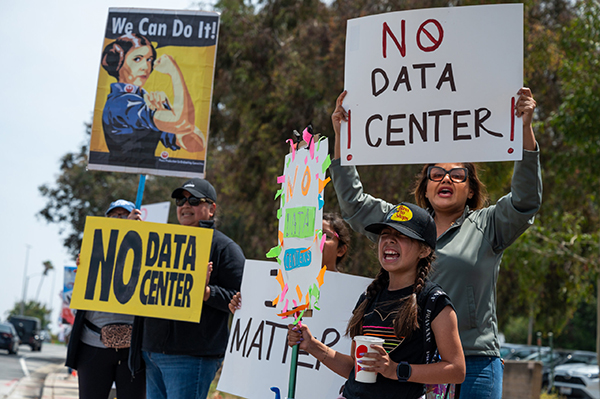
In May, dozens of residents from diverse backgrounds and communities rallied at Peter F. Schabarum Regional Park across the street from the Puente Hills Mall to protest the proposed data center. Another rally is set for Oct. 18
“I’m sick of being sold out by our politicians. These spaces should be for the people that are surrounding it, for the communities, not to be lining their pockets for their own business and profit,” said Alicia Contreras, a resident of La Puente who was attending her first demonstration with the coalition.
“I’m also looking for community,” she added as one of her reasons for protesting. “I just see so many people that don’t look like me, and it’s surprising. I didn’t know that we were all here.”
Semantha Raquel Norris writes for Capital & Main, a Los Angeles-based nonprofit publication focused on inequality. It is published here with permission.