By Joe W. Bowers Jr.
Contributing Writer
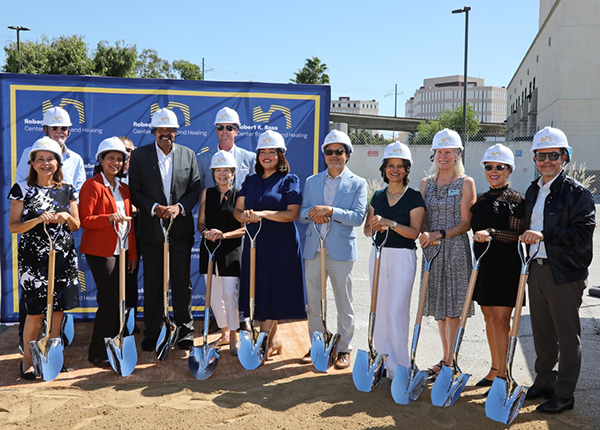
LOS ANGELES — The California Endowment and nonprofit developer Linc Housing broke ground Oct. 6 on a downtown campus combining affordable housing, health care and employment services near Men’s Central Jail, where numerous investigations and oversight reports have documented overcrowding, unsanitary conditions and violence.
Established in 1996, the California Endowment is a private, statewide health foundation focused on improving the health and well-being of Californians, particularly in underserved communities.
The Robert K. Ross Center for Hope and Healing is named for Robert K. Ross, who led the endowment as president and CEO for 24 years before retiring in 2024. His work emphasized how housing, employment and community conditions affect health.
This is the endowment’s first project combining housing and community services on its property. President and CEO Brenda Solórzano told California Black Media that an unused backlot, the neighborhood’s Hope Village vision, and money raised through the foundation’s social bond initiative made it possible.
The endowment and Homeboy Industries, a nonprofit that provides job training, employment opportunities services to formerly incarcerated and gang-involved individuals, began discussing Hope Village in 2019. Linc was selected as the developer in early 2023.
The two-acre site at 800 N. Main St. will include a 66,000-square-foot Community Care Campus and affordable apartments. Linc is developing both components. The endowment will operate the Community Care Campus, while Linc will operate the apartments, including managing applications and leasing.
Homeboy Industries will provide youth reentry services, substance-use recovery support and job training. St. John’s Community Health will provide primary, preventive and behavioral health care. Other assistance will include food, benefits enrollment and legal aid.
The campus will serve people affected by incarceration and homelessness and low-income residents of Chinatown, El Pueblo and surrounding neighborhoods.
Lupe Renteria Salome, a data analyst at USC’s Equity Research Institute and former endowment youth council member, introduced Ross at the ceremony, saying he had mentored her since she was 19.
After 27 years in the United States, including years as an undocumented recipient of Deferred Action for Childhood Arrivals, Salome said she now held an H-1B visa. She credited her workplace and mentors for their support.
“Thank you for leading with love,” she said.
Ross traced the project’s origins to the yearlong Los Angeles County Alternatives to Incarceration Work Group he chaired, which included people directly affected by the justice system.
“It’s the highest form of democracy when those that are most severely and adversely impacted by systems have their voices heard,” Ross said.
He described institutions that treated people “as a criminal first and a patient last” and urged philanthropy to respond.
“I see you in all of your humanity and all of your trauma, and I’m actually going to try and do something about that,” Ross said.
The board surprised him by naming the center at his retirement celebration.
“But it’s really what this center stands for and where it came from, and it came from those listening sessions,” Ross said. “And I reported all that out to the board. The board said we should do something about that, and here we are.”
“We know that this moment calls on the California Endowment to reimagine how we work and how we show up,” said Katherine A. Flores, the endowment’s board chair.
She said the board had directed Solórzano and the staff to pursue that work with community guidance.
“For too long, this corner of downtown told people who had been incarcerated that the jail was the last word on who they were,” Father Greg Boyle, Homeboy’s founder, said in the project announcement. “This center offers a different message.”
The apartments are intended for households earning between 30% and 60% of the area median income.
Solórzano said some apartments will be reserved for formerly unhoused applicants. She identified formerly unhoused people and people leaving the criminal justice system as the project’s priority populations.

The endowment is providing land and supplemental capital funding and will work with Linc to secure additional funding and partnerships. The Endowment’s website lists traditional debt, state and local funds, tax-exempt bonds and low-income housing tax credits as proposed financing sources.
The endowment does not have a current cost projection. Solórzano said costs had risen since planning began, citing tariffs and trade challenges.
The foundation has allocated money for initial operations and is exploring ongoing funding, including support from other funders.
“We haven’t developed the evaluation plan,” Solórzano said. “We do have money for it set aside.”
The evaluation would examine effects on residents, people using the center’s services and the neighborhood.
Solórzano said the board approved doubling the foundation’s spending for a three-year period. She described its assets as approximately $4 billion and customary annual grantmaking as about $200 million.
At the groundbreaking, she said philanthropy cannot “5% our way out” of community challenges. Solórzano told California Black Media she was referring to private foundations’ roughly 5% annual payout requirement and the need to commit additional resources.
Asked whether the center would reduce money available for community grants, she said the endowment can support both. She wants foundations to use property, investments and relationships alongside grants and hopes to see similar centers elsewhere in California.
“A grant may last a year or two. The Ross Center is intended to serve the community for decades,” Solórzano said at the ceremony.
A community advisory board is advising on design and operations. Planning for service providers’ spaces is expected in late 2026 or early 2027, with housing construction beginning in 2027. The announced schedule calls for services to open in early 2029 and residents to move in during early 2030.
Joe W. Bowers Jr. writes for California Black Media.