By Mark Kreidler
Contributing Writer
At first, Julio Godinez said, the move was obvious. His parents, living in his hometown of Hanford, California, were getting to the point where they both needed regular care, particularly his mother, who was battling cancer. Godinez, who had been working at a nearby car dealership, was the person best suited to provide it.
That was almost 20 years ago. Godinez’s mother died in 2011. By the time his father died eight years later, Godinez had come to realize, after years of doing the work, that caring for others in their own homes, which allowed those people to age in place and avoid institutional settings like nursing homes, was his calling.
“If it’s a woman I’m taking care of, I see my mom. If it’s a man, I see my dad,” Godinez, 54, said recently. “Each one, they become like family to me. I love what I do.”
Godinez speaks glowingly of the two men for whom he currently provides care. But there’s a reason that it’s two clients and not one: Godinez cannot cover even the modest costs of his life in Hanford without, essentially, a second job.
Working more than 60 hours a week, Godinez averages about $3,750 in net income each month. Even a cursory run through his monthly bills either taps out that total entirely or leaves Godinez actively in the red. With virtually no savings, he said he could not afford an emergency expense like a repair bill, and he is currently foregoing health insurance because of the cost.
Asked if he is close to living on the edge, Godinez replied simply, “I’m on it. I’m already there.”
He is not alone. Godinez, employed through California’s In Home Supportive Services program (IHSS), is one of more than 4.6 million such professional home care providers across the country. It is an employment figure that the U.S. Bureau of Labor Statistics expects to rise dramatically over the next several years, as the nation’s population continues to skew older.
California’s home health care program is by far the largest in the U.S., followed by New York, Texas, Pennsylvania and Massachusetts. But although the need for these caregivers is constantly growing, the wages in most states do not reflect that value. According to the Bureau of Labor Statistics, the median wage — half earn more, half less — is less than $17 per hour.
Godinez occupies an unusual space within California’s labyrinth of health care. He is technically employed by his own patients; his paychecks come from the state; but his wage is set locally, by Kings County officials.
Today, that rate is $17.50 per hour, barely above the state’s minimum wage of $16.90. Even by the standards of a job classification that does not pay well, it’s on the lower end among California’s 58 counties.
That reality not only pushed Godinez to take on a second client, but pushed him toward activism, which he said he hadn’t previously considered. He’s now a member of the bargaining team for the union that represents him and other IHSS workers in negotiations with the county.
“I still want to do this work,” Godinez said. “It needs to be valued.”
California created its In Home Supportive Services model more than 50 years ago, right after the passage of federal legislation allowed states to establish such public assistance programs. All 50 states, plus the District of Columbia, offer some form of paid home health care.
Its premise was and remains straightforward: Caring for elderly or disabled people in their own homes not only brings those people a greater level of comfort and security, but it’s a relative bargain when set against the state and county expense of placing them in institutional settings like nursing homes.
A state report in 2021 put the savings at between $22,000 and $153,000 per person each year. With an estimated 875,000 IHSS recipients each month, roughly half of whom would qualify for long-term institutional care, that is a potential savings of tens of millions of dollars per year.
As a Medi-Cal benefit, IHSS is funded by federal, state and county dollars. It is designed to assist people with limited incomes who are blind, disabled, medically ill or over 65. By most estimates, about three quarters of California’s IHSS caregivers are family members — the same way Julio Godinez started.
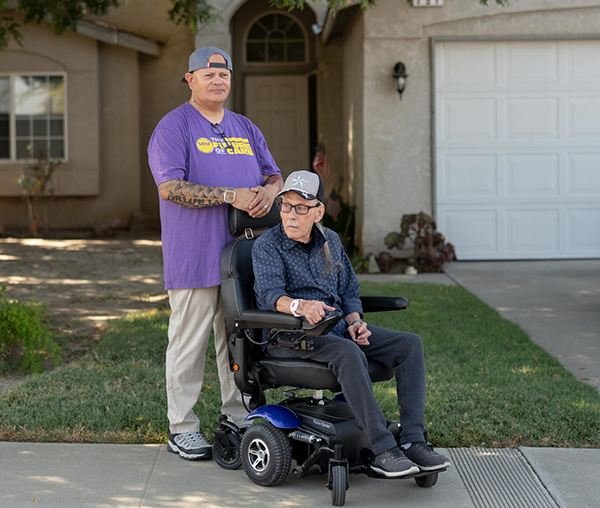
Today, Godinez cares for a 71-year-old Hanford man with severe rheumatoid arthritis, which complicates everyday tasks like bathing, cleaning, cooking and getting to and from medical appointments. Because of the need for close monitoring of his client, Godinez is a live-in caregiver, with a weekly cap of 40 work hours for IHSS purposes.
But after years of struggling — and often failing — to make ends meet financially, Godinez earlier this year added a second client, a 61-year old stroke survivor. He visits that man most days for a few hours a day, about 25 hours per week, to cook, clean and drive him to appointments.
Godinez is thus bumping up against an IHSS mandated limit of 66 hours per week for any caregiver who works with two or more clients. Even so, he often finds himself juggling bills, deciding which payment to delay.
In a typical month, Godinez said his net pay lands somewhere between $3,500 and $4,000 once taxes and other withholdings are deducted. (His 40 hours as a live-in caregiver are not subject to state or federal income tax.) It is gone almost before he can count it.
Although he stays overnight at his primary client’s home, Godinez has his own small house in Hanford, which he said he was able to buy from a longtime family friend years ago at a price so low that his monthly mortgage (including home insurance) is only $1,000.
Still, it needs to be paid — and the house needs to be constantly running, especially with Godinez’s dog there most of the time. His utility, energy and internet bills add another $400 to $450, depending upon the time of year. Godinez’s monthly balance sheet doesn’t leave room for something like an appliance or plumbing repair.
As an IHSS provider who needs to drive both of his clients to appointments or errands on a near-daily basis, Godinez said he felt the need to invest in a quality car, a 2025 Nissan Pathfinder SUV. As a purchase rather than a lease, that monthly cost is also $1,000, plus $350 for insurance and $250 to $300 for gas. (IHSS providers are generally not reimbursed for the miles they drive for clients.)
His groceries come to $250 or so. Godinez said he rarely eats out, although his clients occasionally take him for a meal as a way of saying thanks.

As a result of years of low-wage work, Godinez also carries small credit debt on three cards, which amount to $250 to $300 in monthly payments. And he spends about $50 a month to pay off a back debt to Southern California Edison after having skipped his energy payment several months ago. Those payments will last about another year.
Those costs alone suck up almost everything Godinez earns between the two jobs — and until he added the 25 hours from the second client, he had been falling further behind every month. Even with both clients, Godinez said he visits the Kings Community Action Organization’s food bank about once a month.
And there’s something missing: health insurance. Godinez’s relatively low earnings were nevertheless too much to allow him to qualify for Medi-Cal, and when Covered California’s policy offerings skyrocketed in cost after enhanced federal tax credits ended last December, he found himself searching for an affordable alternative — without success.
“That’s another thing I’m still looking for,” Godinez said. “But [insurers] are asking for almost 400 bucks a month plus deductible, and right now, I just don’t have that.”
What to do? Godinez is considering adding a third job. How that would happen within the structure of his existing 66-hour work week, he said, is hard to see right now.
Godinez’s experience is not unlike those of many of the estimated 3,500 IHSS caregivers in Kings County. In a survey of its members last fall shared with Capital & Main, the Service Employees International Union Local 2015 found that more than 70% of its IHSS members said they worked a second job at least some of the time in order to make ends meet.
Forty-five percent of the survey’s respondents said they sometimes or always have trouble paying their rent or mortgage. More than half said they relied on Medi-Cal themselves for their health care coverage.
Godinez said he joined SEIU more than a decade ago, while still caring for his father, but his activity has ratcheted up in recent years as the hourly wage in Kings County continued to fall further behind the cost of living.
“I know what caregivers go through, and they need a voice,” Godinez said. “I just want to advocate for them so that we all get what we deserve.”
According to the union, its last negotiated wage increase with Kings County took effect in August 2022, and that contract expired in 2025. The union and county officials have held occasional talks this summer, but with no progress. Kings County public information officer Matthew Boyett said the county has not made a wage offer, and had no details on when an offer might come.
When asked what sort of wage would ease his financial crunch, Godinez paused for a moment, then replied, “If we had, man, $25 an hour, that would be great.” In fact, the MIT Living Wage Calculator estimates that a person in Godinez’s exact position — one adult, no children — would need to earn $24.16 an hour in 2026 dollars, working fulltime, to meet basic needs while living in Kings County.
The road from $17.50 to $25 will clearly be a long one, Godinez said — years in the making. The caregiver said he’s on board for that ride.
“Even with not getting paid what we should, I honestly still find it a blessing to work for these clients,” Godinez said. “It’s what I know. I’m going to keep on doing it and fighting for it.”
Mark Kreidler writes for Capital & Main, a Los Angeles-based nonprofit publication focused on inequality. It is published here with permission.