By Mark Kreidler
Contributing Writer
LOS ANGELES — The affordability issues that drove the midterm elections weren’t mitigated by the mere fact of a blue wave. Democratic leaders in Congress and the individual states still face systemic problems, some of which can appear intractable.
ANALYSIS
That’s especially true in California, where some 14 million residents, more than a third of the population, rely on Medi-Cal, the state’s version of the low-income Medicaid program, for their health care. California’s poverty rate is among the highest in the nation, as it has been for nearly 15 years.
The challenge to millions of low-wage workers — find a way to afford life in the Golden State — has never stood taller.
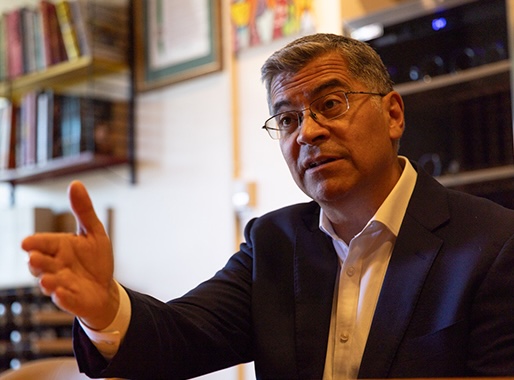
But that’s not the same as saying there are no answers. And incoming Democratic Gov. Xavier Becerra doesn’t need to wait to begin initiating meaningful improvements in the lives of those workers in such critical areas as renter protection, child care and the soaring cost of health care.
Interviews with multiple stakeholders and political strategists over the past few weeks have identified a number of actions that Becerra, who will succeed Gov. Gavin Newsom in January, can undertake along with the Democratic supermajority in the state Legislature. Some of those actions directly address affordability issues facing the low-wage workers and their families who form the backbone of many of California’s largest industries.
These measures certainly aren’t free.
“Meaningfully addressing California’s longstanding affordability crisis will require bold solutions, which in turn will require new state funding,” said Scott Graves, budget director at the California Budget & Policy Center. “To raise revenue, state leaders should focus on ensuring that corporations and the wealthy contribute their fair share of taxes.”
That said, here are five ideas that Becerra can begin pursuing almost immediately after taking office:
• Strengthen renter protections and add forgiveness. California’s Tenant Protection Act puts a cap on how much a landlord can raise the rent each year, but that cap remains onerous: 5% plus a cost of living increase, up to a maximum overall raise of 10%. If a landlord follows that law to the max for even a couple of years in a row, a low-wage worker can quickly be priced out of their own home. Considering California has nearly 16 million renters, that’s an ongoing affordability problem.
Lowering the allowable rent increase would be a good first step, along with making the Tenant Protection Act permanent (the law is scheduled to expire in 2030). But there’s something else Becerra and the Legislature can do.
Currently, California renters have only three business days after receiving an eviction notice to pay off back rent and remain in their homes. But California could join 21 other “redemption states” in the U.S. that allow a tenant to pay the rent owed and avoid eviction long after such a proceeding is under way — weeks, even. Past efforts to do this have run up against the powerful landlord lobby in Sacramento, so it’s no slam dunk.
• Enforce the labor laws already on the books. “Wage theft takes money straight out of low-wage workers’ pockets,” said Enrique Lopezlira, director of the Low-Wage Work Program at the UC Berkeley Labor Center. “It may be the most direct affordability issue that doesn’t need a new law.”
Wage theft, by which employers underpay their workers either intentionally or through payroll mistakes, costs low-wage workers in California at least $2 billion per year, according to the Economic Policy Institute. Other reports suggest the figure could be more than twice that.
Once in office, Becerra can redirect resources toward enforcing the state’s wage laws. That includes increasing staffing in the Labor Commissioner’s Office, the better to pursue wage theft claims more aggressively and start collecting past unpaid judgments.
• Expand access to affordable child care. One of the primary drivers of the affordability crisis for low-wage workers is finding a way to care for their children while they’re on the job — often a crushing, self-defeating expense.
Newsom has worked on this issue on and off for years. In 2021, he promised to expand affordable child care by phasing in 200,000 new subsidized spots by 2025-26. He’ll fall far short of that goal, leaving Becerra to pick up the ball and continue running.
This is an enormously popular issue; more than three-quarters of Californians surveyed are in favor of increasing state funding so that child care programs are available to more low-wage workers and their families. And Becerra could double down on it by simultaneously pushing for something closer to a living wage for child care workers, whose low reimbursement rates likely contribute to a smaller-than-needed talent pool.
• Raise funding to backfill safety-net programs. The Republican-passed H.R. 1 spending bill last year gutted federal Medicaid funding, with California suffering a likely $30 billion per year funding shortfall as a result. Paired with new paperwork requirements for eligible families, it’s going to lead to steep cuts in Medi-Cal enrollment and more California low-wage workers going without health care until they have an emergency.
As a candidate, Becerra loudly endorsed proposed “fair share” legislation as one way to offset some of the federal cuts. That law would essentially slap fines on California businesses that pay their employees so little, their workers qualify for Medi-Cal insurance. The fines would be used to help replace the missing federal funds.
“Why should we subsidize health care for those folks who are working full time because their employer won’t pay them enough so they can afford health insurance?” Becerra said in August. “If you’re not paying enough for your workers, maybe that means we have to raise taxes on some of these bigger companies.”
• Strike the new Medi-Cal premiums on immigrants. Under a policy change pushed by Newsom, certain groups of immigrants who use Medi-Cal for their health care will begin paying monthly premiums in 2027. Though the initial figure may be as low as $30 per month, it’s still significant to a low-wage working family that is trying to make ends meet.
Becerra and state lawmakers have the authority to either lower or eliminate that premium, likely encouraging more low-wage workers to continue using Medi-Cal. That also potentially reduces costs to hospitals, as patients who can’t afford Medi-Cal are statistically more likely to simply go without coverage, then use the emergency room as a source of care once a condition becomes serious. By law, such care has to be provided by the hospital even if the patient cannot pay.
Without question, Becerra also bears a responsibility to work on bigger-picture issues. California’s housing crunch, for example, is by now both generational and the most obvious contributor to the affordability gap facing the state’s low-wage workers.
State Speaker of the Assembly Robert Rivas “has boldly led and passed the strongest housing reforms in 20 years,” almost all of it aimed at streamlining the construction process and getting more houses into the pipeline, said Democratic political strategist Steven Maviglio. “Becerra can get on that train and lead with courage, too.”
The new governor also will take office at roughly the same time that both houses of Congress come under Democratic control. A number of experts suggested that Becerra and California will need to be at the forefront of working with federal legislators to try to roll back some of H.R. 1’s deepest cuts to safety net programs.
But those are long-term projects. California’s low-wage work community needs relief much sooner, not down the line. Becerra and state lawmakers are in a position to start providing just that.
Mark Kreidler writes for Capital & Main, a Los Angeles-based nonprofit publication focused on inequality. It is published here with permission.