By Marisa Gerber
Contributing Writer
LOS ANGELES — El seis, they call it.
That day in June of last year when armed federal immigration officers descended on a garment shop in Los Angeles’ Fashion District, arresting and shackling more than a dozen employees before whisking them away in unmarked vans. The raid on Ambiance Apparel became one of the defining images of the June surge in Los Angeles.
For the family and friends of detained workers from Ambiance Apparel, who gathered for an anniversary press conference this summer, the date had become so ingrained in their minds that it earned the Spanish shorthand for “the sixth.”
An organizer assured the apprehensive crowd that they had permission to be there but cautioned that, if anything happened during the event, they should walk calmly to their cars. When a helicopter hovered overhead a few minutes later, a woman in the crowd glanced up and winced.
High-profile raids have given way to a quieter era of enforcement, but arrests and removals are still happening at high rates across Southern California and, during a national surge in late June, officials detained more than 10,000 people in five days.
“We’re still afraid,” said Francisco, a longtime garment worker in the crowd who works for a different company and asked to be identified only by his first name for safety reasons. After that day, he said, the Fashion District became “a ghost town.”
The financial impact of the raids was swift and devastating across the region.
But commercial corridors near enforcement sites got hit especially hard. In the Fashion District, where a majority of workers and shoppers are Latino, foot traffic tanked, falling almost to pandemic-era levels.
Businesses near nine immigration enforcement sites saw a steep decline in visitors, accumulating an estimated $3.16 million in losses in the two weeks after the raids began, according to a July study from UCLA’s Latino Policy and Politics Institute, which analyzed cell phone location data.
Hardest hit of all was the Fashion District — a business zone so dense researchers tallied more than 550 businesses within a half mile of Ambiance — which lost an estimated $1.52 million in two weeks. And that estimate is conservative, said Ariana Valle, one of the authors of the report, who noted the figure accounts only for formal businesses, not the many street vendors in the district.
Researchers interviewed several business owners this spring, Valle said, including some in the Fashion District whose sales declined so drastically after the raids that they had to take out loans and cancel expansion plans. Others were considering closing their businesses and many spoke of the day of the Ambiance raid in still-fresh detail.
One respondent recalled the collective clang of dozens of roll-down metal security gates on storefronts slamming down, Valle said, and some business owners said even whispers about the possibility of another raid severely erode their sales.
“They are hurting,” said Valle, an assistant professor of sociology at UC Davis. “It’s been a very unsteady and unstable recovery for many of them.”
Anthony Rodriguez, chief executive of the Fashion District’s business improvement district, said that although the area is seeing a gradual recovery, many business owners told the group they’re still working to regain customers.
On a Saturday morning earlier this year, vendors had set up stands on a sidewalk in the Fashion District. A man was selling knockoff Lululemon leggings for $10, and a mother-daughter duo hawked World Cup totes for $4. An influencer walked backward holding a tripod with an iPhone facing her.
“We’re coming to you live from L.A.’s Fashion District!” she said. “Let’s go find some deals.”
The 107-block district, home to retail and wholesale shops and clothing factories, is a key apparel hub for the Western Hemisphere due to its proximity to the ports in the region. Wholesale buyers travel from across the globe to visit showrooms downtown, searching for wedding gowns or street-style sneakers to resell in their shops.
The district encompasses Santee Alley, a bargain bazaar, and bleeds into the Piñata District, where a longtime staple — papered figurines of President Donald Trump — was joined last summer by a newly popularized design: an ICE agent.
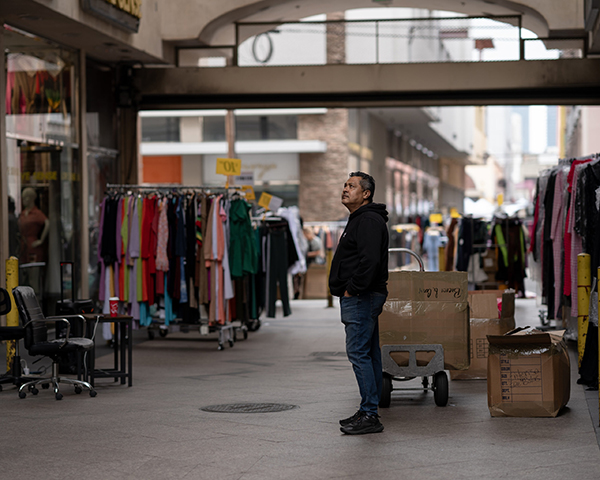
But on this Saturday morning, the busiest stand was the one with the woman selling fresh orange juice and $5 chorizo and potato burritos. Almost every other shop along one stretch had a “For Lease” sign taped to its glass door.
Outside a closed storefront, a woman browsed a metal rack, lingering on a zebra-print halter dress.
“For $1?” she asked the woman working the stand.
“No, I can’t,” the employee said.
“Come on.”
“I can’t. $5?”
The shopper walked away without the dress, and the employee shook her head.
A few weekends later, foot traffic was even slower. The streets were quiet save for the thump of a norteño-sax song blaring from a speaker outside V&C Casual, a shop in the Stanford Wholesale Mart.
The shop’s owner, Regino Tirado, sipped his coffee as he waited for customers. But everything had been slow, he said, since “El Seis.”
“After that day, no one wanted to come to the Fashion District,” he continued, panning toward the sidewalk. “Look, it’s empty.”
Tirado has worked in the Fashion District for more than 25 years through several other lean times, including the Great Recession and pandemic lockdowns. But the past year has been the hardest.
“El peor de los peores,” he called it. The worst of the worst.
A shop across from him closed two months earlier, he said, and another in the plaza shuttered a month before that. Tirado’s business, which sells women’s puffer vests and jackets, had dropped by nearly 60% since a year earlier, and he doesn’t know how much longer he can stay open.
“It’s day by day,” he said.
A feverish demand for Mexico apparel during the World Cup had brought some reprieve. Tirado sold more than 2,000 jerseys to his wholesale buyers for around $10 a piece, but even that put him below the $25,000 in sales he used to bring in most months. These days, he’s lucky to make $10,000. And that’s before paying employees and the $5,000 rent.
His wholesale buyers, some of whom live in Mexico, Costa Rica and Colombia, used to visit twice a month to check out new merchandise. Now they come every other month, he said, and sales have increasingly moved to transactions made over WhatsApp.
“The main shoppers are Latino,” Tirado said, “and now everyone is scared.”
That fear is still palpable for Francisco, the longtime garment worker.

The 62-year-old, who specializes in sewing undergarments, spends his shifts picking up reams of fabric from vendors in the Fashion District and always keeps an eye out for parked SUVs, wondering if they might be unmarked ICE vehicles. He has stopped offering to pick up friends at LAX or taking occasional trips to visit his nephew in the Bay Area.
Some fellow garment workers now take Ubers home from work to avoid the bus stop, where officials have made arrests, and others switched to night shifts to evade raids. His roommates — a couple and their young children — now hole up inside on weekends, and although it pains him, he understands. He had stopped going for Saturday morning runs himself.
During the June 6 press conference outside Ambiance, family members of detained workers stood not far from the spot where they had a year earlier peered past yellow police tape, watching their loved ones get loaded into vans. Other workers were detained from a separate location tied to Ambiance, whose representatives did not respond to a request for comment.
Some of the workers were ultimately released from immigration detention, including a man who introduced himself to the crowd as Lázaro.
“What was a normal day — a day like any other — turned into a painful nightmare,” he said.
A few minutes earlier, the crowd cheered as Ming Tanigawa-Lau, an attorney with the Immigrant Defenders Law Center, walked to the lectern. She had represented and helped secure the release from custody of another Ambiance worker.
“What took place last year was just a preview of what we would experience. Not only in L.A., but across the nation,” she said. “It tore families apart and left entire communities living in fear.”
In the crowd, Leslie Quechol nodded, cradling her newborn daughter to her chest.
A year earlier, she had been scheduled to go to her first OB-GYN appointment since finding out she was pregnant when she heard chatter about a raid at Ambiance. She canceled her appointment and rushed to the shop, where she saw workers in a line with shackles around their wrists.
One of them was her cousin, whom she considers an older brother. She screamed his name, but he couldn’t hear her.
Quechol thought immediately of his wife and three children, especially his middle son, who has autism. He had recently made some big developmental progress. What would happen now, she wondered? And how would they make ends meet without their breadwinner?
“I knew everything was going to go downhill,” said Quechol, who added that, in spite of their ordeal, the family took deep solace in the support of fellow members of the Zapotec community. Her cousin told a community organizer who served as a media liaison at the event that he and his family were too afraid to speak with a reporter.
As the crowd dispersed, some family members stayed behind to dance to live music, and Francisco stood on a nearby sidewalk taking in the scene.
He reflected on the many jobs he’d had in the Fashion District — on the warehouse bosses who paid by the number of pieces sewn instead of hourly and how he sometimes earned as little as $300 a week. He had worked his way out of that place and into a more fulfilling, stable job where he has more autonomy.
He could finally afford to have fewer roommates and no longer thrift all his clothes. Sometimes, he said, he even treats himself to a coffee from the trendy shop near his job, reminiscing over all the years he exclusively visited the corner store downtown to get a cup for $1.
“It had more water than coffee,” he said with a chuckle.
And yet, for the first time in almost three decades, he is considering moving back to Guatemala.
He misses his sisters and often thinks about the tiny home they grew up in and how he’d like to help maintain it now that their mother is gone. He knows it hasn’t been easy for his friend, the soccer companion, who got deported back to Guatemala. But the constant unease is wearing on him.
The same search for a feeling of freedom that pulled him to the U.S. years ago was now pushing him away.
Marisa Gerber writes for Capital & Main, a nonprofit publication focused on inequality. It is published here with permission.