By Antonio Ray Harvey
Contributing Writer
SACRAMENTO — In July 2024, Adrienne Boulware, a 47-year-old mother and grandmother, died from complications related to extreme heat exhaustion while incarcerated at the Central California Women’s Facility in Chowchilla, according to her family.
Assemblyman Mike Gipson, D-Gardena, hopes his legislation, Assembly Bill 2499 — also known as the “Adrienne Act” — will help prevent tragedies like Boulware’s death in California prisons.
“It is no secret that our state prisons have aging infrastructures that have inadequate ventilation systems,” Gipson said. “It should come as no shock that indoor temperatures in these facilities exceed 90 degrees, which means it gets really hot.”
On May 4, Gipson spoke at the Survivors Speak California Rally at the State Capitol to advocate for AB 2499, which focuses on heat and health protections in state prisons. The three-day event was organized by Californians for Safety and Justice, a project of the Crime Survivors for Safety and Justice network.
The bill passed the Assembly Public Safety Committee on April 22 with a unanimous 7-0 vote. It was referred to the Assembly Appropriations Committee on May 6 and placed in the suspense file while lawmakers assess the overall fiscal impact of the legislation.
Boulware’s family attended the rally in support of the measure, which would require the California Department of Corrections and Rehabilitation to establish a pilot program addressing extreme heat by July 1, 2027, in at least three prisons located in different climate zones.
Boulware’s daughter, Michela Nelson, said her mother frequently complained about heatwaves during the summer months in prison. The California Department of Corrections and Rehabilitation stated that Boulware’s death — she was also known as “Twin” — appeared to be related to pre-existing medical conditions rather than extreme heat.
“My mother was not just a mother of four and grandmother of 12. She was a mother to many inside and outside of the prison,” said Nelson, the eldest of Boulware’s children. “My mother didn’t die because she was sentenced to death. She died because she was left in conditions no human being should ever endure.”
AB 2499 would formally create the Climate Justice in Prisons Emergency Response Act. The legislation would require the California Department of Corrections and Rehabilitation to develop a long-term plan for installing heating, ventilation, and air-conditioning systems and shade structures in existing facilities.
In a letter to the Assembly Appropriations Committee, Gipson wrote that the state has a “responsibility to ensure that every individual in its care is housed in safe and humane conditions” as climate impacts “intensify, dangerously high temperatures and poor air quality in prison facilities.”
Gipson also noted that state workers and lawmakers are not expected to work under unsafe conditions.
“These buildings that house state workers have ventilation and have air conditioning,” Gipson said at the rally. “Incarcerated individuals should have the same air conditioning, the same ventilation, (and) the same rights as state employees.”
The Survivors Speak California Rally coincided with other advocacy events at the Capitol supporting survivors of violent crime.
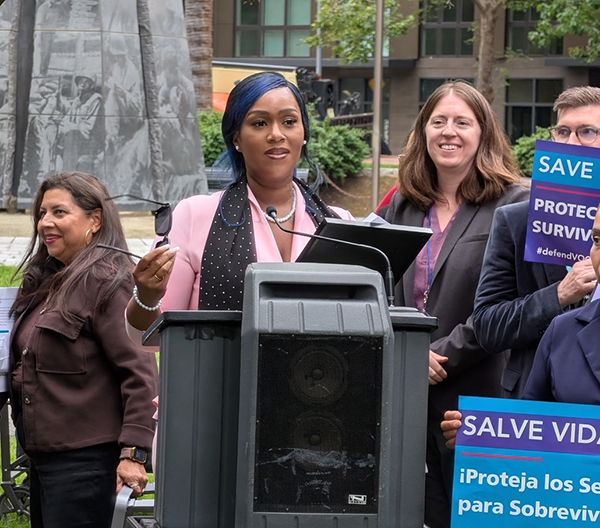
On May 5, Jazz LedBetter and other advocates rallied nearby to urge lawmakers to include $100 million in the state budget for domestic violence and sexual assault services.

Assemblywoman Pilar Schiavo, D-Chatsworth, and state Sen. Susan Rubio, D-Baldwin Park, served as keynote speakers. Both lawmakers have publicly shared their own experiences as survivors of assault.
LedBetter, a survivor of human trafficking, is also an author, activist, and artist who uses her experiences to advocate for human trafficking prevention. She shares her story of survival, addiction, and recovery in her self-published book, “Harlot Heart: Tributes To Triumph.”
“Before I say anything, I want everyone here to take a moment and think about someone finally reaching out for help, and there’s no one here to answer,” LedBetter said during her presentation on the east lawn of the Capitol before a coalition of service providers, lawmakers, and advocates.
Advocates said the funding is needed to help close a gap caused by a sharp decline in federal Victims of Crime Act funding. Organizations across the state that provide emergency shelter, counseling, and support services for survivors of domestic violence, sexual assault, and child abuse are seeking additional funding to avoid service cuts.
LedBetter said that without adequate funding for shelters and support programs, many victims are forced to remain in dangerous situations. Survivors need trauma-informed care to recover and rebuild their lives.
“I am here because I am proof. Proof of what happens when someone gets support. Don’t let this funding (shortfall) be the reason someone doesn’t make it out,” LedBetter said. “Because the difference between survival and unfortunately common sad stories, is whether or not someone is there (to help) when it matters the most.”
Antonio Ray Harvey writes for California Black Media.