By Antonio Ray Harvey
Contributing Writer
SACRAMENTO — The members of the Drop Life Without Parole, a grassroots coalition and sentencing reform group, along with other advocacy organizations, are asking Gov. Gavin Newsom to commute the sentences of more than 5,000 individuals serving life sentences in California before he leaves office.
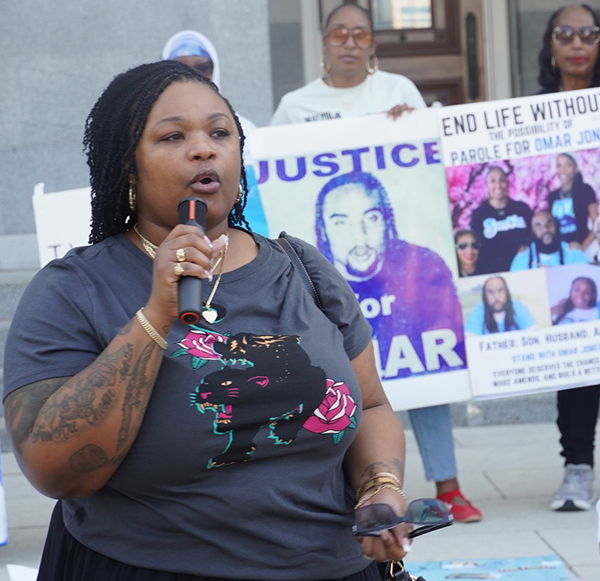
Drop Life Without Parole, along with the California Coalition for Women Prisoners, the Anti-Violence, Safety and Accountability Project, human rights advocates and family members of incarcerated people, called for the release of California prisoners serving life without parole during a Sept. 29 news conference and rally on the west steps of the State Capitol.
Amber Rose Howard, the executive director of Californians United for a Responsible Budget, said those serving life without parole already play a vital role in the broader push for commutations.
“We are here today because we care so much about ending life without parole sentencing,” Howard said. “So many people serving life without parole are the reason why that’s been able to happen. The programs, services, and all of the things that happen inside (of prisons) that rehabilitate (the incarcerated) started many years ago by folks with life without parole. They have proven that we can change ourselves. They paved the way to get ourselves free.”
Californians United for a Responsible Budget is a Black-led statewide coalition of more than 100 grassroots organizations dedicated to shrinking the state’s prison system and redirecting public spending from corrections to community care.
Among advocates and incarcerated people, life without parole is often described as “death by incarceration” or the “other death penalty.”
The calls for commutations come as Newsom is reportedly holding discussions with key advisers about sparing the lives of all 563 prisoners on California’s death row before leaving office in January. According to a number of Capitol insiders and California Black Media sources close to the governor’s office, Newsom has been considering commuting their death sentences to life imprisonment without parole, a move that would represent the largest mass death row commutation in modern U.S. history.
Newsom, who imposed a moratorium on executions in 2019, has not made a final decision. The reported discussions are separate from advocates’ demands for clemency for more than 5,000 prisoners already serving life without parole.
California ranks third in the United States for the total number of people serving life without parole sentences, according to a 2021 report by UC Irvine’s Department of Criminology, Law and Society. The state currently has 5,134 people serving life without the possibility of parole sentences.
Roughly 68% of those serving life without parole in the state are Black or Latino, 62% were 25 or younger at the time of their offense, and 71% were first-time convicted, according to data cited by the Drop Life Without Parole Coalition.
According to Newsom’s office, he has granted 276 pardons, 169 commutations and 43 reprieves during his time in office as of April of this year. The grantees were recommended for clemency by elected officials, correctional staff, including a former prison warden, medical professionals, teachers, and community and faith leaders.
Newsom leaves office in January when his second term ends.
“The governor weighs numerous factors in clemency cases, including an applicant’s self-development since the offense, if the grant is consistent with public safety, and the impact of a grant on the community, including crime victims and survivors,” Newsom’s office said in a statement last April.
Criminal justice experts claim that hope is the most vital protective factor against despair and suicide for individuals who carry the sentence. From the perspective of former prisoners, they argue, restoring or sustaining a sense of hope, is a mechanism that allows them to prove to themselves and society that they are not defined solely by their worst mistake.

Opposition to commuting life-without-parole sentences in California has come from victims’ rights groups, law enforcement organizations and some victims’ families. The Criminal Justice Legal Foundation, Crime Victims United and the Peace Officers Research Association of California have argued that expanding opportunities for commutation or resentencing undermines the finality of sentences and promises made to victims’ families.
The Criminal Justice Legal Foundation and its allies have also challenged new California Board of Parole hearing regulations that provide a process for recommending resentencing or commutation for some incarcerated people, including those serving life without parole sentences.
“Understand what is at stake for those who were promised that life without the possibility of parole meant exactly that,” the Crime Victims United said in a statement opposing California state policies on commutation.
Barbara Chavez, an Outside Policy Fellow for the Ella Baker Center for Human Rights, champions criminal justice reform and campaigns to end life without parole sentences.
Chavez served 20 years and four months in prison for her role as the getaway driver in a 1999 Kern County liquor store robbery in which an employee was killed. She was 22 when she was convicted and sentenced to life without parole under California’s former felony-murder law.
Through a combination of executive clemency and a parole board grant, former California Gov. Jerry Brown commuted her life without parole sentence in 2018, restructuring it to a lesser term that allowed her the opportunity to appear before a parole board.
Chavez was subsequently released from prison in 2019. She says her work now draws on her lived experience to help dismantle systemic barriers through initiatives led by the Inside/Outside Policy Fellowship at the Ella Baker Center.
“I’ve been home for seven years, and I am proof of success,” Chavez said. “When you give other people who have life sentences without the possibility of parole a chance, they will come home and thrive. I never gave up hope, and I am here to tell you don’t give up hope. Hope is alive.”
Antonio Ray Harvey writes for California Black Media.