By Diego Perdomo
Contributing Writer
NEW ORLEANS — Multiple generations of Black civil rights activists met here recently to honor a group of Freedom Riders after they finally completed a disrupted bus journey from Washington D.C. to New Orleans 65 years after the original trip was violently halted.
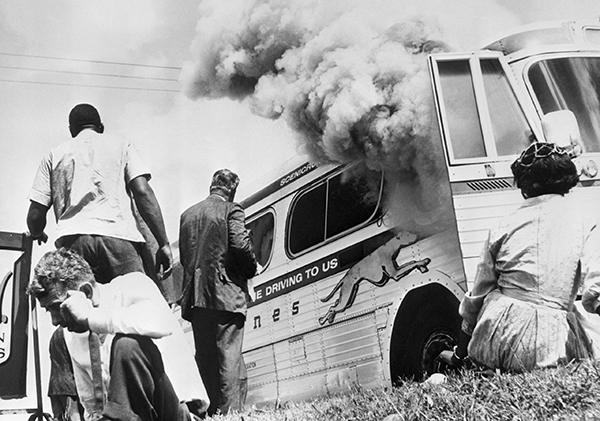
The original ride, the first in a series of trips to protest Jim Crow laws, was interrupted when a segregationist mob firebombed their buses in Anniston, Alabama on May 14, 1961. The 13 riders escaped before the bus exploded but were beaten by an angry mob. The next day, they flew directly to New Orleans and sought refuge at Xavier University after hotels refused to host them out of fears of further violence.
Leaving D.C. on Oct. 17 and stopping in historical cities like Selma and Jackson, the latest cohort of Freedom Riders completed the bus route their predecessors did not. Among the riders were original participants of the 1961 Freedom Rides, including Steve Thomas, who travelled from Jackson to Montgomery.
Interlocking hands to sing the lauded anthem “We Shall Overcome” — and hosting a litany of faith-based activists — the reception honored a legacy of Black political action amidst concerns of voter suppression across America. Those concerns were fueled by two recent concerns: the Louisiana v. Callais Supreme Court decision gutting key provisions of the Voting Rights Act and nationwide redistricting efforts that eliminated majority-Black congressional districts across the Deep South, including one of two in Louisiana.
“We are approaching another election and once again questions about voting rights, equal representation, civic participation and the integrity of our democratic institutions is before us,” said Rev. Traci Blackmon, a Missouri minister. “Across the nation, the communities are wrestling questions that should have been settled permanently long ago: ‘Who gets to vote?’”
One of the original Freedom Riders posthumously honored was Jerome Smith, who confronted then-U.S. Attorney General Robert Kennedy in May 1963 about the government’s failure to protect him and other civil rights activists against angry white mobs across the South. The meeting was seen then as a pivotal factor that pushed the federal government to support the civil rights movement.
“Mr. Smith was more than a fighter and freedom rider. He was a father, a mentor, and a man who demonstrated love, courage, culture and commitment to his family,” said one speaker, Xavier University student Paytra Flood. “We honor him today, and his sacrifice, his service and his journey.”
“As we welcome back Freedom Riders to Xavier, we recognize that we are standing on the shoulders of those who came before us,” Flood added. “As students at this historically Black university, we have the responsibility to understand history that shaped our communities.”
This year’s Freedom Ride also was sponsored to mobilize voters and encourage activists to understand what they can do today to enact change.
Kredelle Petway-Phillips, a 1961 Freedom Rider who also participated in the recent trip, said she wanted to remind young Americans of the importance of their vote and ability to inspire change. Her Freedom Ride was an airplane trip from Montgomery, Alabama, to Jackson, Mississippi, where she was arrested by Jackson police and held for three days.

That lesser-known Freedom Ride helped force desegregation of airline flights.
In 2011, when Petway-Phillips visited Jackson for the 50th reunion of her flight, she said it was rewarding for her to see Black people represented in the local government.
“It’s up to you young people to vote and keep the legacy alive,” she said then. “Fight for what’s right (and) vote for the common good of all people because what affects one affects the other. … We all suffer when one suffers.”
“The reality is that we have to declare that there is more work to be done,” said Bishop Erika Crawford of the Eighth Episcopal District of the African Methodist Episcopal Church that represents AME churches in Louisiana and Mississippi. “There are testimonies about what happens when we refuse to allow the last stops to be the final stop. …This is the last stop, but don’t let it be the final stop.”
Diego Perdomo writes for Verite News, a nonprofit news organization based in New Orleans. The story was distributed through a partnership with the Associated Press.