ANALYSIS: ‘A very non-Black group’
Lack of Black participants at ‘No Kings’ Rally raises questions

By Stephen Oduntan
Contributing Writer
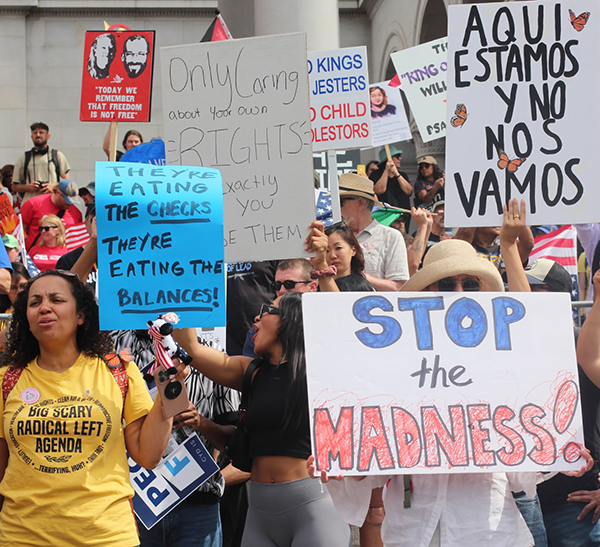
LOS ANGELES — Thousands gathered across Los Angeles March 28 as part of the nationwide “No Kings” protests, joining millions across the country and abroad in a sweeping show of opposition to President Donald Trump and his policies.
Organizers estimated roughly 8 million people participated in more than 3,000 events worldwide, with more than 100,000 attending demonstrations across Los Angeles, Orange and Ventura counties — a scale that could mark one of the largest single days of political protest in U.S. history.
The demonstrations build on earlier waves of mobilization that drew an estimated 5 million people nationwide last summer and roughly 7 million more in the fall, signaling a movement that has continued to grow in size and intensity.
In downtown Los Angeles, crowds filled the streets, waving signs and chanting against Trump, Immigration and Customs Enforcement policies, and the rising cost of living. For many, the protest captured a widening unease about the direction of the country.
Callie Smith, who attended with her partner, said she was motivated by immigration issues and civil liberties.
“I want a better country for my children,” she said. “We’re here to let our voices be heard — that we’re not OK with what’s happening.”
Smith said she believes the United States should remain a welcoming place for immigrants.
“America should be a safe haven,” she said. “Diversity is beautiful, and people should feel welcome here.”
But amid the large and energized crowd, another dynamic stood out: Black attendees did not appear to be represented in the same proportion as other groups.
Shelly Smith, a visitor from Texas attending with her sister, said the imbalance was immediately noticeable.
“I’m just as baffled as anybody else,” she said. “It’s a very diverse group — but it’s a very non-Black group.
“My heart is here,” she added. “I can’t imagine anybody in my race not being here. My whole family would be here.”
Arthur Little, who attended with a neighbor, said he noticed the same pattern.
“I was wondering that myself,” he said. “I think often people feel so sidelined that they stay sidelined.”
Some organizers and longtime activists, however, said the issue may not be about absence, but visibility — and how political engagement takes shape.
Melina Abdullah, a university professor and prominent Black Lives Matter organizer, acknowledged the limited presence but framed it differently.
“There’s not a lot of us,” Abdullah said. “But the conditions people are reacting to now are the conditions Black people have been facing.”
She added that engagement is not always centered in large public demonstrations.
“Most Black people don’t have time for a parade,” she said. “If you want to find us, you’ll find us in the movement.”
The issue of representation has surfaced beyond Los Angeles.
In a widely circulated video from a New York protest, interviewer Nate Friedman — known for confrontational street-style exchanges with demonstrators — pressed one attendee about the limited Black turnout. The woman pointed to safety.
“If anybody’s going to get arrested here, it’s going to be a Black person,” she said. “It is not safe for them. … We need to walk in their name.”
The exchange echoed conversations on the ground at Gloria Molina Grand Park here, where speakers stressed that the rally was only a starting point in a larger political effort.
“This can’t stop here — this is not the destination, this is the on-ramp,” one speaker told the crowd, urging continued engagement through elections and organizing.
Cecily Myart-Cruz, president of United Teachers Los Angeles, tied the moment to deeper economic frustrations.
“No grown adult should work 40 hours a week and not be able to support themselves,” she said. “There is plenty of money — they just don’t want to invest it in our communities.”
She also called for increased funding for public schools and continued organizing, including the possibility of a teacher strike.
Beyond the immediate demands voiced at the rally, the demonstration also hinted at a growing sense of political vindication among some Democratic leaders.
In April 2025, The New York Times reported that former Vice President Kamala Harris, speaking at a public appearance in Orange County, addressed the moment while stopping short of explicitly claiming validation, telling the audience she was “not here to say I told you so.”
Weeks later, at a fundraiser in San Francisco, Harris struck a more direct tone.
“Things are probably going to get worse before they get better,” she said. “But we are ready for it. … We are not going to scatter. We are going to stand together.”
That unease is evident in recent polling. According to Silver Bulletin, Trump’s average job approval rating fell to 39.7% in March, a second-term low, while disapproval climbed to 57.1%, a second-term high. Nearly half of Americans — 47.2% — said they strongly disapprove of his performance.
Other surveys show a similar trend. A Fox News poll found Trump’s net approval declining from minus-14 points at the beginning of March to minus-18 later in the month, while Reuters/Ipsos polling showed disapproval widening to minus-26.
Black voters, meanwhile, continue to support Democratic candidates at some of the highest rates of any demographic group, according to Pew Research Center and AP VoteCast.
Thandisizwe Chimurenga, an award-winning journalist and writer, said that history has shaped how some Black Americans are engaging politically today.
“Black folks — the 92% and the 78% to 80% of us — definitely have said and continue to say, ‘we told you so’ about Trump,” she said. “There’s absolutely a sense of disengagement because Black folks are feeling like, ‘we did our part.’”
At the same time, she said, safety remains a factor.
“Whenever and wherever Black people protest, the response by the state is always heavy-handed,” she said. “Letting others be on the front line for a change is definitely a sentiment.”
Chimurenga added that protest has never been the sole measure of political engagement.
“Black protest has always been part of a larger strategy,” she said. “It has never been our only strategy — and it never will be.”
Stephen Oduntan is a freelance writer for Wave Newspapers.