Bass vs Raman: The great divide
A month from Election Day, many voters are still undecided

By Stephen Oduntan
Contributing Writer
LOS ANGELES — Mary Abraham knows what she wants from the next mayor of Los Angeles: something different.
“We just need younger people in office,” said Abraham, 33, a Los Angeles homeowner and program manager who plans to vote for Councilwoman Nithya Raman. “They have direct understanding of what the issues are. We can’t afford nothing. Everything is too bloody expensive.”
Dr. Ramin Sarshad also thinks Los Angeles needs to do better. He has little praise for Mayor Karen Bass’ first term and agrees with some of Raman’s criticism of her handling of homelessness.
He’s voting for Bass.
And Dean Martin?
He’s voting for neither.
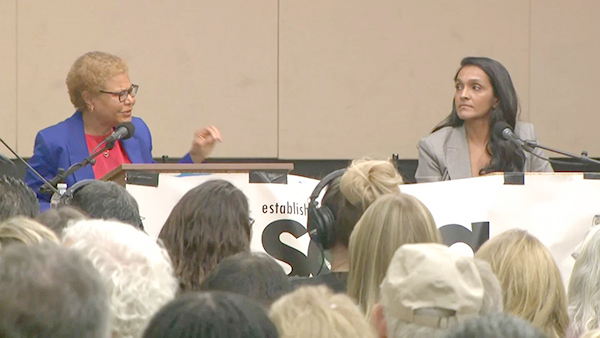
A month before Los Angeles chooses its next mayor, those contradictions are playing out in a race in which the candidates and their allies are spending millions of dollars to reach an electorate that remains remarkably unsettled.
A UC Berkeley Institute of Governmental Studies poll co-sponsored by the Los Angeles Times found Raman supported by 39% of likely voters and Bass by 28%. But the number that may say as much about the state of the race is 33% — the share who had not chosen either candidate.
The poll, conducted Sept. 15-20 among 2,150 likely city voters, had a margin of error of about 3 percentage points. Other recent polls have shown a closer contest.
The money reflects how intensely both sides are competing for those voters. Through Sept. 19, Raman had raised about $2.53 million in contributions and city matching funds, compared with $2.51 million for Bass. But considerably more is being spent outside the campaigns: a committee backed by the Western States Regional Council of Carpenters has raised $6 million to support Raman, while the Los Angeles Police Protective League has spent nearly $2.8 million supporting Bass and Airbnb put $1.75 million into a committee that backed Bass during the primary.
Voters interviewed by The Wave may disagree about the remedy, but their complaints frequently begin in the same place: housing costs, homelessness, public safety and the difficulty of making Los Angeles work for ordinary residents.
For Abraham, affordability is inseparable from her support for Raman.
“I shouldn’t have to earn $250,000 to feel comfortable,” she said. “Who earns that?”
Her argument comes amid a striking generational divide in the Berkeley poll. Raman drew 66% support among likely voters ages 18 to 29 and 64% among those 30 to 39. Bass’ strongest age group was voters 65 and older, among whom she led Raman 41% to 21%.
For another Raman supporter, who has worked in accounting for more than 20 years, the frustration extends to how City Hall explains its decisions.
“You made all these promises, and that’s fine. That’s what you wanted to do,” she said. “But at some point, you can’t just keep saying you’re doing this when it hasn’t been done, and you’re not saying what you’re doing to get it done or what the roadblocks are.”
She said voters might be more understanding if city leaders were candid about what stood in their way.
“Be upfront with people,” she said. “I think when you’re upfront with people, they will forgive you.”
Raman’s challenge to Bass carries its own contradiction. She endorsed the mayor for reelection before entering the race herself.
Appearing Sept. 29 on “Higher Learning With Van Lathan and Rachel Lindsay,” the Ringer podcast covering Black culture and politics, Raman was pressed by Lathan about her decision to challenge a mayor she had previously supported.
“It was not an easy decision for me to step out there and to run against someone that I had supported,” Raman said, explaining that she had waited for someone else to challenge the mayor before deciding “someone needed to step up.”
Bass, meanwhile, is asking voters to look at what has changed during her first term.
In a recent Los Angeles Times interview, she pointed to affordable housing construction and getting homeless Angelenos indoors as major accomplishments. Asked about her biggest mistake, however, Bass pointed to her absence when the Palisades fire erupted while she was in Ghana.
“The bottom line is, I wasn’t here when the city needed me,” Bass said.
Her administration has also pointed to more than 10,000 units of rent-restricted affordable housing completed since she took office. Bass said last week that housing is the city’s primary tool for addressing affordability.
Homelessness remains particularly difficult terrain for the incumbent.
The 2026 homeless count estimated 45,194 people were experiencing homelessness in the city, 3.4% more than the previous year, although the Los Angeles Homeless Services Authority said the change was not statistically significant.
For Sarshad, a medical director, the issue is immediate. He described an encounter with an unhoused man who had been sleeping outside his door and who, Sarshad said, later damaged his security camera. He is also temporarily living in Santa Monica while his condominium undergoes repairs for extensive smoke damage from the Palisades fire.
Asked whether Bass had done anything that convinced him she deserved another term, Sarshad answered:
“Nothing.”
So why vote for her?
Because Raman has not persuaded him either.
“She does not,” Sarshad said when asked whether Raman had earned his vote.
Sarshad considers Raman’s politics too far to the left. His vote for Bass, he said, comes despite his dissatisfaction with her performance, not because that dissatisfaction has disappeared.
For another Bass supporter, the calculation is different.
A 61-year-old Black Los Angeles social worker interviewed by The Wave said she cannot point to a dramatic change in her own life under Bass.

“I don’t know exactly what she’s done,” she said.
But she doesn’t believe the city’s problems can be repaired in a single mayoral term.
“People expect this miracle,” she said. “Nobody can fix this at the drop of a hat. It takes time for everything to be right.”
And there is another reason Bass retains her support.
“She’s Black, she’s a Black woman,” she said.
Fernando Guerra, director of Loyola Marymount University’s Center for the Study of Los Angeles, sees a distinction between enthusiasm for Bass and the significance some Black voters attach to retaining a Black mayor.
“The fear is exactly what you said, that Black voters don’t turn out because they’re not enthusiastic about the election overall or her candidacy in particular,” Guerra said.
But, he added, “while Black voters may not be particularly enthusiastic about Bass, they are very, very enthusiastic about a Black mayor.”
Then there is Martin, an armed security officer who has no plans to vote for either candidate.
He gives Bass some credit for navigating the pressures of the job.
“She’s very good at not buckling under pressure,” Martin said.
But Martin’s skepticism extends beyond either candidate. Asked what he would like the next mayor to do about the issues affecting Los Angeles, he questioned how much was within a mayor’s power in the first place.
Homelessness, he said, is one problem he would like to see addressed.
“The homeless issue has always been an issue in L.A. that I would love to see some type of solution [to],” Martin said. “But … I don’t see a big solution.”
His decision not to vote isn’t based simply on the idea that one ballot doesn’t matter.
“I’m not one of those people that necessarily believes my one vote doesn’t matter,” Martin said. “I believe that what’s gonna happen is gonna happen, no matter what.”
What could Bass or Raman do between now and Nov. 3 to change his mind?
“Not a thing, sir,” Martin said. “Not a thing.”
Stephen Oduntan is a freelance writer for Wave Newspapers.