By Antonio Ray Harvey
Contributing Writer
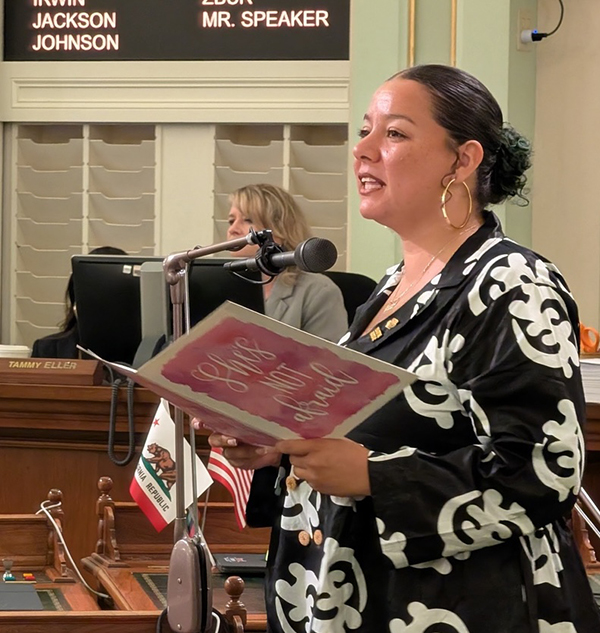
SACRAMENTO — A bill Assemblywoman Sade Elhawary, D-Los Angeles, authored would make it illegal for law enforcement officers to deny or delay emergency medical care for people under their control when it is safe to provide treatment.
Assembly Bill 2318, known as the Ensuring Accountability After Tragedies Act, was placed on the Senate Appropriations Committee’s Suspense File Aug. 3 because of its projected cost to the state.
The bill would amend Section 832.11 of the California Penal Code to prohibit officers from denying, delaying, obstructing or failing to facilitate medical care when a medical professional is present or has been requested and is willing to help. The requirement would apply when providing access is safe and reasonable.
If an officer denies or delays care when a medical professional is available, the officer or law enforcement agency would have to document the reason within 72 hours. Officers who violate the law could face disciplinary action, including suspension or termination.
Elhawary said the bill was prompted by several high-profile cases in which authorities allegedly blocked or delayed medical treatment for injured people, including the Jan.7, shooting death of Renee Nicole Good in Minneapolis. Witnesses said federal agents did not perform CPR and prevented a bystander who identified himself as a physician from assisting Good. Paramedics later administered CPR, but Good died from her injuries.
“Our intention is really to focus on Immigration and Customs Enforcement (ICE) and holding the Trump administration accountable,” Elhawary told California Black Media at the State Capitol on Aug. 6. “It’s been awful to see what these ICE agents have been doing to terrorize our communities.”
Elhawary, a member of the California Legislative Black Caucus, said the concerns raised by the bill extend beyond federal immigration enforcement.
“This is something we know happens at the federal level and across the board. It happens at the local level as well,” Elhawary said. “They are using this uniform to act as if they have absolute immunity to kill someone and let them die. For some of them, I think they think it’s a badge of honor.”
“We’re in a time where we are hiring ICE agents and not training them properly,” Elhawary said. “Some of these people are truly racists and have next-level biases against communities like ours.”
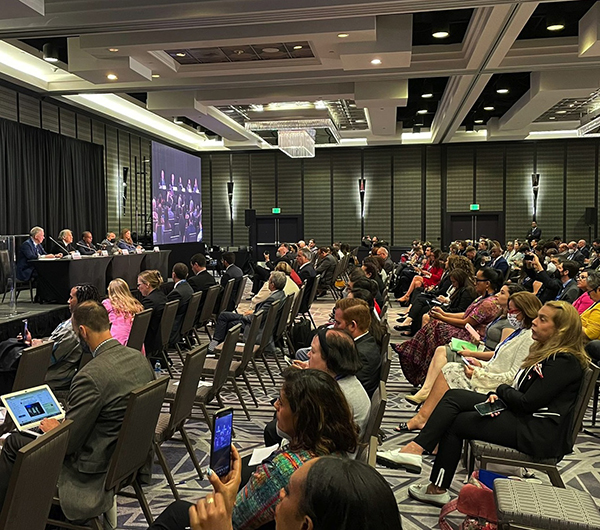
Kevin Benedicto, vice president of the San Francisco Police Commission, testified in support of AB 2318 in his personal capacity before the Senate Public Safety Committee on June 23. Benedicto, a civil rights attorney and civil litigator, said “access to medical professionals, following critical incidents, is key.”
“This bill would standardize what is already a best practice statewide, increase transparency and accountability, and could save lives,” Benedicto said. “I think this bill could also encourage more proactive cooperation between law enforcement and medical professionals.”
Opponents say the legislation is unnecessary and could force officers to evaluate the credentials of people claiming to be medical professionals during chaotic or dangerous incidents.
The California State Sheriffs’ Association opposes AB 2318, arguing that peace officers are already trained to assess emergencies and initiate appropriate medical care.
Cory Salzillo, the association’s legislative director, told the Senate Public Safety Committee, chaired by state Sen. Jesse Arreguín, D-Berkeley, that “the bill is at best unnecessary.”
“How are we supposed to know that those people are qualified to render medical care, much less emergency medical care? It just creates an untenable situation,” Salzillo said. “This is not a good justification for changing the law in this regard. For those reasons, we’re opposed to the bill.”
The bill’s reporting and training requirements have also raised concerns about costs to local law enforcement agencies and possible state reimbursements.

AB 2318 would require the California Commission on Peace Officer Standards and Training to incorporate the new requirements into law enforcement training. Because it would impose additional duties on local agencies, the state could be required to reimburse some implementation costs.
The bill is co-authored by state Sens. Lena Gonzalez, D-Long Beach, and Scott Wiener, D-San Francisco. Supporters include the California Latino Legislative Caucus, California Public Defenders Association, Los Angeles City Council President Marqueece Harris-Dawson, Voters of Tomorrow, Ella Baker Center for Human Rights and Women’s Foundation California.
Elhawary said her office has been working with law enforcement groups and other stakeholders to address concerns about the legislation.
“I do want to be clear about that. We’ve been working with them, and they have been providing good amendments,” Elhawary said.
The Senate Appropriations Committee is scheduled to hold its suspense hearing on Aug. 13. Bills may be advanced to the Senate floor, amended or held in committee. Most bills held in the Suspense File do not move forward.
Under Senate rules, measures generally go to the Suspense File if they are projected to cost at least $50,000 from the general fund or $150,000 from a special fund in any fiscal year.
Aug. 14 is the deadline for fiscal committees to report bills to the floor for a vote by all members of the Assembly or Senate.
Antonio Ray Harvey writes for California Black Media.