By Stephen Oduntan
Contributing Writer
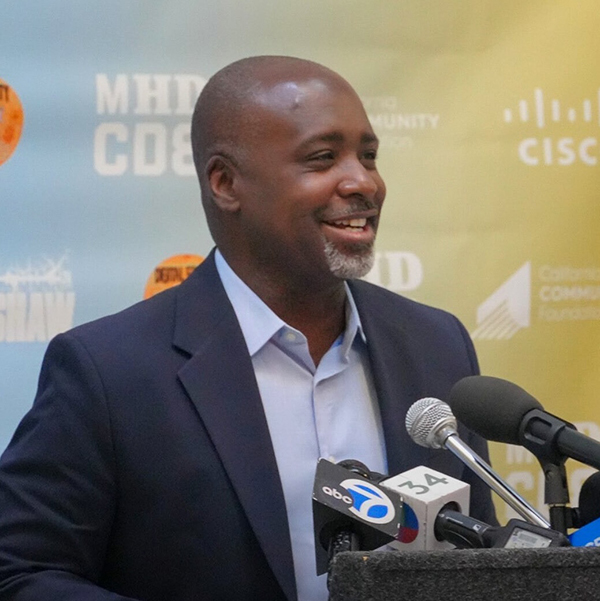
LOS ANGELES — As Los Angeles City Council returns from its winter recess, Council President Marqueece Harris-Dawson says the city is entering another year of fiscal strain — one that will test its ability to preserve services, continue progress on homelessness and public safety, and avoid widespread layoffs.
In an interview, Dawson said the council’s immediate focus in the first quarter will be preparing the city’s next budget amid lingering economic uncertainty and the prospect of reduced federal support. The city adopted a budget of roughly $13 billion last year after warning that revenue shortfalls could trigger significant layoffs, a scenario council leaders say they are again trying to prevent.
“Last year, we avoided hundreds — if not thousands — of layoffs,” Harris-Dawson said. “The financial picture in some ways has gotten better, but between federal immigration policy, the impact on tourism and broader instability, we’re still facing a challenging year.”
Harris-Dawson said council members are reviewing city operations for efficiencies, examining whether revenue collection can be improved, and identifying areas where spending can be tightened without reducing core services. Under his leadership, he said, success in 2026 will be measured by whether Los Angeles can maintain essential city functions while showing incremental improvement in quality-of-life indicators.
Those fiscal pressures are closely tied to one of the city’s most persistent challenges: homelessness. Funding uncertainty at the federal level and unresolved coordination with county agencies continue to shape how the city approaches the crisis.
City officials have pointed to recent point-in-time counts showing modest declines in unsheltered homelessness, though advocates continue to debate whether those gains are sustainable.
“We’ve dropped homelessness by double digits each of the past two years,” Harris-Dawson said. “Our goal is to continue that trend, even with interruptions in support from the state, county or federal government.”
Harris-Dawson said the city’s Homelessness Bureau, approved last year, is expected to begin operating this year and will serve as the primary mechanism for administering homelessness funds on the city side. He also acknowledged uncertainty surrounding the future role of the Los Angeles Homeless Services Authority after the county pulled back its involvement.
On housing more broadly, Harris-Dawson said local policy adjustments and incoming state measures could help accelerate housing production — an outcome he said is essential to easing rents and expanding availability — though he did not outline specific legislative proposals.
From homelessness, Harris-Dawson shifted to public safety, framing it as an issue that extends beyond traditional crime statistics. Traffic-related deaths in Los Angeles have exceeded homicides in recent years, reshaping how city leaders are defining safety and enforcement priorities.
“Public safety is a holistic thing,” Dawson said. “If you don’t deal with streetlights, sidewalks, potholes and traffic enforcement, communities are still unsafe.”
He said the council is preparing proposals aimed at reducing armed police interactions during routine traffic stops, particularly for non-dangerous code violations such as broken taillights or equipment issues. Harris-Dawson said he supports moving away from a system in which officers conduct stops for infractions that do not pose an immediate threat to public safety.
“We have this idea where a person with a gun stops you for a broken windshield or brake light,” he said, referencing civil rights attorney Connie Rice’s description of such encounters as “stop and frisk in a car.” Harris-Dawson said the city should move toward community-based approaches to traffic enforcement that reduce unnecessary police contact while maintaining safety.
Harris-Dawson said measuring whether city policies are working will require more than statistics alone, arguing that public confidence depends on whether residents experience tangible change in their daily lives.
“It’s not just the quantitative data,” he said. “Do I feel like there are fewer encampments? Do I feel safer walking around? Do people with mental health conditions actually have a place to be taken and given treatment?”
For working-class neighborhoods and communities of color, Harris-Dawson said accountability will hinge on whether budgeted programs translate into visible improvements rather than symbolic commitments.
“A lot of times things go into the budget and we think something great happened,” he said. “Then you follow up a year later and nothing has changed — and sometimes the money doesn’t even get spent.”
That emphasis on outcomes, Harris-Dawson said, is also central to rebuilding public trust in City Hall following corruption scandals that have led to the departure of several former council members in recent years.
“The people who are left have to show up and do their work,” he said.
Harris-Dawson added that he does not believe new ethics rules are necessary, noting that existing laws have been used to prosecute wrongdoing.
“If we go years without major gaps in adherence to the rules, the public will come around,” he said.
That focus on long-term confidence, Harris-Dawson said, extends to the city’s largest upcoming undertaking: preparing for the 2028 Summer Olympics. With less than three years until the games, the event is expected to drive billions in infrastructure spending and contracting.
“This is the year we have to really be on track,” Harris-Dawson said. “Small businesses and communities should benefit from the Olympics — not make sacrifices and get nothing in return.”
Asked what message he would send to frustrated Angelenos at the start of the year, Harris-Dawson struck an optimistic note.
“L.A. is coming back,” he said. “It’s been a long road — COVID, political instability, immigration raids, fires — but we’ve always made our way back.”
Stephen Oduntan is a freelance writer for Wave Newspapers.