By Cerise Castle
Contributing Writer
LOS ANGELES — Tucker Collins, 19, has undergone a series of changes since last year. He started his freshman year as an astronautical engineering student at USC. He moved to a new part of Los Angeles. And on March 28, he lost an eye from an injury sustained at a protest against federal immigration enforcement.
That afternoon, the amateur photographer and filmmaker decided to go to a No Kings protest in downtown Los Angeles with a new camera his parents gave him as a Christmas gift, he told Capital & Main. He was there to film and photograph Department of Homeland Security agents who have carried out a series of aggressive immigration raids under President Donald Trump.
”I think we’ve seen with DHS specifically, in this case, being used, weaponized into a force of terror against everyday citizens,” he said. “I was there to document any potential crimes.”
Collins was walking as part of a large group of protesters, holding up his camera toward DHS agents near the Metropolitan Detention Center, a prison in downtown L.A. used to detain immigrants, when he was hit in the face with a kinetic impact projectile — also known as a less-lethal round — according to video taken by another protester and provided to Capital & Main by Collins’ attorney V. James DeSimone.
Collins crumpled to the ground and began to scream, the video showed, and strangers pulled him to safety. Another protester drove him to the hospital, he said, and the injuries were so severe that his eye had to be surgically removed.
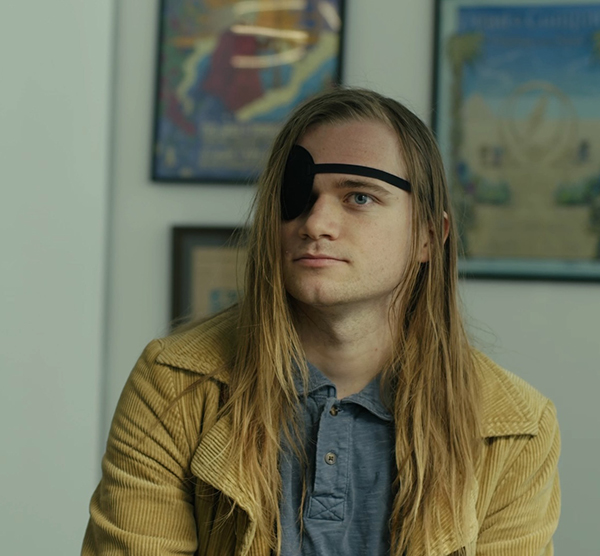
Collins is soft-spoken with long blond hair covering the right side of his face. When he moves, his hair sweeps away just long enough to reveal a large black eye patch covering a glass eye underneath.
“This was a crime, and it was, I guess, surprising that it happened to me,” he said. “But not surprising that it happened.”
Collins is one of numerous people injured by local police or federal agents during protests that have continued in Southern California in the year following the Trump administration’s surge of immigration enforcement actions that began in June 2025.
In dozens of cases, local and federal officers, often outfitted in riot helmets and bulletproof vests, have fired kinetic impact projectiles, including plastic or rubber bullets commonly referred to as less-lethal rounds, into crowds of demonstrators. Los Angeles Police Department officers fired at least 2,587 such rounds at protesters between June 6, 2025, and March 28, 2026, according to use-of-force reports published by the department.
While there is no official tally of the number of people injured during protests in Southern California, the Los Angeles Press Club has documented in a federal lawsuit over a dozen incidents in which journalists in the area were injured covering the protests. Some of the people injured recovered in the days and weeks after, but others were left with life-altering wounds.
Those with serious injuries have filed claims or lawsuits against police or federal law enforcement.
A Capital & Main review of claims and lawsuits filed since June 2025, as well as interviews with attorneys and reviews of bystander videos, documented at least five people who were, like Collins, shot in the eye with a projectile. Capital & Main spoke with three of them, each of whom described feeling anxiety and a sense that something deeply unjust had happened to them. They said they were also continuing to reckon with their lives being suddenly and permanently altered.
All of the five injured men lost vision in at least one eye. Three of them required surgeries to remove their injured eyes, according to legal claims filed against the agencies whose officers they believed to be responsible. Each of them has had to navigate the new challenges of living with a significant visual impairment.
The Los Angeles Police Department and U.S. Department of Homeland Security did not respond to Capital & Main’s questions about the complaints filed against them by five people who were shot in the eye. The agencies have said elsewhere that they do not keep internal records of the total number of injuries to protesters since June 2025.
Due to the severity of his injury, Collins was transferred to another hospital where a surgeon removed five plastic fragments of a projectile from his skull, said Collins and his attorney, V. James DeSimone. The fragments destroyed the structure of Collins’ eye. And the collection of blood and fluid that made up the remains of his eye were determined to have passed the point of repair, they said, so the eye was removed.
The first few weeks of his recovery were filled with agonizing headaches, Collins said.
“The pain was still too much for me to want to do anything but lie in bed all day,” he said. “It hurt to move my head.”
Since losing his eye, Collins said he has had to relearn dozens of basic tasks, from walking without running into people and objects to completing his schoolwork.
“I’m worried how much it will, you know, impact my ability to do the things I love,” he said. “I’d like to think that I’ll still be able to do my career path as normal, but in reality I don’t know.”
Marcos Lemor, an ophthalmologist affiliated with Adventist Health-White Memorial and East Los Angeles Doctors Hospital who surgically removed what was left of Collins’ eye, said that the gravity of his injury presented a significant challenge. Without both eyes, Collins has lost his depth perception.
“He’s never going to be able to really do that kind of very fine manual work because he does not have that perception,” Lemor said, “That’s lost forever.”
Collins is still grappling with his new reality and said he feels a great sense of loss.

“It’s strange to think of my life now having a before and after,” Collins said.
Collins isn’t the only protester or bystander to sustain a life-altering eye injury from a law enforcement projectile at a Southern California protest.
During a previous No Kings rally on June 16, 2025, an LAPD officer shot photographer Marshall Woodruff, 29, in his right eye, according to a lawsuit filed against the department. His eye had to be removed, leaving the aspiring filmmaker with an uncertain future in film, said his attorney, Aaron Liskin, a partner at Kinsella Holley Iser Kump Steinsapir LLP in Los Angeles.
Jesus Javier Gomez Islas, 23, was riding a scooter home from work near a demonstration at the Metropolitan Detention Center on Jan. 31 when he was shot in the eye by a Los Angeles Police Department officer, according to his attorney, Jamal Tooson, a partner at Lessem, Newstat & Tooson, LLP in Los Angeles, and a claim filed by Gomez Islas against the department. Gomez Islas had his eye surgically removed, according to Tooson and the filing.
Tooson said that his client has developed sympathetic ophthalmia, a rare, auto-immune condition that occurs when the inner eye tissue is exposed and the body does not recognize it as its own. The immune system then launches an attack to destroy the healthy eye. He said Gomez Islas is in danger of losing his remaining eye due to the severity of the original injury.
In an email, a Los Angeles Police Department spokesperson Norma Eisenman declined to respond to questions about Gomez Islas’ cases because it is “pending litigation.”
Collins said he is resolute in his commitment to return to a normal life. He dreams of being an astronautical engineer; he wants to build rockets that go into outer space.
A few weeks after he was discharged from the hospital, he joined USC’s Rocket Propulsion Lab in Nevada’s Black Rock Desert for a launch. He has been able to stay engaged in the field with the help of the university’s rocketry team for now.
That kind of precision work is “so much harder now that I have one eye,” Collins said.
But Collins said his experience has left him more confident in the importance of documenting what he sees.
He plans to pick up his camera again and return to protests to bear witness.
Cerise Castle writes for Capital & Main, a Los Angeles-based nonprofit publication focused on inequality. It is published here with permission.