By Mark Kreidler
Contributing Writer
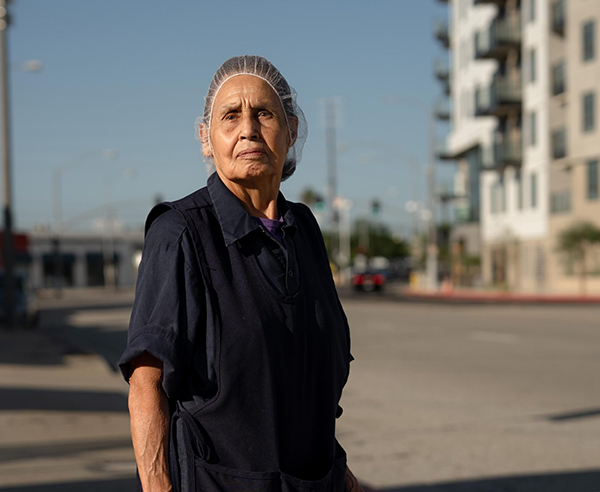
LOS ANGELES — For Salud Garcia, the numbers still don’t add up. It isn’t for lack of trying on her part.
Garcia has been working full time at the same Los Angeles International Airport food service company for 33 years, trying to build financial stability for herself. Inside a nondescript warehouse in nearby Inglewood, she stands over steaming industrial dishwashers for hours at a time, loading dirty plates from previous flights to be cleaned and sanitized for reuse.
But as an hourly employee, Garcia has never been able to out-earn her expenses. Her rent, food and transportation costs keep climbing, putting every month on the edge financially. She fears any extra expense, even for a refill of the medication she uses to control her blood pressure.
Garcia recently got a raise to $25 an hour, as required by Los Angeles’ “Olympic wage” ordinance, which mandates minimum wage increases for tourism-industry workers as the city prepares to host the 2028 Olympic Games. Even so, Garcia finds herself struggling to keep up with the spiraling cost of holding together her modest life.
“I wish I could retire,” Garcia said by phone at the end of a recent shift. “But I don’t think that will happen.”
She sounded tired. She should have. It had been a long day, and another hourslong commute home, a grueling part of her daily life, lay ahead for the 83-year-old Garcia.
Her story, while heartbreaking, is not unique. Nationally, nearly half of adults over 60 don’t have the household income needed to cover basic costs. But Salud Garcia is also one of the millions of workers trying to stretch their dollars in California — increasingly, a daunting and often unreachable goal.
The high cost of living across the country is both a popular and evergreen topic. From Southern states like Mississippi, Louisiana and Alabama to New Mexico, Texas and Florida, the plight of workers earning low wages is amplified by constantly rising costs, and the crush of that economic pressure has never been more fierce.
In California, where housing costs are often double the national average, those screws are turning even tighter. Despite living in a largely pro-labor state, with a Democrat-controlled Legislature and dozens of cities and counties with wage floors higher than the state minimum, with low-wage workers are losing ground. And their numbers are swelling.
The UC Berkeley Labor Center, which has extensively researched this topic, puts the current number of low-wage workers in the state at 5.7 million — nearly 35% of all of California’s workers. That figure represents an increase of about 100,000 such workers from the center’s most recent full report in 2024.
The majority work full time. The majority are older than 30, not teens on summer jobs. The share of the low-wage workforce that is 55 or older doubled in the state from 2000 to 2022, the research center found, as California’s cost of living spiraled away from them and retirement became a distant thought.
And there are probably more low-wage workers than even the UC Berkeley Labor Center’s robust estimates indicate. The research center applies the term to those earning less than $20.83 an hour, or two-thirds of the median full-time wage in the state. But many others earning more than that are living low-wage lives.
“Workers don’t experience their standard of living through wages alone. They experience it through what their paychecks can actually buy,” said Enrique Lopezlira, director of the Berkeley center’s Low-Wage Work Program. “And in California, the cost of basic necessities — especially housing, but also child care, health care, food and transportation — has risen sharply. The low-wage story here is increasingly an affordability story as much as a wage story.”
That story takes in a broad swath of occupations. They are hotel workers, airport workers, theme-park employees, health care professionals, in-home caregivers. They work in retail, transportation, educational services. They plant and harvest the food, haul the waste and recycling. About nine in 10 work in the private sector.
They are barely holding on. A statewide survey of working Californians last year found that since 2020, their food and rent were up 25% on average, with utilities and gasoline up by 40%. In that survey, conducted by the Public Policy Institute of California, more than 70% of respondents said they did not believe the American dream — if you work hard, you will get ahead — holds true.
For low-wage workers, a breaking point feels constantly close. Increasingly, they are mobilizing — and unionizing — at rates that outpace the rest of the country in an effort to improve the conditions that they feel they can control.
When Salud Garcia’s pay at Flying Food Group was raised to $25 an hour this summer, it was because of the “Olympic wage” ordinance passed by the Los Angeles City Council in 2025.
That level of earning is new to Garcia, who was paid $21.46 an hour as recently as June 2025. Garcia’s union, UNITE HERE Local 11, has been negotiating with Flying Food Group for three years without reaching agreement on a new contract.
The wage increase represents a welcome step up for Garcia. But Living Wage for Us, which pushes for employers to pay a living wage to workers, estimates that it would take $38.61 an hour for a typical household to meet those needs while living in the lowest-cost area within an hour’s commute of L.A. That’s far beyond Garcia’s rate. And the MIT Living Wsage Calculator shows that Garcia would need $28.92 an hour to meet just her own costs for necessities.
“Wage policy can raise the floor,” UC Berkeley’s Lopezlira said. “But if the cost of the things families need keeps rising faster than their incomes, even workers who are earning more will find that their paychecks stretch less than they used to.”
For Garcia, making her money stretch means living in Reseda, about 25 miles away from work. She pays $2,237 a month for a two-bedroom apartment there, which she shares with the youngest of her six children, a son. He works, she said, but not full time.
The journey to her workplace each day is an odyssey involving multiple transfers — and waits — among the tangle of bus and train routes that eventually connect Reseda and Inglewood. On the days when her son drives her as far as the North Hollywood bus station on his way to work, Garcia said, she leaves home at 5 a.m. On the days he doesn’t, she’s out at about 4.

Work starts at 9 a.m. and ends at 5:30, and Garcia said she’s usually back in Reseda between 8:15 and 8:30 p.m. for a quick turnaround before starting again. In those few moments before sleep, she sometimes shuffles through the bills.
Her rent is reasonable by L.A. County standards, where the average for a two-bedroom unit in August was $3,100 was and the fair market value of such units is put at $2,601 by the federal Department of Housing and Urban Development. Garcia, though, said she expects a rent hike soon. Her transportation cost varies depending upon which combination of trains and buses she uses, but spending hundreds a month to get to work is not uncommon.
Rising food and utility costs are another concern. She uses a $1,736 Social Security monthly payment to offset some of that, but when a recent three-month refill of her blood pressure medicine and some vitamins came to $600, she had to ask her union for financial assistance.
Quitting her job, she said, is out of the question.
Besides, she has unfinished business.
It was after decades of work at Flying Food Group that Garcia, then in her 70s, decided to try to be part of an effort to improve both conditions and pay.
Along with others, she led the effort to unionize workers at the company, and in 2015, UNITE HERE Local 11 came on board. The union now represents about 800 Flying Food Group workers and has secured contracts for them in the past, but it has been locked in go-nowhere negotiations with the company since 2023.
“I do want to continue to fight alongside my co-workers,” said Garcia, who came to California from Mexico in 1979, raised six children as a single mother and is now a U.S. citizen. “We want a fair contract and to get a better working place for all of us.”
That isn’t all about money. Flying Food Group has been cited multiple times been for safety violations at its LAX operations, and UNITE HERE Local 11 recently filed a new complaint alleging unsanitary conditions and workers’ exposure to mold, maggots and cockroaches on food plates. (In a prepared statement, Flying Food Group called the complaint a “false and misleading narrative” being pushed by the union, adding that the company will cooperate fully with any regulatory review.)
Garcia said she has experienced poor working conditions, including standing water that leaked out of the industrial dishwasher. But she has no thought of leaving. For Garcia and millions of other low-wage workers in California, it is impossible to separate their finances from any other part of their lives.
The need to make the math work is constant — and, constantly, the math doesn’t work.
She left Mexico for California, Garcia said, to escape grinding poverty and find a better life. After 45 years of low-wage work she says “I’m still looking.”
Mark Kreidler writes for Capital & Main, a Los Angeles-based nonprofit publication focused on inequality. It is published here with permission.