Wave Staff Report
LOS ANGELES — Charles R. Drew University of Medicine and Science hosted its 11th annual President’s Breakfast Feb. 27 at the Colburn School in downtown Los Angeles. Nationally recognized civil rights leaders and advocates gathered to examine this year’s theme: “Civil Rights in the 21st Century.”
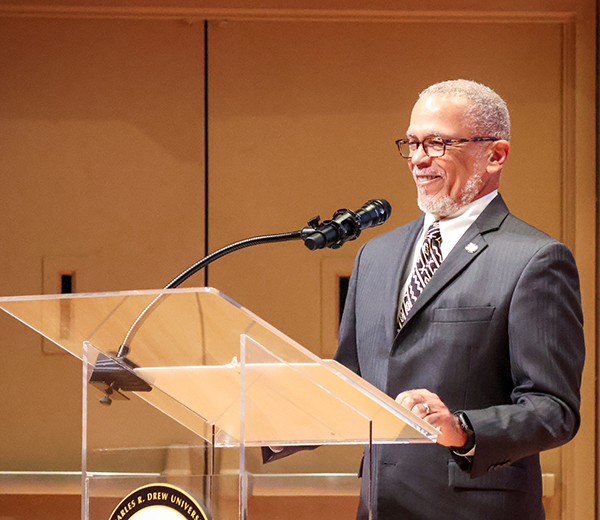
University President and CEO Dr. David M. Carlisle opened the conversation by acknowledging the tension shaping the national climate and the enduring role Drew University has played in shaping history since its founding in the aftermath of the 1965 Watts Riot.
“CDU’s 60th anniversary carries such profound meaning because 60 years later, and against all odds, we are still here, blocks away from the epicenter of an uprising that demanded we exist,” Dr. Carlisle said. “Still training physicians, nurses, and public health professionals who return to serve the communities that need them most; and still advancing health equity as a daily responsibility because health equity is a civil rights issue.”
Legendary civil rights leader and community organizer Dolores Huerta energized the audience with a direct call to organize and protect democracy.
“We have such a big fight on our hands,” Huerta said. “In 2026, we’re going to have midterm elections and every one of us has got to get out there to recruit, organize and get more people on the ground.”
Her message reminded those in attendance that democracy is not self-sustaining, it requires participation, vigilance and people power.
Connie L. Rice, a nationally acclaimed civil rights attorney, delivered a keynote address that served as both warning and blueprint. Drawing parallels between today’s political polarization and the civic collapse of the 1850s, Rice argued that the nation is no longer operating within a traditional civil rights framework.
“We must become builders of a rule-of-law democracy that radically reconstructs society to put human well-being first, end necrocapitalism that kills people, and put universal opportunity and upward mobility at its core,” Rice said. “We must become the architects of E Pluribus Unum, out of many, one democracy.”
A distinguished panel moderated by Carlisle further explored what civil rights leadership must look like in this era.
Tavis Smiley, managing editor and host of the nationally syndicated Tavis Smiley radio show, reflected on the kind of servant leadership required in this moment.
“You can’t lead people unless you love people and you can’t save people unless you’re serving people,” Smiley said. “By love, I simply mean that everybody is equally worthy just because. When we tap into that definition of leadership, leadership that loves us and serves us, then we can have a different kind of conversation.”
Philanthropic leader Joanna S. Jackson emphasized the responsibility philanthropy has to stand courageously with communities.
“Movements and servant leaders are going to do the work whether philanthropy shows up or not,” Jackson said. “The question is how is philanthropy going to show up and move in partnership.
“Are we going to stand up and be courageous the way people in the community are being courageous because they have no choice?” she added. “We have the responsibility to fund in a way that allows people to be in the work for the long haul.”
Thomas Saenz, president and general counsel of the Mexican American Legal Defense and Educational Fund, addressed the judiciary’s critical role in protecting civil rights and called for boldness.
“We depend on the courts today because they’re the only branch that is not wholly owned by the White House,” Saenz said. “The responsibility of all of us is to support good judges and make sure more judges gain courage. This is the chance to revisit the long established limitations on civil rights in the courts that have no application today.”
To close the panel discussion, Carlisle invited each panelist to offer final reflections. Their responses converged on the defining moment our nation faces.
“We are the ones right now who have to show up and make sure that we protect elections and continue to build forward,” Jackson said. “Future generations will look back at this moment in history. It is our responsibility to show up with courage, with love, with hope, and do the work in a way that invites people in to build a bigger ‘we.’”
For more than a decade, the Charles Drew University President’s Breakfast has served as a platform for informed dialogue and collective strategy. This year, the gathering moved decisively beyond reflection. It offered a clear blueprint to build institutions that center human well-being, to defend democratic norms, to support courageous leadership, and to expand opportunity for all.