By Cynthia Gibson
Contributing Writer
CULVER CITY — “Uncle George The Music Man,” a documentary chronicling the life of George Daniels — the godfather of music for generations of rap, hip-hop, soul, and R&B artists — closed the 34th Pan African Film & Arts Festival Feb. 22 at the Culver Theatre.
The festival featured more than 150 films from 40 countries, 27 world premieres, 22 U.S. premieres, 41 West Coast premieres, and 18 Los Angeles premieres. In addition to the screenings, the festival encompassed a week-long Artfest, a spoken word fest, a comedy fest, a fashion show, industry panel discussions and special programming for seniors, teens and children.
The closing-night film shined a light on the influential “unsung hero” and cultural gatekeeper who powered George’s Music Room in Chicago. The small, independent record store was a must-stop destination for music icons, executives, entertainers, and fans for more than five decades.
Long before algorithms from streaming platforms like Spotify and Apple Music shaped musical preferences, independent record stores across the country partnered with Black radio stations to promote the work of Black artists.
“Only AM radio stations played Black music back in the day, and they were literally on 24 hours a day,” Daniels said. “They had on-air personalities doing live shows in every market that had a station playing Black music. When it comes to bringing music to the public, there’s a lot of history that needs to be talked about.”
From Beyoncé to rapper Common, Daniels supported generations of talent — often before they became household names. Narrated by TV and radio personality and podcast host Sway Calloway, the one-hour-and-45-minute documentary captured how Daniels’ advocacy, industry savvy and personal style helped elevate Black-owned music retail and transform careers.
The film featured testimonials from numerous artists and entertainers who benefited from Daniels’ support, including Common, Akon, Deon Cole, Daymond John, LisaRaye McCoy, Paula Newsome and A.J. Calloway.
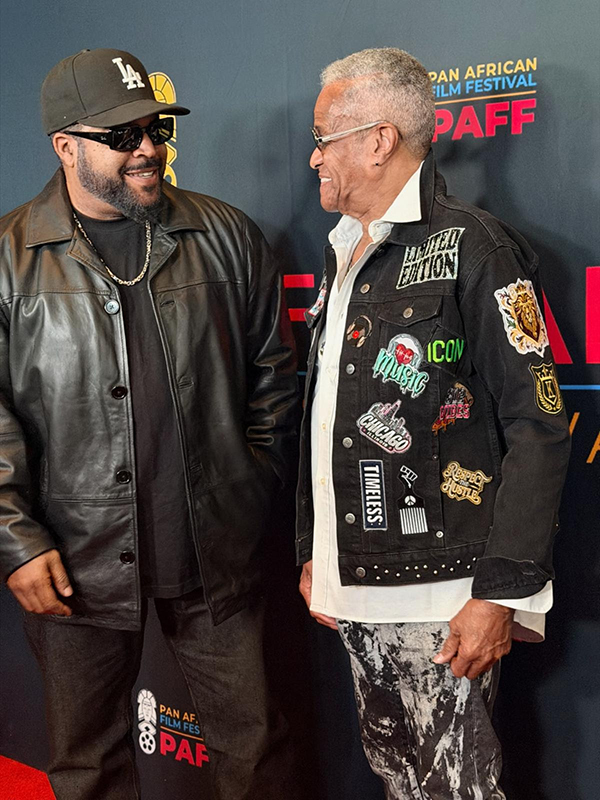
Rapper Ice Cube and R&B singer Howard Hewett were among the many artists Daniels supported who attended the screening to show their respect and admiration.
“He’s been in the game for so long and seen so many different eras of music, and he’s still here, still respected, never lost his feel for the game or his enthusiasm for artists,” Ice Cube said. “He’s always there to lend a helping hand whenever you need him.”
The “Friday” and “Barbershop” franchise star also recalled an incident in which Daniels contacted the governor of Illinois on his behalf to resolve a case of mistaken identity involving an assault suspect. The day after Daniels’ intervention, Ice Cube received a televised media apology and retraction.
“I love this man. It took him 30 minutes to contact the governor,” Ice Cube said. “We need more people like George Daniels.”
Director and writer Pamela Richardson said the film was shot in Brooklyn, Washington, D.C., Las Vegas, Scottsdale, and Chicago. Everywhere the crew traveled, she noted, Daniels was already known.
“It was so easy to get people to come out to shoot because they knew George and respected him,” Richardson said. “He’s the biggest non-celebrity celebrity I’ve ever known in my life. I’ve never seen anything like it.”
Prior to the closing-night screening, the festival awards were presented at the Filmmakers Awards Brunch at Baldwin Hills Crenshaw Plaza. Eighteen award-winning films were recognized across categories including Jury Awards, Audience Favorites, Programmers’ Awards, and the Ja’Net DuBois Founder’s Award, named after the actress and festival co-founder who passed away in 2020.
“What we witnessed this year was proof that Black storytelling continues to innovate, disrupt and redefine cinema,” festival Executive Director Oduduwa Olantunji said. “These filmmakers are pushing boundaries while honoring history. PAFF is more than a festival — it is an ecosystem. We champion these artists from premiere to potential distribution, and as an Academy Awards-qualifying festival, we are proud to help open doors that have historically been closed to our community.”
Filmmakers echoed the sentiment that the Pan African Film Festival serves as a vital conduit for exposure to audiences eager for Black films and to distribution channels that might otherwise remain out of reach.
Director and writer Leon Hendrix III debuted his film “Montmartre” — about a woman who finds love and a renewed passion for life while vacationing in Paris — at this year’s festival. Hendrix said his debut would not have achieved the same success at another festival. “Montmartre” won two awards: the Jury Award for Best First Feature Narrative and the Audience Favorite Award for Feature Narrative.
“PAFF is driven to tell Black stories in all their color, glory, and pride,” Hendrix said. “I’m extremely excited, proud and happy to debut at a festival where it’s clear that they care about Black filmmakers and their stories.”
As the festival concluded, organizers were already looking ahead to celebrating the festival’s 35th anniversary in 2027.
“It’s going to be an explosion of all the previous years,” PAFF Assistant General Manager Linda Bronson Abbott said. “We’re going to bring back many of the filmmakers who started with us and are now established directors and celebrity filmmakers. PAFF 2027 is going to be very exciting.”