Wave Staff Report
SOUTH LOS ANGELES — On a residential block in Hyde Park, a new multi-home project is demonstrating how California’s efforts to expand housing density can create pathways to homeownership in communities where affordability has long been out of reach.
The Coalition for Responsible Community Development broke ground last week on Fourth Avenue Homes, one of the first projects in South Los Angeles to move forward under Senate Bill 9, a 2021 law designed to make it easier to add small-scale housing in single-family neighborhoods.
The development represents a collaboration among nonprofits, financial institutions and community organizations working to show how new housing policy can be applied with community input and a focus on equity — in a neighborhood where Black and Latino families have faced decades of barriers to homeownership and where renters far outnumber owners.
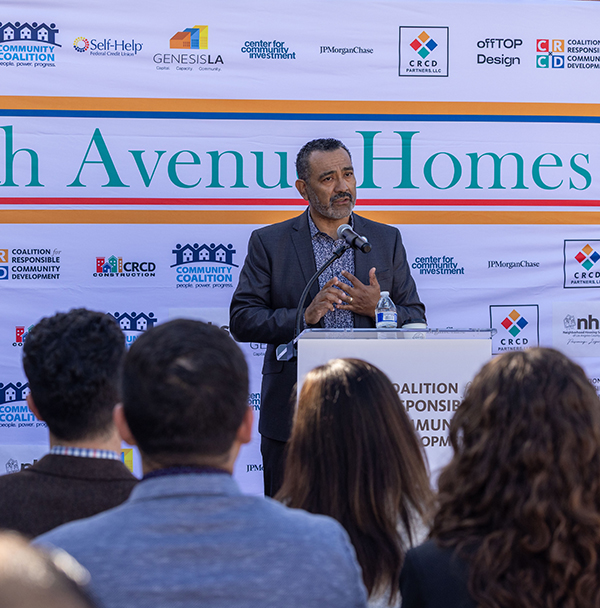
“This is the first project to move into construction under Senate Bill 9 in the Hyde Park neighborhood, and that matters,” said Alejandro Martinez, president of CRCD Partners. “It allows us to see what’s possible when a new housing policy is applied thoughtfully and at a scale that fits the community.”
Senate Bill 9, known as the HOME Act, allows eligible properties to accommodate up to four residential units without requiring discretionary approvals or public hearings. The law was designed to address California’s severe housing shortage by making small-scale development more accessible.
For Martinez and the Coalition for Responsible Community Development, Fourth Avenue Homes represents an opportunity to use the new framework to create homeownership opportunities in South Los Angeles, where incomes are lower than the city average and where rising housing costs have steadily pushed ownership out of reach for working families.
The project emerged from years of planning and community engagement. Martinez said the development team worked closely with residents and nonprofit groups to ensure the project would serve the neighborhood’s needs.
“It allowed us to meet with community residents and talk about what it means to be able to sell a home — and then to decide who gets to buy it,” he said. “We want this to be scalable. We want others to learn from our successes.”
The architectural design was led by Demar Matthews of offTOP Design, a Los Angeles-based firm focused on creation rooted in Black culture and community. Matthews, who earned his master’s degree from Woodbury University and received the Graduate Thesis Prize for his project on Black architecture, brought a particular sensibility to the Hyde Park development: buildings that would fit the neighborhood’s existing character while serving families who have long called South L.A. home.
A distinctive feature of the project is its use of tenancy-in-common ownership, which allows buyers to purchase shares of a property rather than owning it outright. The structure can lower the barrier to entry for working families who have been priced out of Los Angeles’ housing market.
Self-Help Federal Credit Union is developing a mortgage product tailored to that structure, which has historically been difficult to finance.
“For many working families, buying a traditional single-family home is impossible,” said Todd Cooley, a Self-Help representative. “Tenancy-in-common homes can serve as a first step — a way to build equity, stability and a long-term stake in the communities that folks have been living and working in for a long time.”
Cooley emphasized that responsible lending practices and thoughtful underwriting can make homeownership accessible to families without intergenerational wealth — a critical need in neighborhoods like Hyde Park where the racial wealth gap has widened over generations.
The project brings together Genesis LA, a nonprofit developer; JPMorgan Chase, which has committed more than $1.5 billion to affordable housing in Los Angeles; and Community Coalition, a South L.A. advocacy group co-founded by Mayor Karen Bass.
Emily Dane, representing JPMorgan Chase, described the project as an example of innovative housing solutions that address both affordability and equity in communities that have historically been disinvested.
“This project is groundbreaking in every sense,” Dane said. “Our goal was simple: support bold cross-sector strategies that go beyond individual projects.”
Marsha Mitchell of the Community Coalition emphasized the importance of centering residents in the development process and ensuring that homeownership opportunities reach Black and brown families who have faced systemic barriers to building wealth.
“The people closest to the problem usually have the solution,” Mitchell said, describing the months of community convenings that helped shape the initiative. “We want to make sure we can replicate this, because it will help to address a myriad of things, like the wealth gap in this country.”
Martinez emphasized that the project is designed to help residents stay rooted in the communities they know, rather than being displaced by rising costs.
“It’s an opportunity for individuals to come back to their communities, spend their money locally, send their kids to local schools, and be around their social networks,” he said.
Tom De Simone, executive director of Genesis LA, said the partnership is already planning additional projects, including a second development on South Figueroa Street, as part of a broader effort to expand housing options in neighborhoods that have historically had limited pathways to ownership.
“We’re here because we know this city needs more housing — and we need more housing that people can own a piece of,” De Simone said. “This is the beginning, not the end.”
Local elected officials also recognized the milestone. Hallie Hutt, field deputy for Assemblywoman Tina McKinnor, D-Inglewood, and a South L.A. resident herself, presented a certificate honoring the project — and reflected on what it means for young people trying to build lives in the neighborhoods where they grew up.
“To be just turning 30 and hoping that my parents don’t sell so I can raise my family in the same home I grew up in,” Hutt said, “this opportunity is amazing.”
Martinez reflected on what Fourth Avenue Homes represents beyond its four units: a pilot project testing whether new state zoning laws can be used to develop entry-level homes that integrate into existing neighborhoods and help prepare residents for homeownership.
“This is a starting point,” he said. “It helps set the foundation for future investments that support homeownership, stability, and long-term opportunity for families who already call Hyde Park home.”