By Roxsy Lin
Contributing Writer
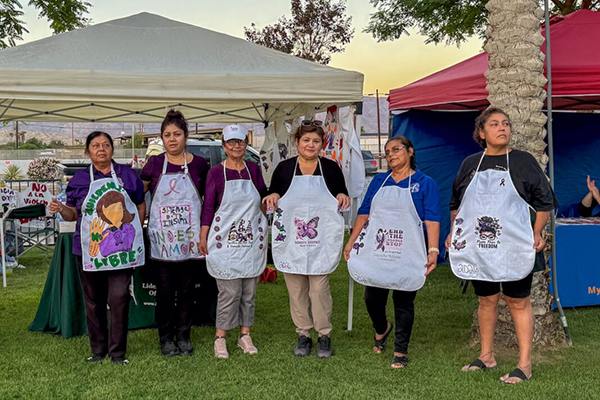
RIVERSIDE — In communities throughout the state, members of the nonprofit Líderes Campesinas gathered to paint small aprons with messages centered on domestic violence.
For many of the women, the messages were deeply personal, drawn from their own experiences of abuse.
The colorful aprons, known as “mandilitos” in Spanish, are part of a series of exhibits and community events Líderes Campesinas organized through October to mark Domestic Violence Awareness Month. Events were held from Monterey County to the Coachella Valley.
Lourdes Contreras, coordinator of the organization’s Coachella Valley and Soledad adult chapter, explains the mandilitos symbolize “the women, the mother,” who often bear the burden of domestic violence while trying to keep their families together.
Each year, Líderes Campesinas, which means rural or peasant women leaders, selects a slogan from member submissions across the state. This year’s chosen slogan reads, “Mi voz rompe el silencio, mi valor cambia historias” (“My voice breaks the silence. My courage changes stories”).
According to Contreras, the message aims to encourage women to break the silence that often surrounds domestic violence and share their experiences as a step toward seeking help and ending the cycle of abuse.
The message also seeks to recognize the courage it takes to speak out, while emphasizing how sharing personal experiences can inspire others to seek support and begin their own journeys toward healing.
“The moment you decide to speak up, your story will change, and at the same time, you will change the stories of many women who are going through the same thing you are,” Contreras said in Spanish. “It’s very important that we have courage.”
She and her team of volunteers can often be found at information tables set up at community outreach events and exhibitions. Their goal: to remind community members who may be experiencing abuse that they are not alone and that help is available.
Contreras says women can often be uncomfortable speaking openly when their husbands or partners are present. By maintaining a visible presence in parks, stores, and community events, she hopes these women will remember where to turn when they need help.
“If we manage to help even just one person, I feel good, happy, and truly satisfied with myself,” she said adding, “Today, I’ve done my part.”
Erika Guevara is a volunteer with Líderes Campesinas. “We are the eyes of the agencies [that help domestic violence survivors]” she said in Spanish, noting their presence in the community helps them direct survivors to agencies that can provide additional assistance.
Guevara also emphasized the importance of reaching younger generations. Her children, 7 to 11 years old, helped create some of the mandilitos, writing messages such as “El amor no debe herir” (“Love shouldn’t hurt”) and “Mi palabra ‘no’ tiene valor” (“My ‘no’ matters”).
In the Coachella Valley, 14 volunteers helped organize 35 exhibits, a vigil, and a march. The activities reached communities including Thermal, Oasis, Mecca, North Shore and Indio, among others.
Farther north, in Soledad, a Monterey County city about 133 miles south of San Francisco where 80.7% of residents are Latino, volunteer Maria Pereda and her team carried out similar outreach efforts. With the support of 10 volunteers, they set up four informational tables and organized two vigils to raise awareness about domestic violence.
Pereda, 60, says the work is rooted in her experience as a survivor.

At 17, she endured physical abuse, threats, and isolation at the hands of her partner, a man 18 years her senior. Financially dependent on him, she endured six years of abuse without knowing that organizations and resources were available to help protect her and her daughters.
“You can’t move forward in life if you let fear hold you back,” Pereda said in Spanish.
Those experiences left lasting emotional scars, but they also motivated Pereda to learn about women’s rights and help others facing similar circumstances. Six years ago, she joined Líderes Campesinas, where she learned about legal protections and resources available to survivors of domestic violence. Equipped with that knowledge, she became determined to help other women recognize their options and seek support.
She believes raising awareness about domestic violence is essential, especially given the many women who have lost their lives to abuse.
According to a report by the U.S. Department of Justice, Bureau of Justice Statistics, and FBI, in 2025, 41.3% of female homicide victims in the United States were perpetrated by a current or former intimate partner.
While the statistics reveal the devastating consequences of domestic violence, volunteers like Guevara believe that change begins within communities, through awareness, solidarity and a willingness to support those experiencing abuse.
“I’ve always said we need to stand more united and look out for each other,” she said.
Roxsy Lin is a UC Berkeley Local News Fellow whose reporting centers on Latino communities. This story was provided by American Community Media.