By Emilie St. John
Contributing Writer
INGLEWOOD — The City Council has approved a $261 million public-private partnership that will build the Inglewood Transit Connector’s mobility hubs and reenvision the streets of downtown Inglewood.
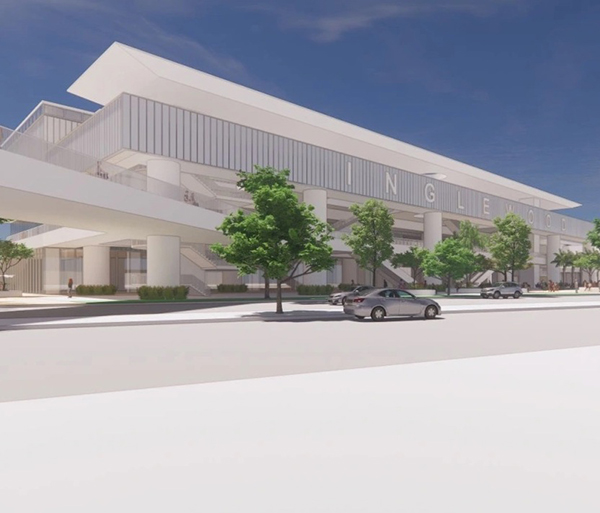
The mobility hub is designed to meet the growing need to connect transit riders from the K Line to the Inglewood Sports and Entertainment District that houses the Intuit Dome, Hollywood Park, Kia Forum and the Intuit Dome.
The project has been in the works since 2019 after an environmental report stated the Intuit Dome would contribute to a “significant and unavoidable” increase in traffic, noise and pollutants and that drivers would see more traffic at up to 61 intersections and at eight segments of the San Diego (405) and Glenn Anderson (105) freeways.
The city proposed building a $2 billion automated people mover system that lost federal funding after Rep. Maxine Waters, who represents Inglewood, wrote that the project was too costly and that the city didn’t look for other transportation alternatives.
“It will not provide convenient connectivity to employment or public services for local residents,” she said. “The ITC is designed primarily to allow public transit users to connect the extra 1.6 miles from K Line to sports and entertainment venues. Shuttle buses could most likely accomplish the same goal at a fraction of the cost, but have not been seriously considered as an alternative.”
The city then looked into the creation of mobility hubs as a way to ferry public transit users from the downtown Inglewood corridor to the sports and entertainment district.
“Inglewood has proven what can be accomplished when we set our sights high,” Mayor James T. Butts Jr. said. “This agreement caps our cost, and construction is funded through a partnership with the state and the Metropolitan Transportation Authority — using grant dollars we competed for and won, and not a dime from the general fund. When the world arrives in 2028, Inglewood will have the downtown transit capacity to meet the moment, and our residents will have it long after the world goes home.”
During the 2026 FIFA World Cup in June and July, the MTA moved record numbers of fans to and from matches at SoFi Stadium using dedicated bus lanes, signal priority and expanded shuttle service, demonstrating that the same tools now being built into the Inglewood Transit Connector project can meaningfully cut event-day gridlock in Inglewood.
Dedicated event-day shuttle lanes will run from the north and south of the city to the sports and entertainment district, with synchronized signals giving buses priority through the corridor. Improved commuter shuttle service will be deployed for both every day and event day trips — closing the first/last-mile gap between the K and C Lines and key destinations across the city.
Elevate Inglewood Development Corporation was selected as the best value proposer through a competitive procurement. The consortium is led by Plenary Americas as the developer, with Swinerton as design-build contractor and Walter P. Moore as architect of record.

“This agreement gives Inglewood one contract, one team, one fixed price and one deadline,” Councilman Eloy Morales Jr. said. “The developer carries the cost and schedule risk, which protects Inglewood taxpayers. This is how we build something that uplifts downtown Inglewood and keeps it thriving for generations to come.”
Through the agreement with EIDC, Market Street, Manchester Boulevard and Queen Street will be reenvisioned with new hardscape and landscaping, irrigation, traffic controls, street furniture and pedestrian-scale lighting. Three mobility hubs will be constructed, collectively delivering more than 1,000 new parking stalls, along with a pedestrian bridge over Florence Avenue connecting the downtown core directly to the K Line’s Downtown Inglewood Station. The plan also preserves all necessary right-of-way for a high-capacity automated people mover system in the future.
The largest hub, at Market Street and Florence Avenue, brings transit-oriented retail, parking, a bus plaza and a kiss-and-ride lot to downtown. The work is being coordinated with the city’s Destination Market Street program, which is funding facade and tenant improvements along the same corridor.
“Downtown Inglewood is the heart of this city, and this vote is an investment in it,” Councilman Alex Padilla said. “New sidewalks, lighting and mobility hubs will give our small businesses the foot traffic and the front door they deserve.”
Emilie St. John is a freelance journalist covering the areas of Carson, Compton, Inglewood and Willowbrook. Send tips to her at emiliesaintjohn@gmail.com.