By Stephen Oduntan
Contributing Writer
LOS ANGELES — As December arrives each year, Kwanzaa returns to public conversation — often framed by a familiar question: Why hasn’t it become as widely practiced as other cultural holidays?
Created in 1966 by the Black nationalist organization US — whose name signifies “us” as opposed to “them” — Kwanzaa emerged during a period of intense political organizing aimed at cultural self-definition and collective responsibility among Black people in the United States.
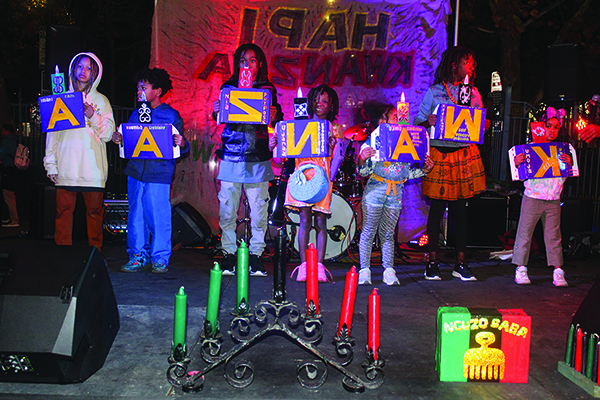
Conceived as a nonreligious, African-centered observance running from Dec. 26 through Jan. 1, it centers on Nguzo Saba — the seven principles of unity, self-determination, collective work and responsibility, cooperative economics, purpose, creativity and faith — principles intended to guide daily life, not just a season.
In its early decades, Kwanzaa gained broad visibility. During the 1980s and early 1990s, it was frequently mentioned alongside Christmas and Hanukkah, taught in schools, featured in mainstream media and even marketed by major retailers. Kwanzaa greeting cards, candles and kinara appeared in department stores, and popular artists released Kwanzaa-themed music.
That level of visibility, however, proved difficult to sustain.
In a 2012 NPR segment titled “Is Kwanzaa Still a Thing?”, Duke University professor Mark Anthony Neal traced the holiday’s rise to a period when access to Black history and African-centered scholarship was limited. At the time, Neal noted, Kwanzaa offered cultural grounding and structure that many institutions did not yet provide.
As Black studies programs expanded, digital access to Black history grew and African-American culture became more visible year-round, the urgency that once fueled Kwanzaa’s growth faded.
“There’s just not that kind of intensity around the holiday,” Neal said, adding that for many families, Kwanzaa never replaced Christmas but existed alongside it — if at all.
More than half a century later, Kwanzaa is approaching its 60th anniversary. Yet the perception that it failed to “spread” may rest on a misunderstanding of what the holiday was intended to be.
For Thandisizwe Chimurenga, who has reported on Black cultural and political movements for decades, the framing itself is flawed.
“It has spread,” Chimurenga said, pointing to both household observances and large public celebrations in cities like Detroit, home to one of the largest Kwanzaa displays in the country. “There are people who do things within their homes, and there are public Kwanzaa celebrations.”
She stressed that Kwanzaa’s trajectory differs fundamentally from holidays like Christmas or Juneteenth — and intentionally so.
“Christmas comes from a religion that was spread all over the world,” Chimurenga said. “Kwanzaa is a uniquely African in America holiday. It grows out of our specific experiences here. I don’t expect Black people in Britain or Trinidad to celebrate it the same way — if at all.”
In her view, Kwanzaa’s reach in the United States has been shaped by two overlapping forces: historical controversy and resistance to commercialization.
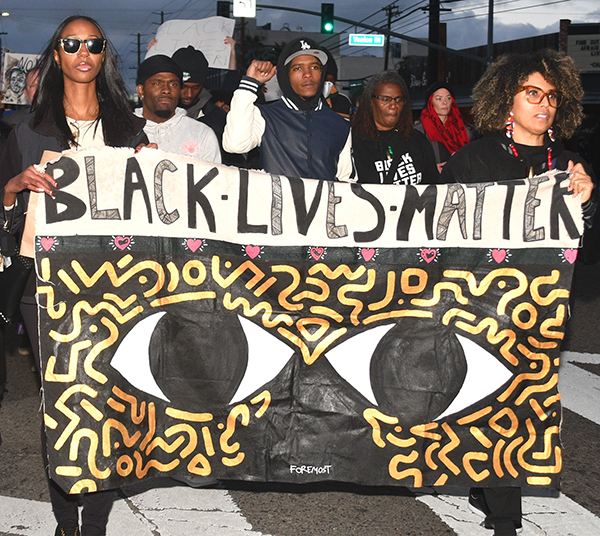
Each December, criticism of Kwanzaa resurfaces, often tied to opposition to Maulana Karenga and the organization US —particularly among those whose political memory includes the violent conflict between US and the Black Panther Party in the late 1960s, a period later shown to have been exacerbated by federal counterintelligence programs that intentionally sowed division among Black liberation groups.
“That tension exists,” Chimurenga said. “There are people and organizations who refuse to deal with Kwanzaa because it’s associated with Karenga and US. At the same time, there are many who argue that the principles predate Karenga — that they’re ancient, African and universal — and they separate the ideas from the individual.”
Equally significant, she said, is that longtime practitioners have actively resisted Kwanzaa’s commercialization — an ethos that helps explain why the holiday has receded from mainstream retail spaces.
“You’re not supposed to buy a Kwanzaa product from a big white corporate store,” Chimurenga said. “That defeats the purpose.”
On the ground in Los Angeles, cultural organizer Billion Godsun of the Africatown Coalition sees the issue less as disappearance than displacement.
“I don’t really see younger people practicing it the way the generation before me did,” Godsun said. “You hear them talk about it online, but the community events don’t draw like they used to.”
He pointed to Leimert Park — long regarded as the cultural hub of Black Los Angeles — and to Africatown, where merchants still host Kwanzaa-related programming, though turnout varies. This year, local businesses plan to host events aligned with each day of the Nguzo Saba, though Godsun said participation remains uncertain.
Gentrification, he added, has reshaped the cultural landscape of historically Black neighborhoods.
“You’ve got more people, different races, different traditions,” he said. “People are doing Navidad, Hanukkah, Christmas. Kwanzaa doesn’t have the same space to grow like it might have before.”
The COVID-19 pandemic delivered another blow. Before the shutdowns, multiple community centers hosted Kwanzaa events with strong attendance. Since then, Godsun said, the momentum has not fully returned.
For Letha Davis, a longtime community elder and veteran of civil rights-era organizing, Kwanzaa arrived at a moment when her life was already shaped by decades of activism.
“I was curious,” Davis said of first hearing about Kwanzaa. “But I didn’t really know what it was all about. There was no internet back then — everything was word of mouth.”
By the time Kwanzaa emerged, Davis said she was “fresh out of the movement,” having spent years marching, participating in sit-ins and organizing for voting rights, including the Selma-to-Montgomery march.
“I respected what he was doing,” she said of Karenga’s role in Kwanzaa’s creation. “I understood that something he’d been through led him to help shape it.”
Still, Kwanzaa never became a regular practice in her household.
“It just wasn’t one of the things I dug into,” she said. “I had already been through a lot.”
Over time, her relationship to Kwanzaa became indirect but respectful. She watched her grandchildren participate in celebrations and said she supports the values being taught, even if she never fully embraced the observance herself.
“I’ve celebrated it before — the candles, the meanings of the days,” she said. “My grandchildren can explain it better than I can now.”
Taken together, these perspectives suggest that Kwanzaa’s story is not one of disappearance, but of evolution. It persists in homes, community centers and cultural spaces, even as its public footprint has narrowed.
As Chimurenga put it, “Kwanzaa hasn’t gone anywhere. It just doesn’t announce itself the way people expect.”
Stephen Oduntan is a freelance writer for Wave Newspapers.