Wave Staff Report
LOS ANGELES — A group of Latina leaders gathered at Cal State Los Angeles earlier this month to soft launch an upcoming multidisciplinary art project, “A Bill of Rights for Our Future.”
As the United State approaches the 250th anniversary of its founding on July 4, Hispanas Organized for Political Equality (HOPE) is reimagining the Bill of Rights.
The nonprofit is examining the first 10 amendments of the U.S. Constitution and asking how they can be supplemented in a country that is much more diverse than the one known by the Founding Fathers.
HOPE tasked a diverse group of Latinas to view the Bill of Rights through a 21st-century lens and produce 11 — not 10 — amendments that would address key issues the nation faces in the present day.
“Latinas weren’t at the table at that time, but we are today,” said HOPE Chief Executive Officer Helen Torres. “That was the genesis for the idea of ‘A Bill of Rights for Our Future.’ It’s really centered on the concept of what our community needs today. We are building on the rights that are currently there but thinking futuristically, and asking, how do we protect those rights?”
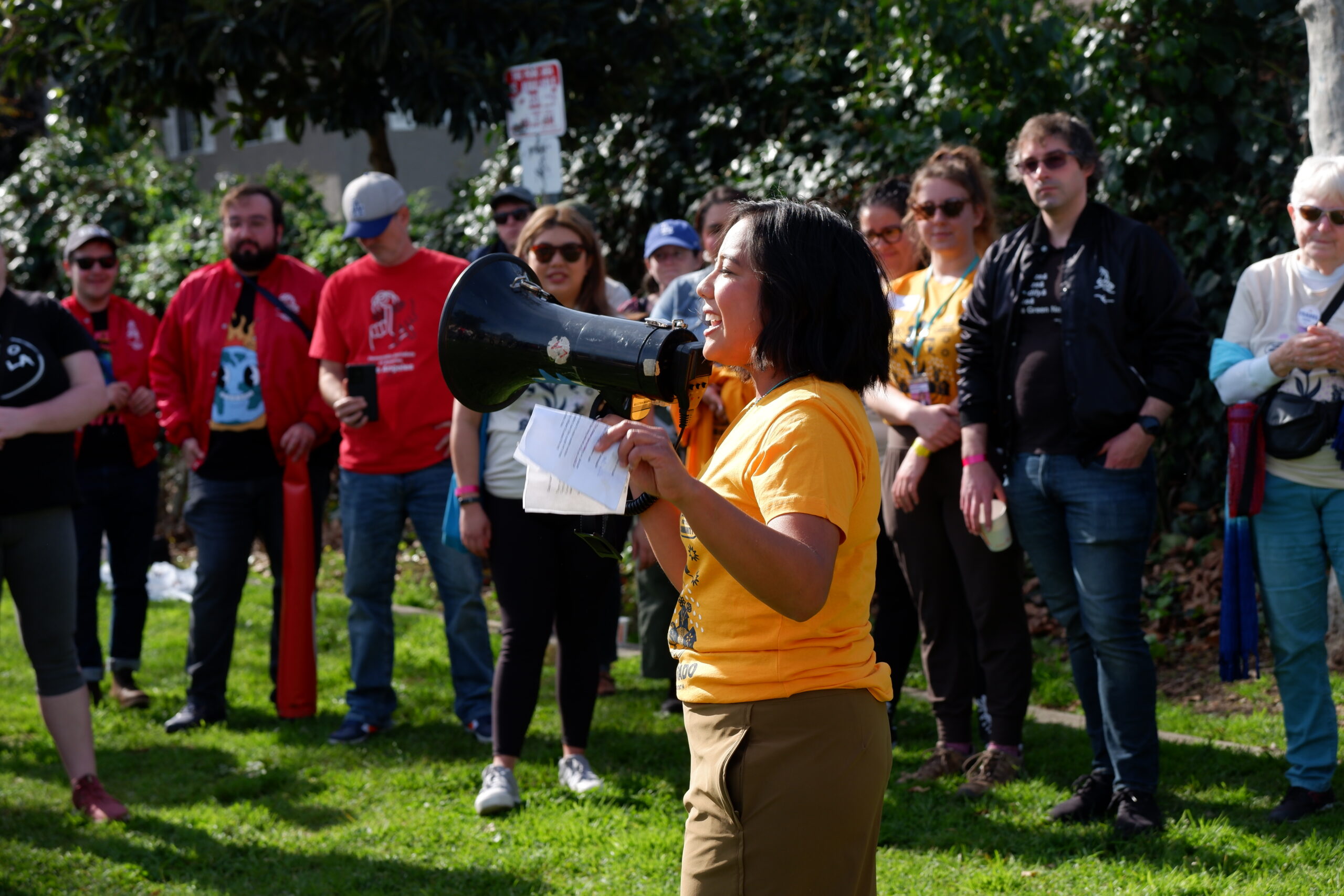
The March 5 event, the 35th annual Latina History Day VIP Salon, highlighted Cal State L.A.’s strong ties with HOPE. More than 200 Cal State L.A. students and distinguished thought leaders from around Los Angeles attended “The Future We Claim: Leadership and a Bill of Rights for Our Future” salon.
“At Cal State L.A., we have many first-generation students,” said President Berenecea Johnson Eanes in her welcoming remarks. “Many are working while earning their degrees. Many are the first in their families to step into spaces like this. This room is filled with women who look [like them]. That’s why it’s important for us to do this. We are proud to host you tonight. This is your home. We are proud to be your partner; we are proud to be the university that serves as the civic home for these conversations.”
HOPE is a nonpartisan organization committed to ensuring political and economic parity for Latinas through leadership, advocacy and education to benefit all communities and the status of women. Its programs and educational events are open to all individuals who support Latina leadership to strengthen democracy and advance economic mobility.
More than 350 Cal State L.A. alumni, including Associate Vice President for University Advancement Luisa Acosta, are members of HOPE.
“Tonight, I see the intersection of access and advocacy, education and empowerment, opportunity and responsibility, and I am simply grateful as an alum and as a HOPE sister to witness two powerful forces come together,” Acosta said. “When education and leadership development align, when access means advocacy, when we invest in women who invest in others, we don’t just host events, we build legacies.”
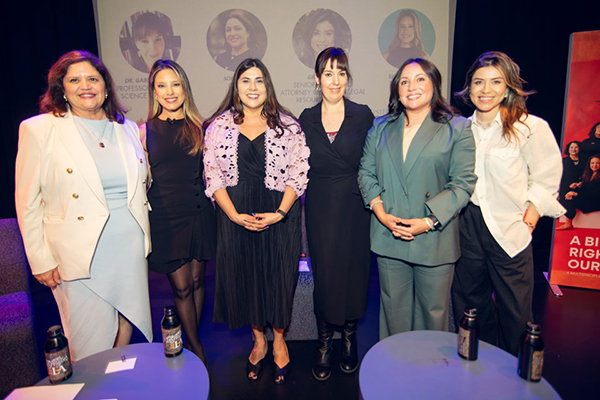
The salon featured a panel that included Gabrielle Clark, Cal State L.A. professor of political science; Sonja Diaz, civil rights attorney and founder of Unseen; and Grisel Ruiz, senior managing attorney with the Immigrant Legal Resource Center. Telemundo host Silvana Effio served as the moderator.
Much of the discussion centered around how to preserve individual rights. The panelists provided hope, pointing out that progress over the United States’ 250 years has not come in a straight, continuous line.
“We’re moving away from established rights for women, marginalized communities, immigrants, etc.,” Clark said. “So, what can students take from this? The Constitution is vague and indeterminate. That can be good and bad, so keep investing in the good.
“While the moment right now is not the most propitious for realizing a particular goal, your time will come again,” Clark added. “I want to have hope that the pendulum will swing and students, as they invest in their ideas for social progress, will be vindicated. I see it every day in my classroom at Cal State L.A.”
Said Diaz: “What gives me hope is the anger, the rage, the engagement. It’s the way that people are opening their eyes and getting activated. It’s the youth who are staging walkouts in their schools. All of that is what truly gives me hope.”
Ruiz and Diaz were two of the participants in the “A Bill of Rights for Our Future” art project, which will officially launch online in April. Over several months in 2025, they looked to build upon the original amendments’ enduring principles by offering bold proposals that reaffirm their original promises while extending their vision for the future.
Diaz explored the right to universal health care, while Ruiz tackled the right to thrive as a human being. The other topics covered in the project are real opportunity, food, equal education, equal pay, equitable infrastructure, the pursuit of economic opportunity, financial independence, compensation for digital labor and data, and full and meaningful participation.
“The project revolves around these Latina voices, but it’s designed to have everyone be engaged,” Torres said. “The Bill of Rights is strong. Those rights need to be protected and defended, but our project explores what needs to be added to them, knowing what we know today with the experiences that we have today.”
The salon, which was co-sponsored by the Public Relations Student Society of America, was preceded by a reception at the University Club.