By Manuel Ortiz
Contributing Writer
LOS ANGELES — It’s a cold Sunday afternoon in MacArthur Park near downtown Los Angeles. The air is thick with the smell of urine, trash and burning drugs. An occasional scream echoes through the air, likely someone fighting off an unseen ghost.
Mostly men wander among the palm trees, walkways and surrounding streets, their eyes wild and mouths agape. Some walk slowly, their bodies hunched over. At times they become completely still, their torsos collapsed — the “fentanyl fold,” as it’s known, the typical zombie-like posture of those who have succumbed to the powerful opioid.
Located in the densely populated and largely Latino Westlake neighborhood, and bisected by Wilshire Boulevard, MacArthur Park covers 35 acres, a large artificial lake at its center.
What was once envisioned as an urban oasis for working-class families has transformed into a haven for gangs, drug trafficking and the sale of stolen goods, as well as a refuge for the homeless. However, with no other option, some low-income families still use the park to relax and let their children play.
Others, like Edie Baltazar, come to preach the gospel.
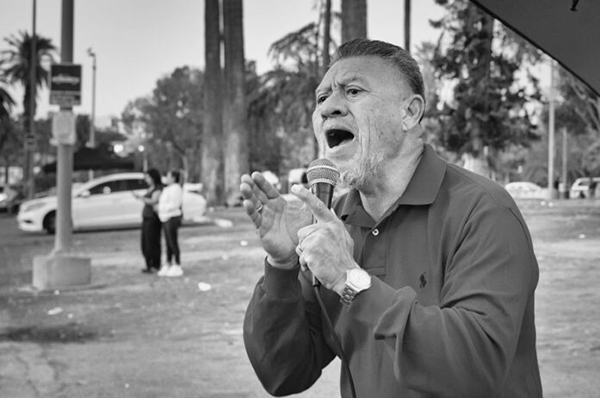
Minutes before darkness completely envelops MacArthur Park, microphone in hand, a small crowd — their faces showing visible signs of hardship — listens attentively as Baltazar implores his listeners to abandon drugs and alcohol.
“I am as much a sinner as any of you,” he says. “We are the same. I know what hurts you, I know what attracts you, because I have been there.”
Tears well up on more than a few of the faces.
“On the path of Jesus, you are no longer bad,” continues Baltazar, who holds down a regular 9 to 5 job in order to be in the park each Sunday. “We’ve seen many die in this park, and Jesus died for all of us.”
In another section of the park, Jack, a barber, provides free haircuts to park residents.
“For me, what I do is very satisfying,” says Jack, part of the nonprofit Feed the People, which provides food and social services to the area’s unhoused. “It gives people confidence in themselves; it allows them to see themselves as they are.”
One of those people is Germán.
“I was walking by and saw that they were cutting hair and giving people food;” Germán said. “It’s extraordinary work. This is what I call contributing to the community, one haircut at a time.
“I realized that this guy [Jack] does an excellent job, so I decided to try it. Helping people is rewarding. I want to volunteer if they’ll let me,” Germán added.
Across from MacArthur Park at the intersection of 6th Street and South Park View is the Mexican Consulate General’s office, one reason why many Mexican immigrants frequent the park during the week.
The park also has a close connection to Central American immigration, explains Raúl Claros, who is running to represent District 1, which includes MacArthur Park, on the Los Angeles City Council.
Claros’s father arrived in the Westlake neighborhood in the 1980s fleeing civil war in El Salvador, a war the U.S. helped subsidize, prolonging the violence and fueling migration to cities like Los Angeles, Claros said.
As night falls, Claros and I walk along the park’s dimly lit paths. The atmosphere is tense. A young white man, walking briskly while dragging his right foot, approaches us, urgently trying to sell us a bread toaster for $10.
Claros points out that many people die in MacArthur Park, whether from overdoses, drowning in the lake, or murder.
“Do you think I can bring my daughter here for a walk/” he asked. “Do you think working families feel safe and comfortable in this park? No. The place is worth a lot, but now it’s a disaster.”
Claros blames the decisions of past politicians for the sad state of MacArthur Park and says a raid by federal immigration agents and the U.S. National Guard only made matters worse. According to Claros, the July 7 raid was never about pursuing criminals, many of whom remain, but rather intimidating Latinos and other immigrants.
As part of his commitment to improving conditions here, Claros has pledged to live in his recreational vehicle in the park for the first 100 days of his term if he wins the council seat. The primary election is in June, with the runoff in November.
There are no quick fixes here, no miracles. What there is are small, persistent, almost invisible acts: a kind word, a haircut, a presence that remains when everyone else has left. In a territory scarred by violence and drugs, these gestures don’t heal the park, but they sustain those who still walk its paths.
This story was produced by American Community Media in collaboration with the Laboratory for Environmental Narrative Strategies at UCLA as part of the Greening American Cities initiative supported by the Bezos Earth Fund. Pamela Cruz contributed to this story.