By Darlene Donloe
Contributing Writer

LOS ANGELES — The Los Angeles Black Worker Center is more than just a building on a street corner — it’s a lifeline for Black workers navigating a system that often feels designed to keep them down.
For more than a decade, the center has been the heartbeat of a movement, pulsing with the determination of those who refuse to be defined by poverty and exploitation.
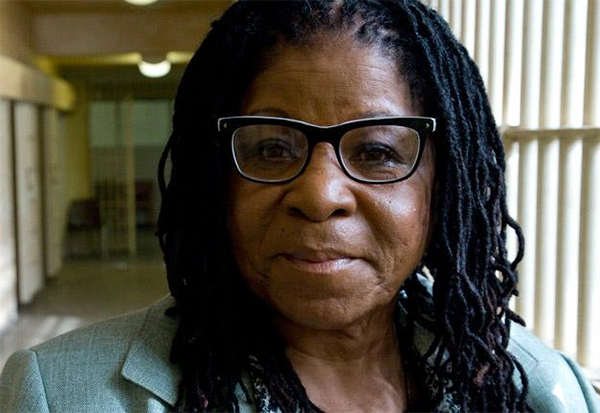
Trina Traylor, the ccnter’s campaign and coalition manager, has been with the organization for 13 years, six as a volunteer, and seven as a staff member.
She plays a key role in driving campaigns forward, working closely with the team and amplifying the organization’s message on social media.
The Black Worker Center’s mission is to increase access to quality jobs, decrease discrimination, and improve industries that employ Black workers through unionization.
The organization is tackling the ‘Black jobs crisis’ with 50% of Black workers either unemployed or underemployed.
“We envision a world where Black workers thrive in an equitable economy that builds vibrant families and communities,” Traylor said. “What we have coined as the Black jobs crisis. Fifty percent of us are either unemployed or underemployed. So what we are trying to do is build equity for Black Angelinos by creating pathways to quality jobs.”
Traylor said she is “passionate” about improving working conditions for Black workers in Los Angeles.
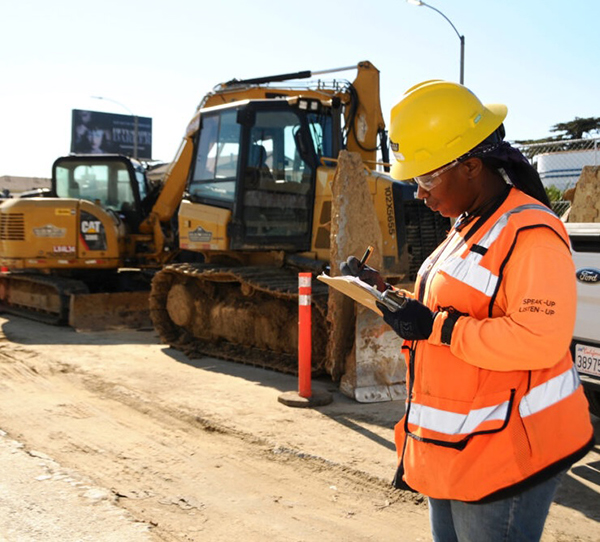
“When I first started at the Black Worker Center as an intern, there were these four Black women who were focused on construction jobs,” Traylor said. “I didn’t understand why they were so focused on construction jobs. One of my first assignments was to count the Black folks out on the Crenshaw LAX line project that Metro had.”
Traylor said she discovered there were fewer than 2% Blacks on that project.
“When the contractor was awarded that bid, they promised to do 25% local hire,” she said. “But then they claim they couldn’t find Black construction workers, and that is still a predominantly Black neighborhood.
“What drove my activism was the fact that I grew up on Crenshaw. I lived on 116th and Crenshaw. I worked at the Crenshaw Mall, and back in the day, we hung out on Crenshaw,” Traylor added. “When we uncovered that there were no Black folks out on their job, that really ignited a fire in me. Especially after I found out what those folks were making out there.
“So I would go outside, and I would talk to the non-Black folks and ask where they were from. A lot of those folks out there were actually coming in from Apple Valley.”
Traylor said eventually the center was able to get Black workers into some of the construction jobs.
“Once we were able to get our members on there, some of them were able to buy homes,” Traylor said. “It’s all about getting the opportunity. We’re doing a lot of policy work that has to do with establishing human and civil rights.”
Currently, the center is focusing on public sector jobs.
“These are unionized jobs,” said Traylor, who is in talks with the Department of Water and Power and the Port of Los Angeles about jobs. “You get a pension. You get retirement. Life expectancy is longer when you have a public sector career because of the health benefits. In the community, when you work for the public sector, the community looks up to you.”
Inside the walls of the Black Worker Center are stories of struggle and resilience.
One success story is Rene Thomas, a single father of a 5-year-old son, who transitioned from being a mailman to a maintenance laborer with the city of Los Angeles.
“I was a mailman in Studio City,” said Thomas, who attended L.A. Trade Tech. “I didn’t like the job. I went to an event at Southwest College where [the Black Worker Center] were signing people up. That was the summer of 2022. When I got picked, I quit the post office and took a chance.”
Thomas, 30, was hired in January 2023. Since then, he’s been employed by the city of Los Angeles.
“I’m a maintenance laborer, water conveyance operator,” Thomas said. “I clean the sewers. You can say I’m a plumber for the city of L.A. I love it. After my first year, I was able to purchase a home. I’m off at 4 p.m. and can pick up my son from school.”
Thomas said he would wholeheartedly recommend the program.
“I would recommend the program to anyone serious and willing to work,” he said. “I recommend it to every young Black man trying to get a job with the city. There are so many different pathways from here. I’m very thankful for the Black Worker Center.”
The center’s approach is rooted in community-led change. The organization understands that Black workers aren’t just statistics — they’re community leaders, parents and changemakers.
The center’s member-led model puts workers at the forefront of campaigns for justice, whether it’s fighting for fair wages, safer working conditions or an end to discriminatory hiring practices.
The 1000 Strong Campaign is a prime example. Launched to tackle the staggering 20% Black unemployment rate in Los Angeles, it seeks to create direct pathways to high-quality jobs. It’s not just about filling positions — it’s about building a future where Black families can thrive.
Ready 2 Work, another cornerstone program, offers more than just job training. It’s a space where Black workers share stories, build solidarity and sharpen their skills to take on industries and systems that have long marginalized them.
The center’s impact extends beyond individual success stories. Through strategic partnerships and coalition-building, it is shifting the narrative on Black labor in L.A. It is pushing for policies that address systemic inequities and holding corporations accountable for their role in perpetuating them.
The fight is far from over, but the center’s momentum is undeniable. As it continues to organize, mobilize and uplift, one thing is clear: Black workers are demanding justice and they’re not backing down.
Traylor said the organization measures its success by the number of people it is able to place in quality jobs and the salaries those people make.
“Through our workforce equity demonstration project with the Board of Public Works, we’ve placed 49 individuals in jobs, which generates approximately $3 million in annual economic impact for the community,” she said. “These placements were made in partnership with the city of Los Angeles, and the program ran from January 2023 through July 2025.”
The center’s work is a testament to the power of community-driven change. It’s a reminder that when workers come together, they can challenge even the most entrenched systems of oppression.
“We just established 501(c) 4 status,” Traylor said. “C4 means now we can endorse candidates. It gives us a lot more power.”
The center isn’t just building a movement. It’s trying to build a future where Black workers can thrive, not just survive.
Darlene Donloe is a freelance reporter for Wave Newspapers who covers South Los Angeles. She can be reached at ddonloe@gmail.com.