Staff and Wire Reports
LOS ANGELES — The unveiling of new memorial plates at the Honoring Our Fallen Memorial Wall in Long Beach was one of the many ways cities throughout Los Angeles County celebrated Memorial Day May 25.
The newly added plates will honor individuals who died in World War I, World War II, the Korean War, Vietnam War, Operation Desert Storm and Operation Desert Shield, the Global War on Terrorism, first responders and those who died from suicide, according to Laura Herzog, the founder, CEO and director of programs for Honoring Our Fallen.
The reading of the nearly 7,000 names of Americans who have died in combat and training exercises since the 9/11 attacks as reported by U.S. Central Command was held at Rosie the Riveter Park in Long Beach. Members of Gold Star families, local active-duty military members, law enforcement officers, first responders and veterans assisted in reading
the names in order of death as inscribed on the park’s memorial wall.
Honoring Our Fallen describes itself as “dedicated to serving our nation’s fallen and the families these heroes have left behind by providing comprehensive support.”
Other Memorial Day events in Los Angeles County include parades in Canoga Park and La Cañada Flintridge and ceremonies at various cemeteries and parks throughout the county.
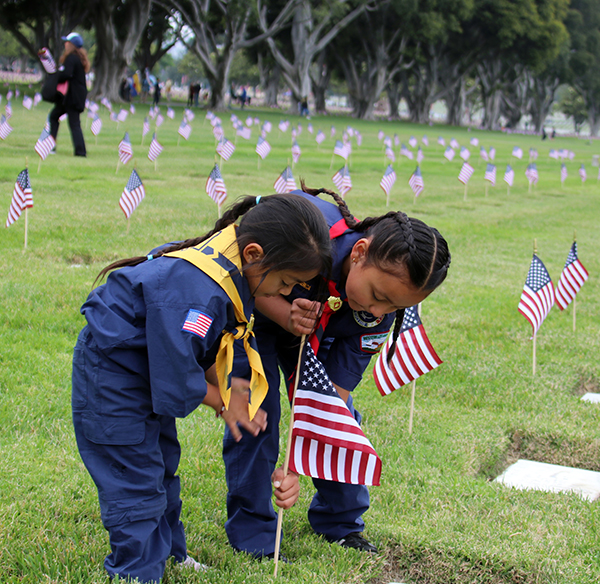
The Los Angeles National Cemetery placed U.S. flags on more than 90,000 graves of fallen service members, continuing an annual tradition that has lasted more than 50 years. Sons of the American Revolution, Daughters of the American Revolution and scouts from Western Los Angeles County Council of Scouting America along with community volunteers placed the flags on graves May 23 in a daylong event.
Memorial Day observances will be held at Forest Lawn memorial parks in Covina Hills, Hollywood Hills, Glendale and Long Beach and an outdoor Mass honoring U.S. armed forces members who died in service was celebrated by Archbishop José H. Gomez of the Los Angeles Archdiocese at San Fernando Mission Cemetery and Mission Hills Catholic Mortuary in Mission Hills.
President Donald Trump proclaimed Memorial Day as a day of prayer for permanent peace, designating 11 a.m. in each time zone as a time during which people should unite in prayer, citing a 1950 joint resolution by Congress.
Trump also asked all Americans to observe the National Moment of Remembrance beginning at 3 p.m. in each time zone under a bill signed into law in 2000 by then-President Bill Clinton. It was first held on Memorial Day in
2000 under a proclamation by Clinton in an attempt “to reclaim Memorial Day as the noble event it was intended to be, to honor those who died in service to our nation.”
The Moment of Remembrance is a “way we can all help put the memorial back in Memorial Day,” its founder Carmella LaSpada said.
Trump’s proclamation also requested governors of all U.S. states and territories and the appropriate officials of all units of government to direct that flags be flown at half-staff until noon on Memorial Day on all buildings, grounds and naval vessels throughout nation and in all areas under its jurisdiction and control.

“The greatest fighting force the world has ever known is built upon the extraordinary service of selfless men and women who safeguard our liberty and preserve our way of life,” Trump said in his proclamation. “Since the birth of our nation nearly 250 years ago, countless souls have lost their lives in this noble and righteous pursuit. On Memorial Day, we honor these American heroes.
“Today, we especially remember the 13 members of the joint force who have fallen in support of Operation Epic Fury to defend our national security and preserve the blessings of liberty for future generations,” Trump added. “These warfighters lost their lives for freedom’s cause and we will never forget the cost.”
What became Memorial Day was first observed on May 30, 1868, as Decoration Day, a time for the nation to decorate the graves of the Civil War dead with flowers.
It was established 25 days earlier by Maj. Gen. John Logan, national commander of the Grand Army of the Republic, an organization of veterans who fought for the Union in the Civil War. It is believed that date was chosen because flowers would be in bloom all over the nation.
By the end of the 19th century, Decoration Day ceremonies were being held on May 30 throughout the nation. After World War I, the holiday was changed to honor Americans who died fighting in all wars.
The term Memorial Day was first used in 1882, became more common after World War II and declared the official name by federal law in 1967.
Memorial Day had been observed on May 30, until being moved to the last Monday in May in 1971 under terms of the Uniform Monday Holiday Act, which became law in 1968.