Wave Wire Services
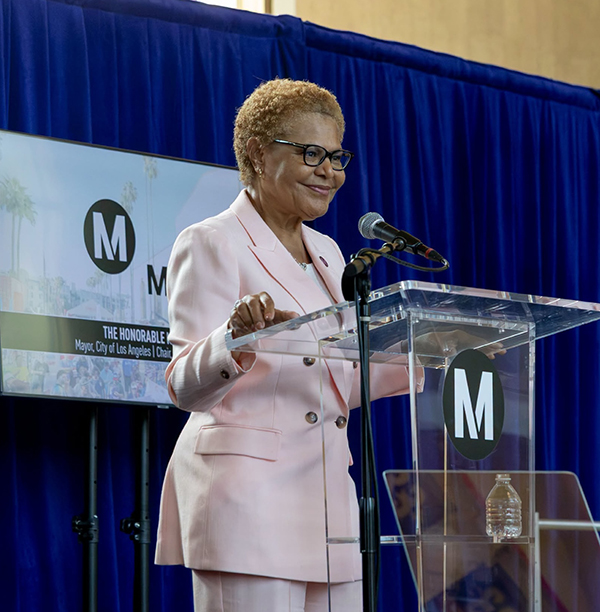
LOS ANGELES (CNS) – Outgoing Metropolitan Transportation Authority Board Chair Fernando Dutra formally presented Los Angeles Mayor Karen Bass with a ceremonial gavel July 22, as she takes the helm of the regional transportation agency for the 2026-27 fiscal year.
Bass, who will chair the MTA’s Board of Directors for a second term, shared her vision during the annual State of the Agency address at Union Station, outlining her four priorities: safety, affordability, reliability and readiness.
“That is our north star because a region where transit is safe, affordable, reliable and ready means every Angeleno can get around without a car,” Bass said. “To every community it means expanded opportunities and a stronger local
economy. It means cleaner air and a real answer to the climate crisis,” she said.
“Public transit, quite literally, is one of the most powerful tools to change and improve the quality of life, and that’s what we’re building,” she added.
Bass spoke as work continues to get the agency’s in-house Department of Public Safety up and running, and efforts continue to grow the LIFE program and develop a long-term financial strategy and plan for buses and trains to be fare-free.
On reliability and readiness, Bass said she would work to increase 80 miles of peak-hour bus lanes to more than 100 miles.
“At its core, this is about proving what we just proved during the World Cup — that we can move a crowd, and that we can run a world-class system under pressure,” Bass said.
She also spoke about the opportunities to come with the Olympic and Paralympic Games two years away, and thanked Dutra for his service.
“It’s just been a pleasure working with you over these last for years that I have served on the board,” Bass said. “You’ve been a fabulous chair, and we’re going to have to figure out how we keep you around.”
Dutra, a former Whittier city councilman, will step down from the board, having lost his re-election bid in April.
MTA officials announced that Long Beach Mayor Rex Richardson will replace Dutra on the board.
Glendale Mayor and MTA Director Ara Najarian is also expected to step down after he announced his retirement earlier this year. Glendale City Councilman Ardashes “Ardy” Kassakhian was selected to succeed Najarian in April. Last week, Santa Clarita City Councilman Jason Gibbs was elected to the board to replace Najarian in representing the cities of north L.A. County and the San Fernando Valley.
Gibbs’ appointment is expected to be finalized in a ratification vote during a meeting of the Los Angeles County City Selection Committee North County/San Fernando Valley Corridor Sector on July 30.
In his address, Dutra touted MTA’s accomplishments in the past year, such as expanding rail options with the extension of the A Line to Pomona and the opening of three new stations on the D (Purple) Line along Wilshire Boulevard, from mid-city to Beverly Hills.
He noted progress on major transportation projects such as the Sepulveda Pass Corridor Transit Project, beginning construction on I-105 Express Lanes, and construction of the Section 2 and 3 extension of the D Line, approving the K Line light rail extension route from Crenshaw to mid-city, and breaking ground for the Bus Rapid Transit route from North Hollywood to Pasadena.
“There’s a tremendous amount of fight that has to happen in order to make these projects happen,” Dutra said.
“Together, we built an MTA that lasts, that’s growing, and that’s only getting better and better day by day,” he added. “It’s been a privilege of a lifetime to serve on the board for the past five years, and to spend the final chapter as your chair.”
L.A. County Supervisor and MTA Board First Vice Chair Kathryn Barger discussed the agency’s efforts to improve safety, noting that reported violent crime has decreased by more than 22% since 2024. Operator assaults have been reduced by half and serious assaults are down by 67% as well, she said.
Barger credited the installation of taller fare gates at 26 stations, expanded tap to exit, upgraded security cameras, an opened state-of-the-art emergency security operations center, and retrofitted buses with safety barriers for drivers.

She said investments to improve station lighting, expanded cell service throughout underground station and cleaning were important as well.
“Perhaps our board’s boldest decision has been creating MTA’s own sworn police department and consolidating our multi-layers safety programs under a single Department of Public Safety,” Barger said.
Officials previously announced that former San Francisco Police Chief Bill Scott would head the new department. In June, the transit agency began recruitment of officers, with more information available at JoinMetroDPS.com.
By the end of 2029, the MTA aims to deploy in-house police officers alongside its other public safety teams utilizing a zone-based deployment model. Each zone will have at least one crisis co-response team assigned to respond to calls and do proactive engagement onboard trains, buses and at transit stations.
Stephanie Wiggins, who became the MTA’s CEO in 2021, said this year’s address emphasized the progress the agency has made over the last few years.
“Metro was coming out of one of the most difficult periods in its history — the whole world was,” Wiggins said of the early 2020s. “Ridership was down, public confidence was shaken, and our incredible employees were carrying extraordinary burdens, serving as frontline workers for Los Angeles.”
Five years later, things are much different, Wiggins said.
The MTA recorded a total of 26,265,480 rides last month, representing an increase of 2 million compared to June 2025, or a 9% growth, and separately more than 212,000 fans boarded buses for the MTA’s World Cup enhanced service.
“Our reinvention has given L.A. a new outlook, and while the World Cup revealed some of the reinvention, it certainly did not create it,” Wiggins said. “We have been evolving and transforming for years.”