By Antonio Ray Harvey
Contributing Writer
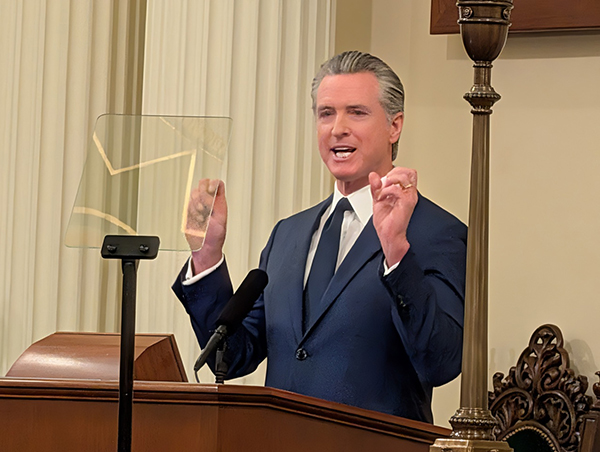
SACRAMENTO — Before a joint session of the California Senate and Assembly, Gov. Gavin Newsom delivered his final State of the State address Jan. 8, fulfilling a requirement of the state Constitution that the governor report annually to the Legislature.
Several members of the California Legislative Black Caucus were present for the address, which ran a little over an hour.
During his remarks, Newsom described California as a “beacon” of democracy and progress.
“In California, we are not silent,” Newsom said. “We are not hunkering down. We are not retreating. We are a beacon. This state is providing a different narrative, an operational model, a policy blueprint for others to follow.”
“This state, this people, this experiment in democracy, belongs not to the past, but to the future,” Newsom added. “Expanding civil rights for all, opening doors for more people to pursue their dreams. It’s a dream that’s not exclusive, not to any one race, not to any one religion, or class.
“Standing up for traditional virtues — compassion, courage and commitment to something larger than our own self-interest — and asserting that no one, particularly the president of the United States, stands above the law.”
It was Newsom’s first in-person address to a joint session of the Legislature since 2022. In previous years, he fulfilled the requirement with a written letter in 2023, a letter and video in 2024 on California’s 175th anniversary, and a recorded video message in 2025.
Members of the Legislative Black Caucus in attendance included Assembly member Isaac Bryan, D-Culver City’ Sade Elhawary, D-Los Angeles; Mia Bonta, D-Alameda; Corey Jackson, D-Moreno Valley; Lori Wilson, D-Suisun City; Mike Gipson, D-Gardena; Tina McKinnor, D-Inglewood; LaShae Sharp-Collins, D-La Mesa; and Rhodesia Ransom, D-Stockton. From the Senate, Sens. Laura Richardson, D-Inglewood; Akilah Weber Pierson, D-San Diego; and Lola Smallwood-Cuevas, D-Los Angeles; attended.
Black constitutional officers Malia Cohen, controller; Tony Thurmond, state superintendent of public instruction; and Shirley N. Weber, secretary of state, also were present.
Cohen, who recently said government spending exceeds revenue, emphasized fiscal discipline.
“I remain committed to working with the governor and Legislature to strengthen our long-term fiscal position and ensure taxpayer dollars are spent prudently, transparently, and with measurable results,” Cohen said. “While we face challenges ahead, taking a forward-looking and transparent approach to our budgeting will allow us to meet this moment with strength, discipline and confidence.”
Newsom’s address covered the state’s resilience, economic strength and policy priorities, including housing affordability, climate action, health care and a reported 9% drop in unsheltered homelessness last year. He also discussed plans to address large investors buying homes, which contributes to the state’s affordability crisis.
Newsom also pledged his continued support for high-speed rail.
The high-speed rail project lost significant federal funding after the federal government scaled back commitments in 2025, leading the state to shift efforts toward seeking private investment.
In discussing wildfire recovery, Newsom recognized the first anniversary of the devastating 2025 Los Angeles County wildfires, specifically naming Altadena as one of the hardest-hit communities. More than 31 lives were lost during the fire season, which included the Eaton Fire in Altadena and Pasadena and the Palisades Fire in Malibu, the Pacific Palisades and other surrounding areas. The fires scorched 48,000 acres and destroyed roughly 16,000 structures.
“(The Legislature) passed a dozen-plus bills to remove time-wasting red tape, allowing survivors to begin rebuilding. And it’s true, the city and county have issued over 2,500 building permits,” Newsom said. “But it’s not good enough. Not nearly enough.
“We need to turbo-charge our efforts to rebuild these communities. That’s why we’re working to create a new rebuilding fund to close the gap between insurance payouts and the cost of rebuilding — helping survivors get back in their homes even faster.”
According to UCLA, a year after the Eaton Fire, the Black community in Altadena faces a “generational crisis” marked by displacement and slow recovery, eroding a historic base of Black middle-class homeownership.
Assemblyman David Tangipa, R-Fresno; criticized Newsom’s remarks on homelessness after the address.
“When (Newsom) came into office, the homeless population in the state was about 130,000. Now it’s nearly 180,000. So, he’s talking about a drop from an increase that he led over,” Tangipa told California Black Media. “You can’t brag about those numbers. We’ve seen HUD statistics from other states that have lowered the unsheltered and homeless numbers. He is bragging about failing for the last seven years.”
To close his address, Newsom reiterated his vision for California’s role in the nation’s future.
“Every year, the declinists, the pundits and critics suffering from California derangement syndrome look at this state and try to tear down our progress. But California’s success is not by chance — it’s by design,” Newsom said.
Antonio Ray Harvey is a reporter for California Black Media.