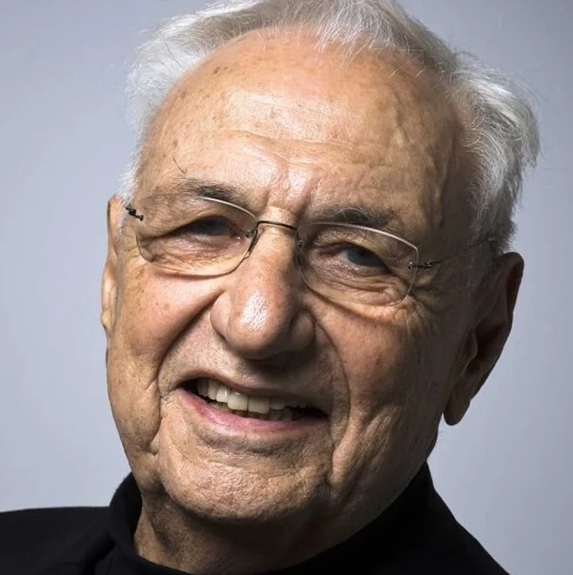
Frank Gehry, whose design of the Walt Disney Concert Hall transformed the landscape of downtown Los Angeles, died Dec. 5 at his home in Santa Monica. He was 96.
Courtesy photo
Wave Wire Services
SANTA MONICA — Condolences and tributes poured in for Frank O. Gehry, the innovative master architect and prolific designer whose organically shaped, steel-covered Walt Disney Concert Hall transformed the landscape of downtown Los Angeles.
Gehry died Dec. 5 at his Santa Monica home at age 96. His death followed a brief respiratory illness, Gehry Partners chief of staff Meaghan Lloyd said.
Gehry, who won the prestigious Pritzker Architecture Prize in 1989, is considered the most recognizable American architect since Frank Lloyd Wright. Among the first architects to embrace the potential of computer design, he pioneered an adventurous style frequently incorporating unexpected raw materials.
Along with Disney Hall, his most famous works include the Guggenheim Museum in Bilbao, a titanium-clad building that received international acclaim on its opening in 1997.
Other notable works are Miami’s New World Center, a concert hall finished in 2011, and the Fondation Louis Vuitton, a museum in Paris completed in 2014.
He began designing in Los Angeles in the late 1970s, and there are more than 20 Gehry buildings located in the city, including the Venice building that is currently the local offices of Google.
“Los Angeles mourns the loss of one of its most beloved and impactful cultural giants,” Mayor Karen Bass said in a statement. “Frank Gehry was not only a legendary architect, but a true visionary who transformed the way our city — and the world — sees and experiences Los Angeles. Frank’s imagination reshaped our skyline into something unmistakable, iconic, and unique.
“From the Walt Disney Concert Hall — the crown jewel of our Grand Avenue Cultural District — to The Grand’s cutting-edge design just across the street, community-rooted projects across our neighborhoods, his work did more than define space — it defined possibility,” Bass added. “With a body of work spanning more than six decades, Mr. Gehry made Los Angeles his home, his canvas, and his proving ground — his buildings sparking economic and cultural renewal, inspiring generations of artists, architects and dreamers.
“But Mr. Gehry’s impact went far beyond his most recognizable works at home and beyond,” she continued. “He also designed the Children’s Institute in Watts. He volunteered his time and talents to shape the L.A. River Master Plan. He developed housing for homeless veterans. For all of his global acclaim, he always remained deeply committed to the city that helped shape him — and he used his brilliance to give back.”
On X, Los Angeles County Supervisor Janice Hahn wrote that Gehry “didn’t just design buildings — he created spaces that lift up artists and have brought generations of people together. His design of the Southeast L.A. Cultural Center on the L.A. River will be a lasting gift to the families of Southeast L.A. We’ve lost a giant. Thank you, Frank.”
Supervisor Chair Hilda L. Solis offered similar sentiments, saying in a statement, “I am deeply saddened to learn of the passing of my dear friend Frank Gehry.”
“It was one of the great honors of my life to work alongside him on several projects, including The Grand in Downtown Los Angeles, the Colburn School expansion, and our ongoing work to reimagine the Lower Los Angeles River — where his vision helped inspire the possibility of the Southeast L.A. Cultural Center, a concept that continues to develop with community engagement,” Solis said.
“Frank’s brilliance was matched only by his generosity of spirit, and his ability to see possibility where others saw limits transformed not only the County of Los Angeles and communities across the world, but all of us who had the privilege to work with him.”
Solis added that, in recognition of Gehry’s “extraordinary contributions,” she has chosen the Walt Disney Concert Hall as the location for the new 2026 Board of Supervisors photo.
She called the structure “one of his most iconic and breathtaking works, and a treasured county asset,” adding “It is a place that captures both his genius and the spirit of creativity he brought to our county and the world. His visionary legacy will continue to inspire generations. I will miss him dearly.”
Gov. Gavin Newsom and first partner Jennifer Siebel Newsom, in a joint statement, also lauded Gehry as “the mind behind some of the most iconic architectural feats in the world, from the Guggenheim Museum Bilbao to California’s own Walt Disney Concert Hall.”
California’s first couple went on to say, “Drawing on his working-class background, Frank’s designs embraced the reality of living and the beauty of the everyday. His work encouraged imagination and freedom of thought, and recognized the value and the beauty of working people and neighborhoods, seeking to make room for everyone in this world — especially the misfits like himself.
“Frank will be missed, but his legacy — in California and beyond — stands as tall as his finest creations.”
The J. Paul Getty Trust, long connected to Gehry through its archives and design initiatives, released a statement honoring his influence.
“In 2017, Getty was honored to be chosen as the owner and steward of a portion of Gehry’s extensive archive, focusing on the era from the beginning of his career in 1954 until he received the Pritzker Prize in 1989, which includes thousands of drawings, models, and sketches,” Katherine E. Fleming, president and CEO of the J. Paul Getty Trust, said in a statement.
“Great as he was as an architect, Frank Gehry was even greater as a friend and person — generous, hilarious, eternally playful. We join the world in mourning this enormous loss,” Fleming added.
Born Frank Owen Goldberg on Feb. 28, 1929, in Toronto, he changed his last name to Gehry in 1954. After finishing high school, Gehry moved with his parents to Los Angeles, which he once described as a “brash, raucous, frontier” at the time.
Quoted in the 2009 book “Conversations With Frank Gehry,” Gehry summed up the city for journalist Barbara Isenberg. In the 1950s, Los Angeles meant “Carney business. The movies. The development was vast and rampant. Whole neighborhoods seemed to spring up instantly in desert locations.”
Gehry enrolled in night school at L.A. City College, where he took art and architecture classes, then went to USC, where he studied ceramics and architecture. He earned a bachelor’s degree in architecture from USC in 1954.
Along with the Guggenheim Museum in Bilbao, Gehry is perhaps most renowned for Disney Hall, the striking 2,265-seat venue clad in shimmering steel at the top of Bunker Hill that opened in 2003. Gehry’s design includes details as specific as the carpet pattern used in the auditorium.
Resembling silver sails, the hall’s design partly plays off the look of the Music Center’s nearby Dorothy Chandler Pavilion, forging a link between the two.
Esa-Pekka Salonen, incoming creative director of the Los Angeles Philharmonic, described his 2004 composition, “Wing on Wing,” as “an homage to an extraordinary building by an extraordinary man.”
Edythe Broad, co-founder of the Eli and Edythe Broad Foundation, said she and her late husband “revered” Gehry’s commitment to “reshaping downtown Los Angeles.”
“Frank was an artist’s architect, creating spaces where music, performance, art came alive, and his designs invited us all to reflect: what does a building say about a city and its future? Walt Disney Concert Hall did more than transform L.A.’s civic center; it transformed expectations,” Broad said in a statement.
“Los Angeles is more confident, more bold, and more beautiful because of Frank, and his work will endure as a perpetual reminder of what’s possible when we think outside the box, literally in his case. We send our deepest sympathy to his family.”
Gehry is survived by his wife, Berta, and four children.