By Darlene Donloe
Contributing Writer
Fifteen years ago, Kathleen “Katie” Quintas owned a house in Sierra Madre, had a six-figure career working with two of the largest fundraising agencies in the country, and a family that felt unshakable.
Today she runs Here to Serve, a lifeline for families whose child or young parent has cancer, on $150,000 a year. She has 30 families on a waiting list she cannot afford to serve.
“People don’t know about us, only the people who are sick,” Quintas said.
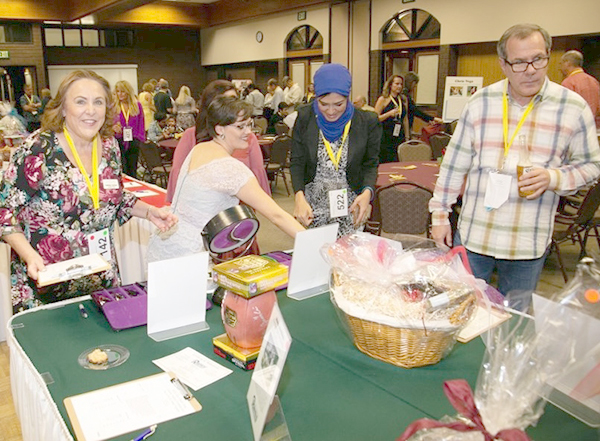
Here to Serve’s “Take A Bite Out Of Cancer” will be held from 5 to 9 p.m. Oct. 3 at the Arcadia Community Center, 365 Campus Drive. Tickets are $90. Attire is festive casual.
The evening includes food, live music, a live and silent auction, and the chance to make a meaningful difference for families navigating cancer. For tickets, information, or to donate, visit heretoserve.org.
Here to Serve believes no family should lose a job, a home, or their health — or face bankruptcy — just to care for a child with cancer.
Quintas, 72, launched Here to Serve in the fall of 2011 with a clear vision: mobilized support for every child or young parent’s cancer journey from diagnosis through treatment.
Physical, financial, emotional help for caregivers and families — provided in one place was, and continues to be, important to her.
Her mission: Eliminate the stress of researching and contacting a plethora of splintered resources.
Cancer, she likes to say, is a three-legged stool, not two. There is research. There is treatment. And there is the journey. The journey is as serious as the lab and the hospital, but has never been given the same awareness and funding.
“The truth is, the journey matters,” she said.
Quintas is reportedly running the only nonprofit in the country to offer wrap-around services inside the home — not referrals, not a packet of phone numbers, but hands-on help where 60% of the cancer journey actually happens.
It is a model she built from personal devastation.
Born in New York and raised in New Jersey, Quintas came West in the summer of 1979 to Huntington Beach, then Marina del Rey, then Sierra Madre, where she married Silvio and built a life.
In 2011, that life collapsed in two diagnoses, two months apart.
Her husband Silvio, a middle school teacher, was diagnosed with leukemia. Her only son Bryan, then 16, was diagnosed with Stage 4 Non-Hodgkin’s Lymphoma.
Bryan was at City of Hope. Silvio was at UCLA.
Quintas was between them, up every two hours at night to give Bryan medication, still trying to work and keep a household intact. It was then she became acutely aware of the pain that happens when a life-threatening crisis moves into the home.
“The home was utter chaos,” she said. “I didn’t take care of myself. I went through menopause and barely noticed it.”
Silvio helped her start Here to Serve. He lived with cancer for three years before dying in February 2014 from side effects of the cancer drugs.
Months later, Bryan won his battle with leukemia and graduated from high school in 2014, shortly after his father died.
Quintas then faced a choice.
“I had to pray about it,” she said. “Do I go back to my six-figure job or do I keep Here to Serve going in honor of Silvio? I felt like God told me to keep Here to Serve going.”
To do it, she drained her retirement account, sold her Sierra Madre house and moved into a rental in Monrovia.
When a family finds Here to Serve, Quintas does a one-to-two-hour intake to learn how their life has unraveled. If they come right after diagnosis, she can do the most.
She builds an online care community — a single place that gathers everyone who knows the family.
Inside is an interactive calendar for every need: walking the dog, taking siblings to sporting events, meals, housekeeping, rides to chemo.
Here to Serve’s coordinators and website bring together people and service organizations to support caregiver parents for the whole journey, not just the beginning.
She also handles fundraising. Not a splash-and-forget GoFundMe, but a sustained campaign on GiveSendGo, where there are no fees. Because she spent 10 years working with nonprofits before launching her own, she knows storytelling keeps giving alive.
“We don’t just focus on the sick child. We focus on the whole family,” she said.
The help is practical. Here to Serve has given mattresses to families sleeping on floors after medical bills.
It has given multiple reconditioned cars through a major donor from the auto industry to families who couldn’t get to treatment. It finds pro bono tax accountants at tax season.

It also does the research others don’t. The American Cancer Society will hand a new family 100 names for financial help.
“They haven’t culled through them,” Quintas said. “You look at the list and think, ‘Oh my, I can’t go through that.’ And so you don’t get the help.”
Here to Serve gives 30 vetted grants, not 100.
Timing matters. If a family finds her a year after diagnosis, the care community often won’t work. People assume they have it under control.
“A year down the line is when it’s the worst,” she said. “They’ve run out of resources; they’re exhausted. Their finances are strained beyond belief.”
That’s why funding is critical. Here to Serve runs on $150,000 a year. A family is served by $6,000 for an entire year.
“$6,000 at a hospital? You’re lucky if you buy a brick,” Quintas said.
It costs $1 billion and 10 years minimum to find one therapy for one type of cancer, she learned from board members in biotech. Research should be supported by government and big foundations, she believes.
Individual donors giving $1,000 or $10,000 should support groups like hers.
What does she want people to know? That cancer doesn’t just attack a body. It attacks a home.
“Two members in a household have to stop working or cut hours back. Income goes down 30 to 50%,” she said.
Medi-Cal may pay medical bills, but not rent, groceries, pet care or housekeeping. And well-meaning offers — “I’ll set up a GoFundMe, a meal train” — leave everything scattered until families push help away.
There was no one-stop shop. Until she built one.
Fifteen years in, Here to Serve which provides services nationwide as well as the counties of Los Angeles, Orange, Riverside, San Bernardino, Santa Barbara, and Ventura, has proven the model. What it hasn’t proven is that Los Angeles knows it exists.
Quintas keeps the files of 30 families on hold, waiting for a donor who understands what $6,000 can do when it isn’t buying a brick.
Quintas said what Here to Serve needs most is simple: to be seen and to be funded.
Darlene Donloe is a freelance reporter for Wave Newspapers who covers South Los Angeles. She can be reached at ddonloe@gmail.com.