By Cynthia Gibson
Contributing Writer
AUSTIN, Texas — The Pan African Film Festival, the nation’s largest Black film and arts festival, marked its fourth year of collaboration with the Austin Film Society July 30 through Aug. 2 at the AFS Cinema. The three-day series featured award-winning narratives, documentaries, short films and animations previously screened at the Pan African Film Festival and curated specifically for Austin audiences.
The Austin series opened with “Muganga: The One Who Treats,” the true story of Nobel Peace Prize laureate Dr. Denis Mukwege. Produced by actress Angelina Jolie, the documentary chronicles the work of Mukwege, who has treated thousands of survivors of wartime sexual violence in the Democratic Republic of the Congo.
“That is a really powerful film. It is a heavier subject matter, but it’s definitely a necessary conversation that needs to take place,” said Melissa Randle, senior programmer and film traffic controller for the Pan African Film Festival. “We’re very honored to be able to show that film and just enlighten people because a lot of people are not aware of all the travesties that are going on in these different places and need to talk about it.”
Since its founding in 1992, the Pan African Film Festival has become a Black History Month tradition in Los Angeles, annually showcasing more than 200 new films from the United States, Africa, the Caribbean, South America, Europe, the South Pacific and Canada.
Founded in 1985, the Austin Film Society has long served as a creative hub for filmmakers and the Austin community. The organization operates AFS Cinema, a repertory and first-run arthouse theater; Austin Studios, a 20-acre production facility; and Austin Public, a collaborative space where diverse media makers can create, learn, and connect.
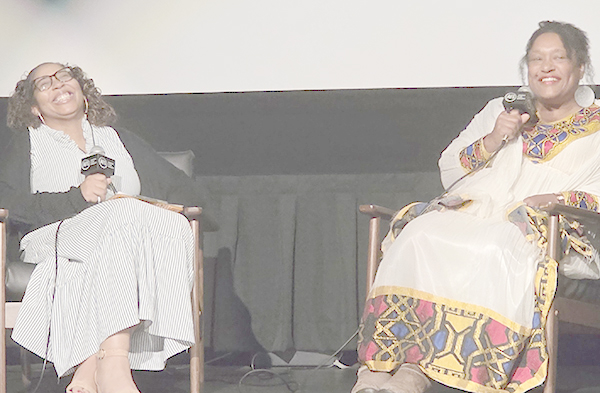
The partnership between the Pan African Film Festival and Austin Film Society began with a conversation at a family gathering between cousins Linda Bronson-Abbott, assistant general manager of the Pan African Film Festival, and Rakeda Ervin, director of access and education programs for the Austin Film Society. Bronson-Abbott said expanding the Pan African Film Festival into major markets across the country has been a long-term goal of the festival.
“Every year we always get people who call us or email us and ask us when they can see these films,” Bronson-Abbott said. “So, we knew that we should expand. “PAFF was in Atlanta at the National Black Arts Festival, but Atlanta closed down during the pandemic.”
Before returning to her home state of Texas, Ervin attended Pan African Film Festival in Los Angeles for years and became a devoted supporter of the festival. She introduced Bronson-Abbott to Holly Herrick, head of film and creative media for the Austin Film Society.
Herrick said the Austin Film Society had long admired the Pan African Film Festival’s distinctive programming and its commitment to showcasing stories from across the African diaspora.
“PAFF has such great films and people love the films. They can’t see these films anywhere else because they’re basically international films,” Herrick said. “When the Pan African Film Festival approached us and said that they were interested in expanding into Texas, we really jumped at the opportunity to bring this event to Austin.”
Under the partnership, the Austin Film Society hosts the screenings at AFS Cinema and promotes the series to its members and the broader Austin community, while PAFF curates the film lineup and supports the event through community outreach, media interviews, and in-person appearances throughout the city.
Randle said programming begins with award-winning films from PAFF’s February festival while also considering films that deserve broader exposure and have not previously screened in Austin. Local demographics also influence the selection process. Of the 12 films presented this year, 10 were Texas premieres.
“We have everything from science fiction to action adventure to drama to comedy,” Randle said. “There are two documentaries and a web series mixed in with our traditional shorts films, including a stop-motion animation on Black queerness that is just beautifully done.”
The lineup featured a special 20th anniversary screening of the comedy “Phat Girlz,” starring Mo’Nique as a woman searching for love, confidence and acceptance. Following the screening, Randle interviewed writer and director Nnegest Likké about the film’s enduring cultural impact.

One of the featured documentaries, “Say It Loud: How Toronto Got Soul,” explores how many of Jamaica’s biggest musical stars helped transform Toronto into a global center of Jamaican music. The story unfolds through the life of reggae singer Jay Douglas, whose six-decade career serves as the film’s anchor.
The second documentary, “Black Is Beautiful: The Kwame Brathwaite Story,” chronicles the life of photographer Kwame Brathwaite, whose work helped shape the Black Is Beautiful movement while documenting Harlem’s rich cultural history and supporting African liberation efforts.
The festival also showcased a diverse block of short films, including “I Am Because We Are,” “Legally Black,” “Time Setters,” “Two Black Boys in Paradise,” “Complicated Grief,” “Spilled Milk” and “The Black Bart of Taco King #17.”
The series concluded with the romantic drama “Montmartre,” starring Ito Aghayere as a woman dissatisfied with her disconnected life who embarks on a transformative journey to Paris. There, she meets an engaging tour guide, played by Jesse Williams, who helps her rediscover her passion for life.
In addition to film screenings, the festival hosted a panel discussion titled “Culture Can’t Be Automated — or Can It? Storytelling and AI.” The conversation explored pressing questions surrounding artificial intelligence, including whose stories are used to train AI systems, whose culture informs AI-generated narratives, and who ultimately benefits from those creations.
Filmmakers, writers, technology professionals, and cultural critics examined how AI is reshaping film production, distribution, and authorship, while discussing what those changes mean for Black artists who have historically fought for the right to tell their own stories on their own terms.
Pan African Film Festival Executive Director Oduduwa Olatunji said the partnership with Austin Film Society reflects the festival’s ongoing mission to showcase the breadth of Black creativity while challenging stereotypes and expanding public understanding of the Black experience.
“PAFF believes film and art can lead to better understanding and foster communication between people in an entertaining way while at the same time, serve as a vehicle to initiate dialogue on the important issues of our times,” Olatunji said.
Cynthia Gibson is a freelance reporter for Wave Newspapers. She can be reached at ckgcommunications@gmail.com.